John Deere’s E100 series starts at around $1,700, while a comparable X350 runs closer to $3,200. That $1,500 gap is exactly where most homeowners make the wrong call. Deere tractors span a wide range of power, build quality, and intended use, and the model number alone doesn’t tell you which one fits your property.
Navigating the lineup takes more than reading a spec sheet. The series structure (E, X, S, and utility) each targets a different workload. Buying one tier too high or too low has real consequences: either wasted money or a machine that can’t handle the job.
Deere Tractor Series at a Glance: Use Case, Power, and Price
John Deere organizes its tractor lineup into distinct tiers, and each tier is built for a specific type of owner. Knowing where each series sits by power, price, and intended workload keeps you from buying a $5,000 machine to mow a half-acre flat lawn.
Series
Typical HP Range
Starting Price (approx.)
Primary Use
E Series
17–24 HP
$1,700–$2,400
Small residential lots, flat terrain
X300 Series
18–25 HP
$2,800–$3,600
Medium residential, mild slopes
X500 Series
22–26 HP
$3,800–$5,200
Larger lots, heavier attachments
S240
18.5 HP
~$2,500
Bridge between E and X
1 Series (CUT)
23–25 HP
$12,000–$15,000
Compact utility, small farm tasks
2 Series (CUT)
25–38 HP
$16,000–$25,000+
Utility, loader work, tilling
Residential Series (E, X, S): What Each Tier Actually Covers
The E Series (E100 through E180) is John Deere’s entry-level lawn tractor line. These run Briggs & Stratton or Kawasaki engines, use a side-by-side hydrostatic pedal transmission on most models, and are built for straightforward mowing on relatively flat ground. Deck sizes range from 42 to 54 inches. They’re not designed for heavy attachment use.
The X Series steps up the frame, the transmission, and the available deck options. The X300 models add a Accel Deep mowing deck and a smoother hydrostatic (continuously variable) transmission operated by a single foot pedal. The X500 series adds a heavier frame, a larger fuel tank, and better support for front-end attachments like snow blowers and front blades.
The S240 sits between the two. It has an X-style transmission but an E-style price, making it a practical option for someone who wants better transmission feel without committing to the full X300 price.
Utility and Row-Crop Tractors: Where Pro Needs Begin
The 1 Series and 2 Series compact utility tractors (CUTs) are a different category entirely. These are four-wheel-drive machines with a power take-off (PTO) shaft, three-point hitch, and loader-ready frames. They handle tilling, box blading, post-hole digging, and loader work that no lawn tractor can touch.
If you’re managing pasture, a large garden plot, or need to move material regularly, a CUT is the right tool. At $12,000 and up, they’re serious purchases and overkill for anyone who just wants a well-cut lawn.
Right-Sizing Your Deere: Match the Model to Your Acreage and Tasks
Most buying mistakes come down to one thing: matching the machine to the marketing instead of the property. Here’s a direct framework for choosing based on what you actually need.
Measure your mowable acreage before you look at a single model. Include slopes, obstacles, and any areas you’ll use attachments on.
List every task beyond mowing: bagging, mulching, snow removal, tilling, loader work. Each one narrows your compatible models.
Set a realistic budget that includes at least one attachment, because most buyers add a bagger or snow blower within the first season.
Check your terrain grade. Slopes over 15 degrees rule out most E Series models and demand X500 or compact utility.
Decide how often you’ll use the tractor. Once a week for five months is a very different duty cycle from daily commercial use, and the machine should match accordingly.
Under 2 Acres: E Series and Entry X Series Are Enough
For a flat or gently rolling lawn under 2 acres, an E150 or E170 handles the job without any compromise. The E170 runs a 24 HP V-twin engine and a 54-inch deck, which is plenty of capacity for a property that size. Spending more than $2,500 on this workload is unnecessary unless you plan to add a snow blower. If you do, the S240 or X330 makes more sense for the attachment support.
2–10 Acres With Varied Terrain: Mid-Range X and Compact Utility
This is where most homeowners with larger suburban or semi-rural properties land. The X350 (18.5 HP, 42- or 48-inch deck) and X380 (22 HP, 54-inch deck) cover this range well. If your property has hills, wet spots, or you want to run a front blade in winter, step to the X500 series. The four-wheel steer option on the X584 is worth considering if you’re working around trees or tight spaces regularly.
Working Land and Commercial Use: Utility Tractors and Above
Once you’re managing more than 10 acres, running a loader, or tilling ground regularly, a compact utility tractor is the only practical choice. The John Deere 1025R (23.9 HP, diesel) is one of the most common entry points into this category, with a starting price around $14,000 to $15,000 depending on configuration. It handles a 60-inch mid-mount mower deck, front loader, and rear tiller without strain.
X Series vs. E Series: The Differences That Actually Matter at Purchase
The E Series and X Series look similar in photos, but the build differences show up fast in real use. The X Series costs roughly $800–$1,500 more depending on the model, and that gap is justified in some situations. Not all of them.
The Accel Deep mowing deck, standard on X300 and higher models, is engineered to move a higher volume of clippings through the discharge chute at faster ground speeds than the Edge cutting system found on E Series tractors. — John Deere product documentation
Frame, Transmission, and Cutting Deck Differences
The E Series uses a welded steel frame that’s adequate for mowing but shows its limits when you add weight. A full bagger system, for example, puts more stress on the front axle than the E frame handles as cleanly. The X Series frame is heavier-gauge steel with reinforced mounting points for front attachments.
Transmission feel is the most noticeable daily difference. The E Series uses a side-by-side pedal hydrostatic system: one pedal for forward, one for reverse. The X Series uses a single-pedal foot-controlled hydrostatic transmission (FCHT), which is smoother and more intuitive, especially on slopes or when maneuvering around obstacles.
The cutting deck is also different. The E Series runs the Edge deck; the X300 and above run the Accel Deep deck, which has taller deck walls and a larger discharge opening. In thick, wet grass, that difference is real.
Which Series Justifies the Price Jump
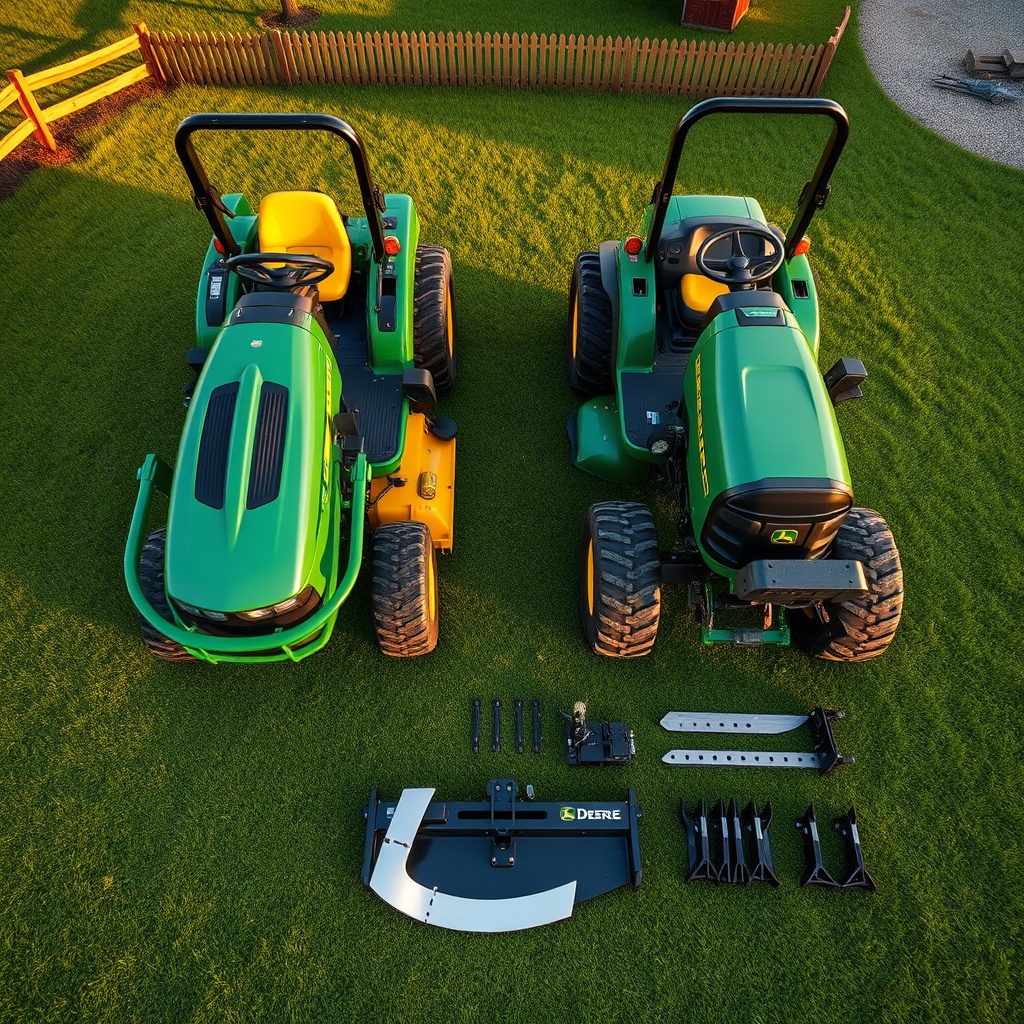
Go with the X Series if you plan to run a bagger, a snow blower, or a front blade. The attachment mounting system and frame support on the X300 and above make those accessories work properly. The E Series can technically accept some attachments, but the compatibility list is narrower and the frame isn’t built for the extra load.
If you’re mowing a clean, dry lawn under 2 acres with no attachment plans, the E Series does the job and saves you real money. The X Series earns its price premium when you’re pushing the machine beyond basic mowing.
Attachments and Compatibility: Don’t Buy the Wrong Tractor for the Job
Buying the wrong series for your attachment needs is one of the most common and expensive mistakes with Deere tractors. The E Series has a limited hitch receiver system; the X500 and above use a heavier Category 1 three-point hitch that accepts a much wider range of implements.
Attachment
E Series
X300 Series
X500 Series
1/2 Series CUT
Rear bagger
Compatible
Compatible
Compatible
N/A
Front snow blower
Not supported
X330+ only
Yes
Yes
Front blade
Not supported
Limited
Yes
Yes
Rear tiller
No
No
No
Yes (PTO)
Front loader
No
No
No
Yes
Front Loaders, Snow Blowers, and Tilling: What Each Series Supports
Snow blower compatibility starts at the X330, not the E Series. A 44-inch front snow blower requires the X-Series front hitch system and enough frame mass to absorb the load. Rear tillers need a power take-off (PTO) shaft, which only compact utility tractors provide.
Checking Compatibility Before You Buy
Use John Deere’s online CompatibilityCheck tool or ask your dealer to run your model number against the attachment SKU before purchase. A mismatch discovered after delivery costs time and restocking fees.
John Deere vs. Kubota, Husqvarna, and Cub Cadet: Honest Value Comparison
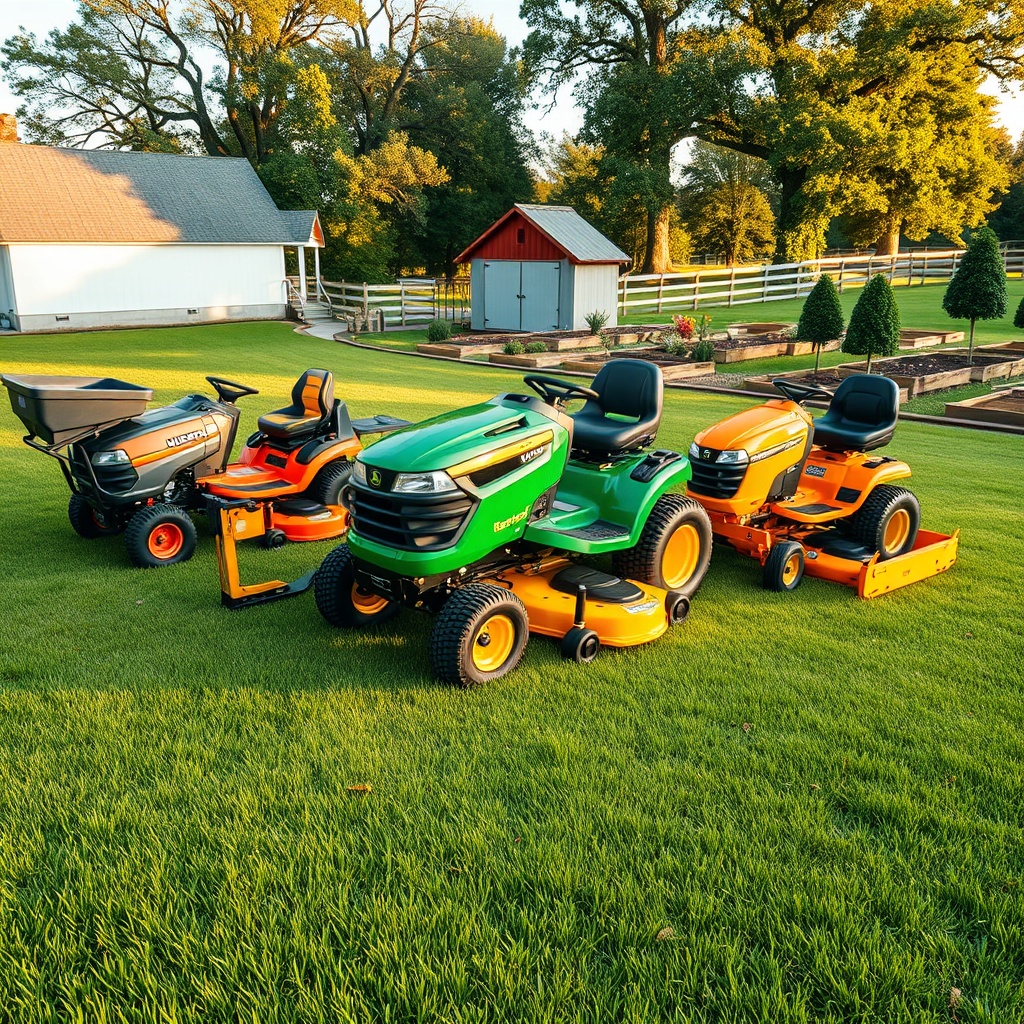
John Deere isn’t the cheapest option, but its dealer network and parts availability are genuinely stronger than most competitors in rural and suburban markets. Here’s how the brands stack up for a typical homeowner buying a mid-range lawn tractor.
Kubota’s BX Series compact tractors compete directly with the Deere 1 Series. Kubota generally prices slightly lower on the BX2380 (roughly $10,000–$11,500 configured) and has a strong reputation for diesel engine longevity. Where Kubota falls short is dealer density — in many regions, the nearest Kubota dealer is farther away than a Deere dealer, which matters when you need a part fast.
Husqvarna’s TS 354D and similar garden tractor models compete with the X300 range on price, often running $200–$400 less for comparable deck sizes. Build quality is adequate for light residential use, but Husqvarna’s attachment ecosystem is narrower, and resale value trails Deere noticeably.
Cub Cadet’s XT2 series is a direct E Series competitor. It’s priced similarly and offers comparable horsepower, but hydrostatic transmission smoothness and long-term parts support lag behind Deere’s. For a buyer who plans to keep the machine 10-plus years, that gap matters.
Long-Term Reliability and Total Cost of Ownership
Purchase price is only part of the cost. A John Deere E180 at $2,799 will need annual maintenance: oil and filter changes run roughly $30–$50 per season, a new drive belt costs around $40–$60, and blade sharpening or replacement adds another $20–$40 annually.
Over a 10-year ownership period, expect to spend $500–$900 in routine maintenance on an E or X Series lawn tractor, not counting any major repairs. The X Series has more complex components — the FCHT transmission, heavier deck spindles — so individual parts cost more, but they also fail less often under normal residential loads.
Compact utility tractors carry higher maintenance costs. The 1025R, for example, requires hydraulic fluid changes and diesel particulate filter monitoring that lawn tractors don’t. Budget an extra $150–$250 per year for a CUT used regularly.
Resale value is one area where Deere tractors consistently outperform competitors. A well-maintained X350 holds roughly 50–60% of its original value after five years, which offsets some of the higher upfront cost compared to a Husqvarna or Cub Cadet at the same age. Themowersguide.com covers routine maintenance schedules for most Deere series in detail if you want model-specific service intervals.
John Deere Dealer Network: Parts Access and Service Reality
John Deere’s dealer network is one of its strongest practical advantages. With roughly 1,500 dealer locations across the United States, most owners are within 30–40 miles of a stocking dealer. That matters when a belt snaps mid-season and you need it today, not in a week.
Parts availability varies by series. Common E and X Series wear items (blades, belts, filters, spindle assemblies) are typically stocked at the counter. Less common parts for the compact utility line, like hydraulic control valve assemblies or loader quick-attach components, may require a 2–5 day order even at a well-stocked dealer.
Warranty support is another factor worth checking before you buy. Most new Deere lawn tractors carry a 2-year/120-hour bumper-to-bumper limited warranty, while the 1 Series compact utility tractors come with a 2-year/2,000-hour powertrain warranty. Those terms vary by model year, so confirm with your dealer in writing at purchase.
The dealer relationship also affects resale. A tractor with a documented service history at a Deere dealer sells faster and holds value better than one without records.
Frequently Asked Questions
What is the best John Deere tractor for a 3-acre residential property?
The X350 with a 42- or 48-inch deck handles a 3-acre residential lot well. It has the Accel Deep deck, FCHT transmission, and enough attachment support for a rear bagger or front snow blower without overspending on compact utility features you won’t use.
How long do John Deere lawn tractors typically last?
With routine annual maintenance — oil changes, belt checks, blade replacement — an E or X Series tractor commonly reaches 1,500 to 2,000 hours. That translates to 15–20 years for a homeowner mowing 80–100 hours per season.
Can I add a front loader to an X Series tractor?
No. Front loader compatibility requires a compact utility tractor with a loader-ready frame and hydraulic selective control valve (SCV) ports. The X500 and X700 series support some front-mounted implements, but a full loader bucket setup starts with the 1 Series CUT, like the 1025R.
Is John Deere financing worth using at the dealer?
John Deere Financial regularly offers 0% interest promotions — often 48-month terms on qualifying purchases above $2,500. If you’re buying an X350 or above and can commit to the payment schedule, those promotions reduce total cost meaningfully compared to a standard equipment loan at 7–9% APR.
A zero turn rider mower can cut mowing time on a half-acre lot by 40% or more compared to a standard riding mower, and that time savings compounds every single week...
Kentucky bluegrass covers roughly 40 to 60 million acres of lawn, park, and sports turf across the northern United States, making it the most widely planted cool-season lawn grass in the...
28 July 2026
The Mowers Guide is reader-supported. When you buy through links on our site, we may earn an affiliate commission.





Comments are closed.