How do you calculate acreage? Measure the area in square feet and divide by 43,560. That’s the whole trick, and it works for a half-acre backyard or a 5-acre lot. The part most people miss is that total acreage isn’t mowable acreage. Below are three ways to get the number, and how to turn it into a mower choice.
1. Tape or measuring wheel: best for small, regular lots
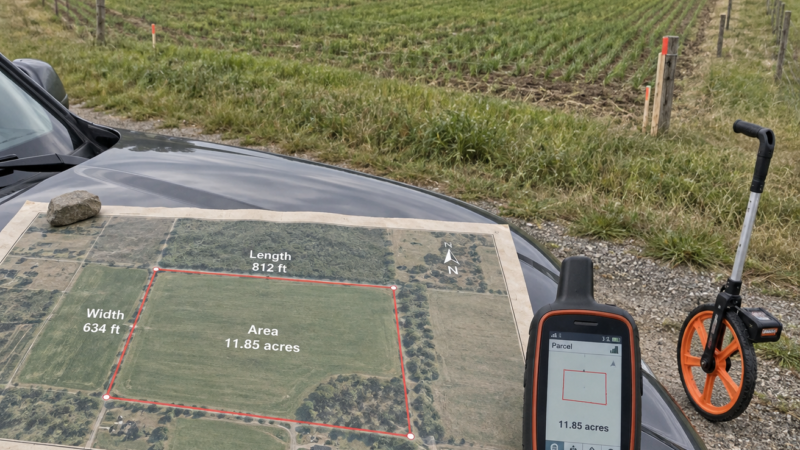
A tape or wheel gives you the most control, and it costs almost nothing. A 300-foot open-reel tape runs about $25, and a measuring wheel is $40-$70. Use it when your yard is mostly squares, rectangles and triangles.
How it works
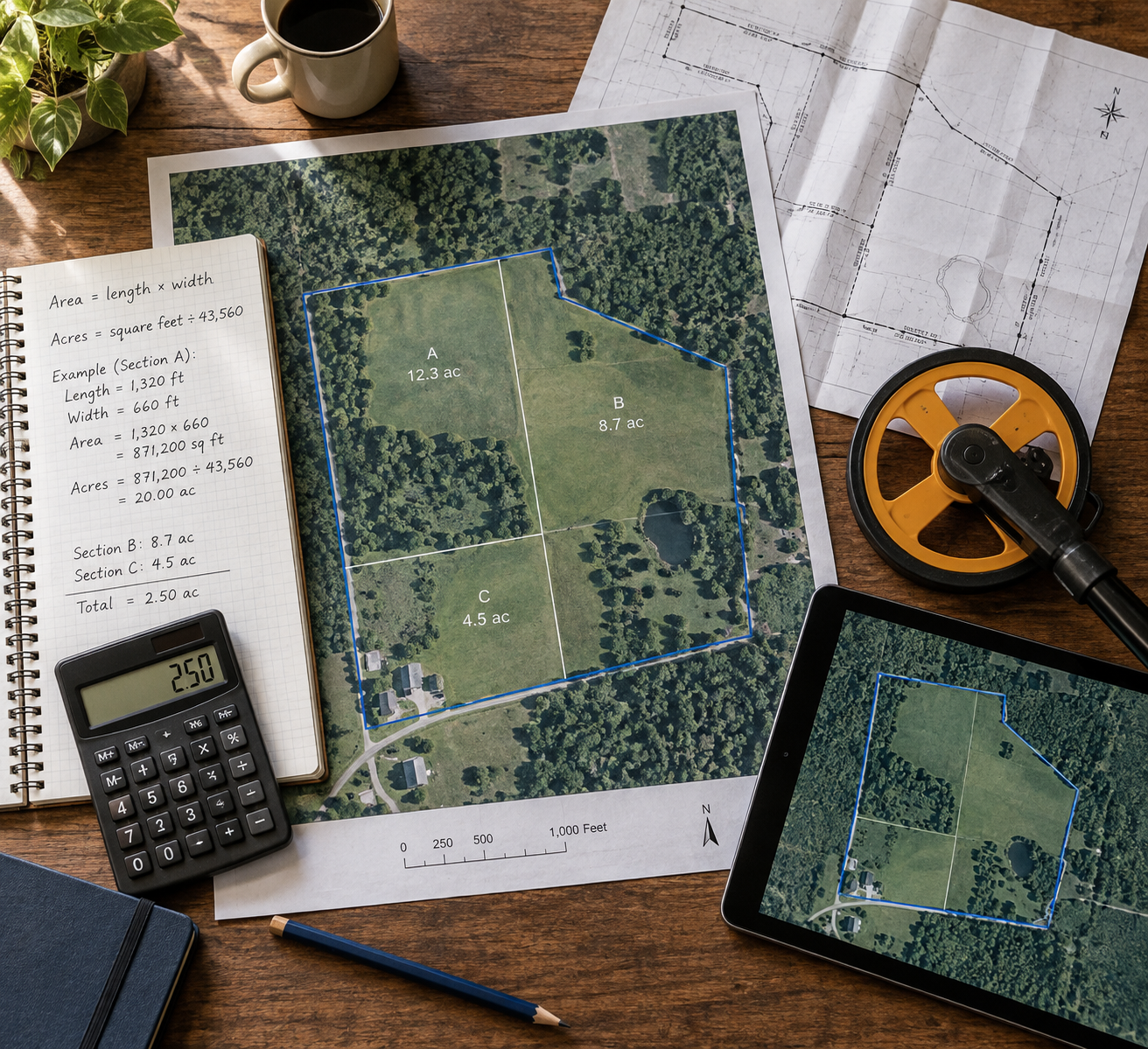
For a rectangle, multiply length by width. A lot that’s 150 feet by 200 feet is 30,000 square feet. Divide by 43,560 and you get 0.69 acres.
For a triangle, multiply base by height, then halve it. A corner that’s 80 feet by 60 feet is 2,400 square feet.
Break an irregular lot into shapes, calculate each one, and add them up. Don’t treat it as one big rectangle using the longest sides. That overstates the area, sometimes by a lot.
What to watch for
Keep your units the same. If you measure one side in feet and the other in yards, convert before you multiply. Also use 43,560 exactly. Dividing by 4,356 or 43,650 throws you off by a factor of ten or a few tenths of a percent.
Who it suits
It suits anyone under about an acre who wants the mowable number, not the deed number. Walk the lawn only, and skip the house, drive and beds.
2. GPS and online map tools: best for speed and odd shapes
A map tool gets you a decent number in about five minutes, and it handles curves and odd corners better than a tape. Google Maps (right-click, then “Measure distance”) and the free Google Earth Pro desktop app both let you trace a boundary. Many county GIS sites do the same.
How it works
Here’s the quick routine:
Open the satellite view and zoom in on your lot.
Click each corner of the area you want to measure.
Close the shape back at your starting point.
Read the area, or the perimeter if that’s all it shows.
Convert to acres: square feet ÷ 43,560.
Trace the house, drive and beds separately, then subtract.
What to watch for
Satellite images can be a few feet off, and tree canopy hides edges. Don’t treat listing or map-tool acreage as exact. It’s fine for picking a mower, but it’s not fine for a fence quote or a seed order near the limit.
Who it suits
It suits irregular, wooded or large lots where walking every edge would take an afternoon. The tradeoff is accuracy: you’re tracing from a photo, not measuring the ground.
3. Survey or plat map: best for exact legal acreage
A property survey or plat map (a scaled drawing of your lot’s legal boundaries) gives the official number. It’s the one to trust when money or boundaries are involved. Your county recorder or assessor often has a copy, and your closing paperwork may include one.
How it works
Most plats list the lot’s acreage or its square footage. If you only get square feet, divide by 43,560. If you get square yards, multiply by 9 first. For square meters, multiply by 10.764 to reach square feet.
One acre equals 43,560 square feet, or 4,840 square yards. (U.S. customary land measure)
What to watch for
The plat gives total lot size, not lawn size. Subtract the house footprint, driveway, patio, beds and tree rings yourself. A surveyed 0.75-acre lot with a 2,000-square-foot house, a 1,200-square-foot drive and 3,000 square feet of beds has about 26,500 square feet of lawn, or 0.61 acres.
Who it suits
It suits buyers, fence installers and anyone who needs the figure to hold up. Getting a new survey is the drawback: it typically runs a few hundred to over a thousand dollars, depending on your area and lot.
Mowable acres decide your mower
Once you have the lawn number, match it to a deck. These are rough ranges, because slope, grass height and obstacles change real-world speed.
Mowable lawn
Typical mower
Approx. mowing time
Under 0.25 acre
21-22 inch push mower
30-60 minutes
0.25-0.5 acre
Self-propelled or 30 inch rider
45-75 minutes
0.5-1 acre
42 inch rider or zero-turn
About 30-60 minutes
1-3 acres
46-54 inch zero-turn
About 1-2.5 hours
The Mowers Guide has more on sizing a deck to your lawn if you’re between two sizes. A wider deck saves time on open grass, but it won’t fit tight gates or mulch beds.
Frequently Asked Questions
How many square feet are in an acre?
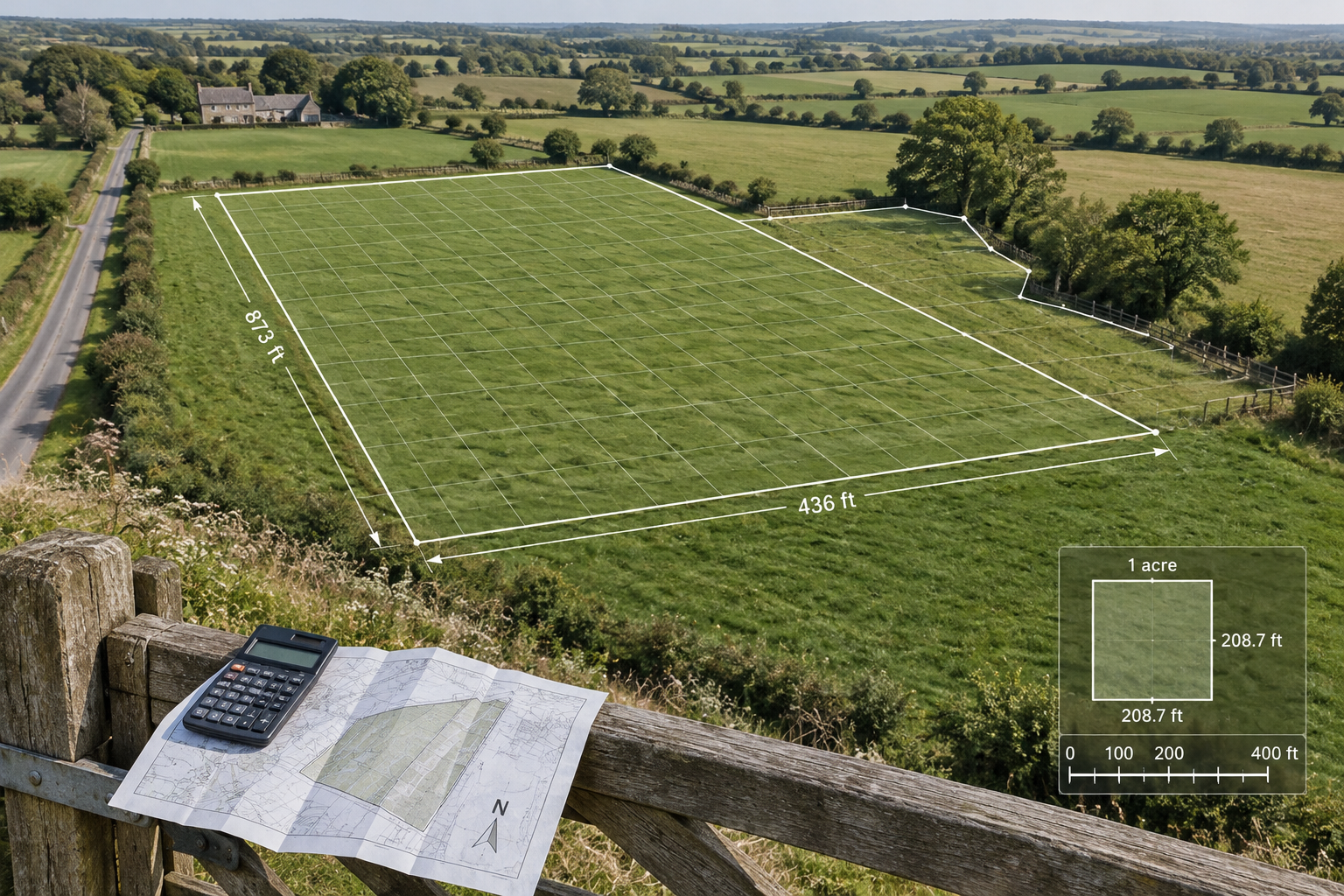
An acre is 43,560 square feet. A square acre is about 208.7 feet on each side. A football field without end zones is roughly 1.1 acres, which helps for a quick visual.
Should I use total acreage or mowable acreage to pick a mower?
Use mowable acreage. Subtract the house, drive, patios, beds and wooded areas from the total. A 1-acre lot often has only 0.6-0.7 acres of grass, which can drop you down a mower size.
How accurate are online map tools for measuring a yard?
They’re usually close enough for choosing a mower, but they can be off by several feet at the edges. Tree cover hides boundaries. Check a survey or plat if you’re buying fencing or materials by exact quantity.
Grass clippings left on your lawn after mulching can return the equivalent of roughly one pound of nitrogen per 1,000 square feet per growing season. That’s a meaningful supplement to your...
A quality hedge trimmer can cost anywhere from $40 for a basic corded model to over $300 for a professional-grade battery unit. Picking the wrong price point often means buying twice....
15 July 2026
The Mowers Guide is reader-supported. When you buy through links on our site, we may earn an affiliate commission.






Comments are closed.