Plant the red maple too deep and you’ve started a slow death sentence. Bury the root flare, pile mulch on the trunk, and swing a string trimmer at the bark, and the tree struggles for years. Red maple planting is simple if you treat the tree as part of your lawn system. Here’s how to pick the spot, dig the hole, and keep your mower away from the trunk.
Check the Site First: When NOT to Plant a Red Maple
Red maples (Acer rubrum) reach 40-60 feet tall in a yard, with a crown 30-40 feet wide. They also send surface roots out under your turf. That matters to anyone who mows.
Skip these spots
Alkaline soil (pH above 7.0). Red maples want pH 5.5-6.5. In high-pH soil the leaves yellow between the veins (chlorosis) because the tree can’t pull iron.
Compacted or soggy ground. Red maples tolerate wet feet better than most maples, but not standing water for weeks, and not hardpan clay.
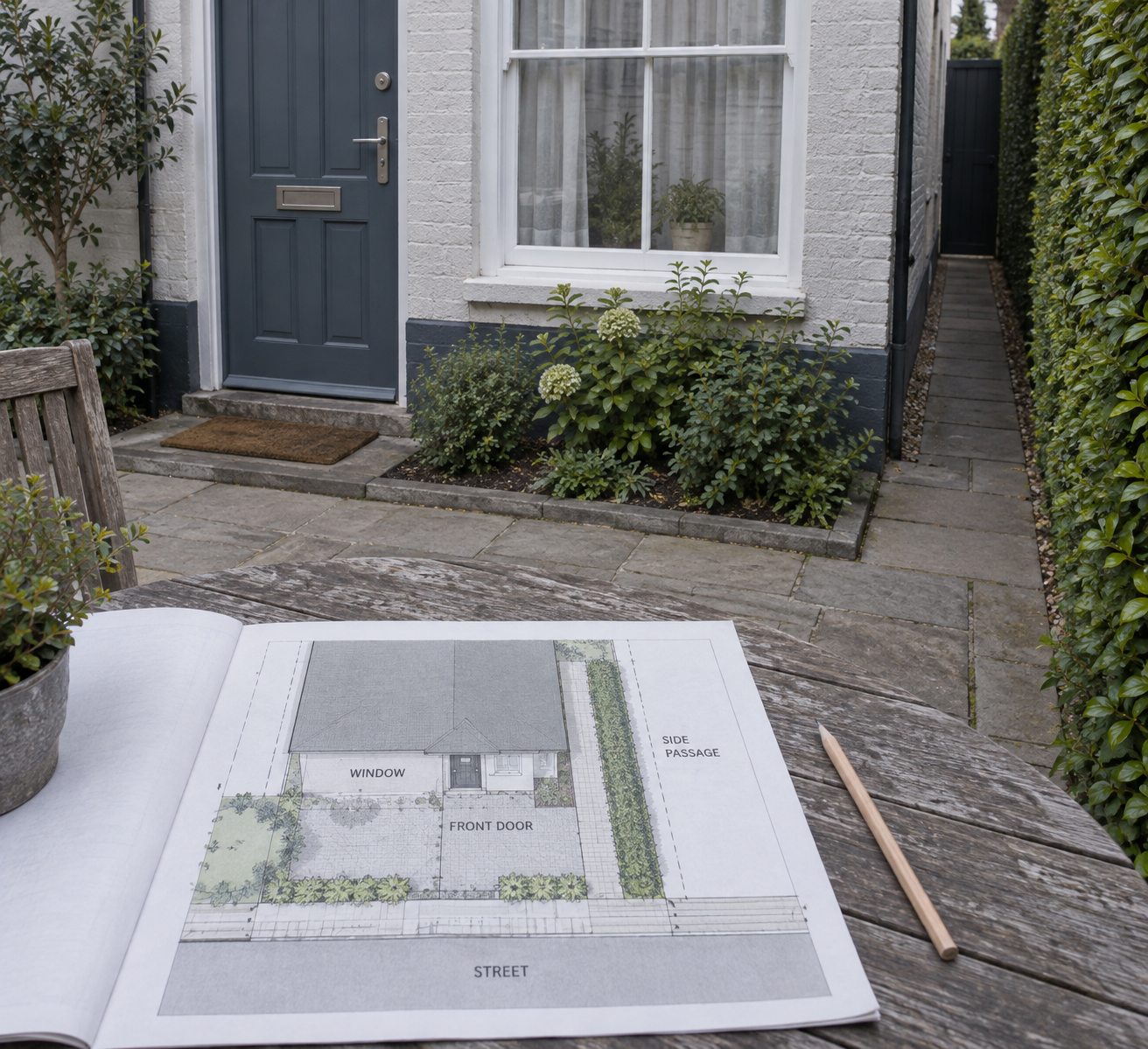
Anywhere within about 20 feet of the house, a sidewalk, a driveway, or a septic line. I’d go 25 feet if you can. Surface roots lift concrete and make bumpy mowing.
Do a quick soil check
Buy a $15-$20 pH kit or send a sample to your county extension office. Then dig a 12-inch hole, fill it with water, and time it. If it’s still holding water after 12 hours, pick another spot.
Call 811 before you dig. It’s free, and it keeps you off buried gas, water, and power lines.
Timing, Cultivars, and Stock Type
Plant in fall (about six weeks before the ground freezes) or early spring before bud break. Roots keep growing in cool soil, so the tree gets a head start before summer heat. Midsummer planting works only if you’ll water religiously.
Three cultivars cover most yards:
Cultivar
Habit
Fall color
Note
October Glory
Rounded, 40-50 ft
Late red
Holds leaves late, so risky in early-frost areas
Autumn Blaze
Fast, 40-50 ft
Orange-red
A red-by-silver maple hybrid (Acer × freemanii); brittle limbs
Armstrong
Narrow, 40-50 ft tall, 10-15 ft wide
Yellow-orange
Best fit for tight lots
Container trees are the easiest for beginners and can go in nearly any time the soil is workable. Balled-and-burlapped (B&B) trees are heavy, roughly 150-300 pounds for a 2-inch caliper tree, so bring help. Bare-root is cheapest, but plant it in early spring while dormant, and don’t let the roots dry out.
The drawback of Autumn Blaze: it grows fast, but the wood is weaker and it drops twigs on your lawn after storms.
Planting Step by Step
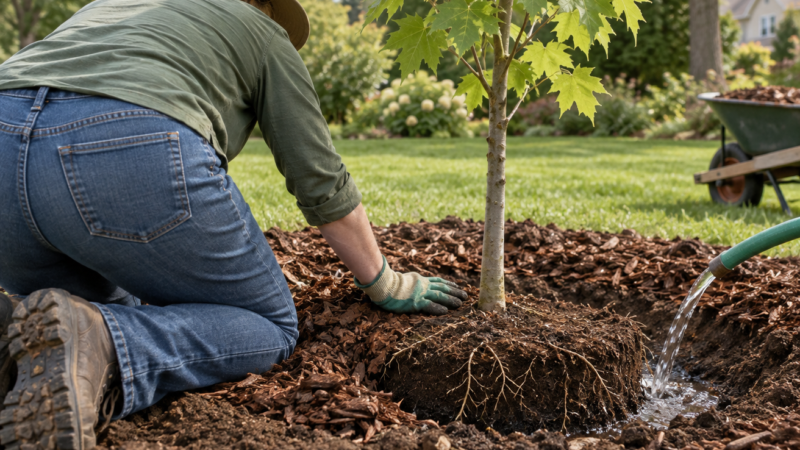
The hole decides whether the tree lives. Dig it 2-3 times as wide as the root ball but no deeper. A wide, shallow hole lets roots spread into native soil.
Find the root flare, where the trunk widens at the base. On many nursery trees it’s buried under soil, so pull the soil back until you see it.
Measure the root ball from flare to bottom, and dig the hole to that depth. Set the flare 1-2 inches above the surrounding grade.
Set the tree on undisturbed soil. Loose soil at the bottom lets it settle too deep.
Cut off wire, twine, and the top third of burlap on a B&B tree. Slice circling roots on a container tree.
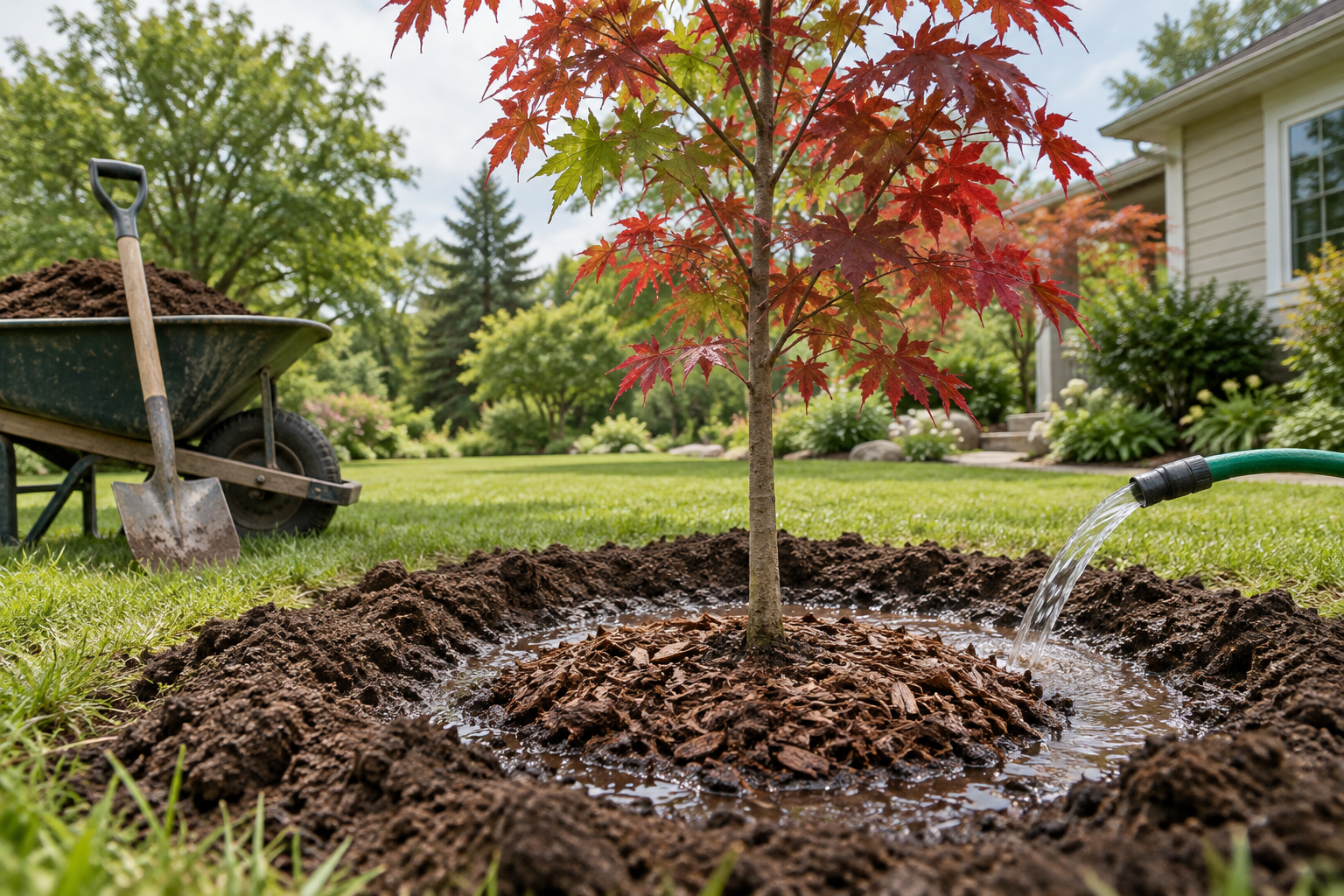
Backfill with the native soil you dug out. Don’t amend it heavily. A rich pocket makes roots stay in the hole instead of reaching out.
Water slowly until the soil is soaked 12 inches down.
Stake only if the tree wobbles in wind. Use two stakes, wide straps, and remove them after one year.
Mulch Ring and Mowing Buffer: Protect the Trunk From Your Own Equipment
Mulch should be 2-4 inches deep and kept several inches away from the trunk. — Common extension guidance, including University of Minnesota Extension
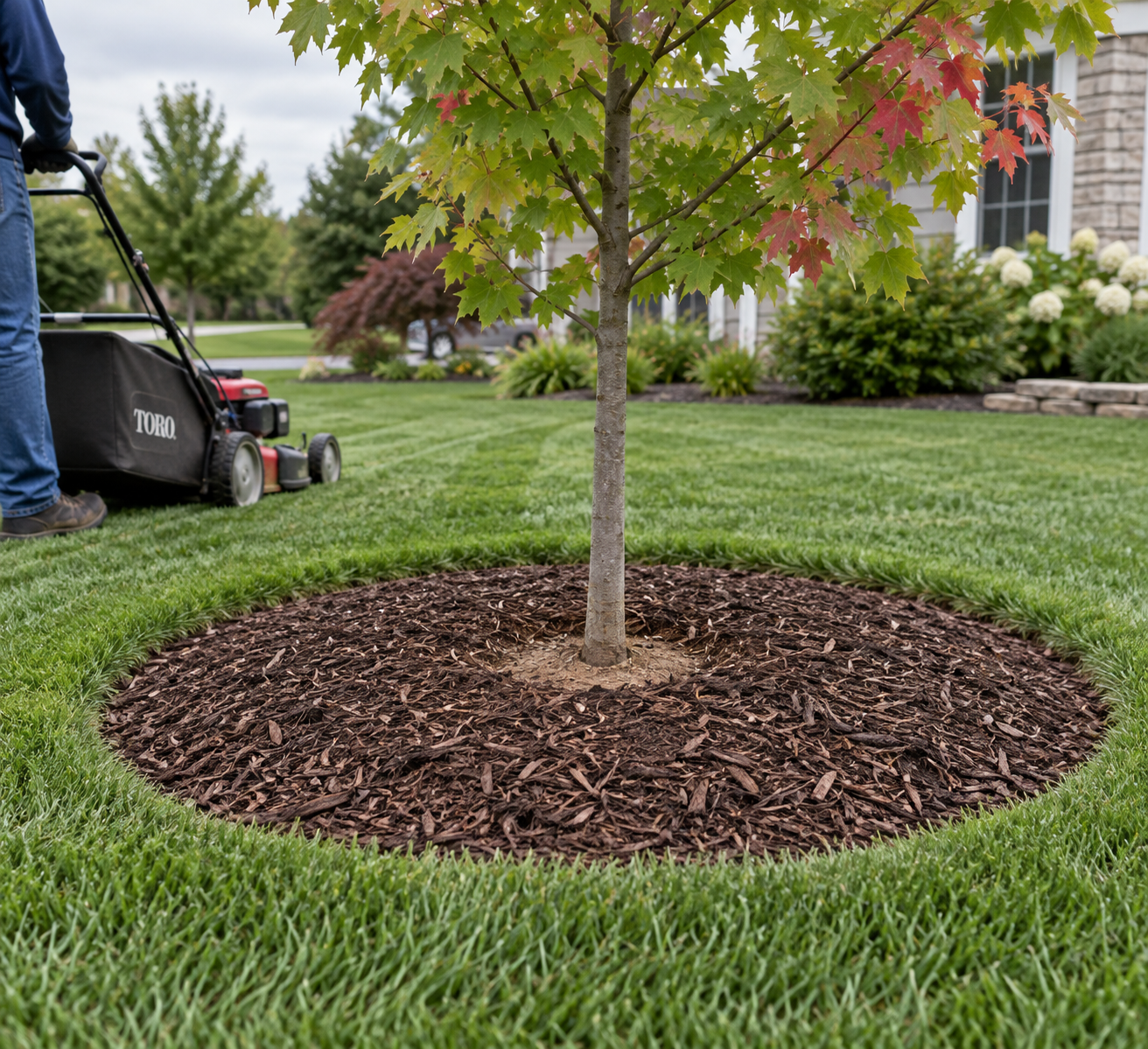
Lay a mulch ring at least 3 feet across from day one, and widen it as the tree grows (a 4-6 foot circle is better). Use shredded hardwood bark. Pull it back so the root flare stays visible, shaped like a donut and not a volcano.
That ring is your mowing buffer. A mower deck or string trimmer nicks bark, and the wound invites rot and borers. Once the cambium (the thin living layer under the bark) is damaged, the tree can’t move water well. Edge the ring with a spade, so you can mow right along it without guessing.
For the first two years, water deeply once a week with 10-15 gallons for a young tree, more in heat. Skip the daily sprinkle, because shallow watering keeps roots near the surface. If you’ve got a sprinkler zone on the lawn, check that it isn’t soaking the trunk.
Later problems to watch: leaf scorch (brown, crispy edges in hot dry spells), girdling roots that wrap the trunk, and aphids or scale. If you want more help with trimmers and mowing near trees, themowersguide.com covers the gear.
Frequently Asked Questions
How deep should I plant a red maple?
Plant it so the root flare sits 1-2 inches above the surrounding soil. The hole should match the root ball’s height, not exceed it. Planting too deep is the most common cause of rot and girdling roots.
How far from the house should I plant a red maple?
Plant at least 20 feet from the house, and farther from sidewalks or driveways if the tree is a full-size cultivar. Armstrong’s narrow form can work in tighter spots, but its roots still spread.
How long do I need to water a new red maple?
Water for the first two growing seasons. Give it a deep soak weekly, adjusting for rain and heat. By year three, established roots can handle most dry spells, though a long drought still calls for a deep drink.
Two brands, one driveway, and a decision that’ll cost you real money for the next decade. Cub Cadet vs John Deere isn’t about which name sounds more trustworthy on a tractor...
Forget the riding mower myth. You don’t need a $3,000 tractor to get those sharp light-and-dark stripes across your lawn — you need a $20-40 roller attachment and a decent mowing...
10 September 2026
The Mowers Guide is reader-supported. When you buy through links on our site, we may earn an affiliate commission.





Comments are closed.