
Muhly Grass: Planting and Care for a Colorful Lawn

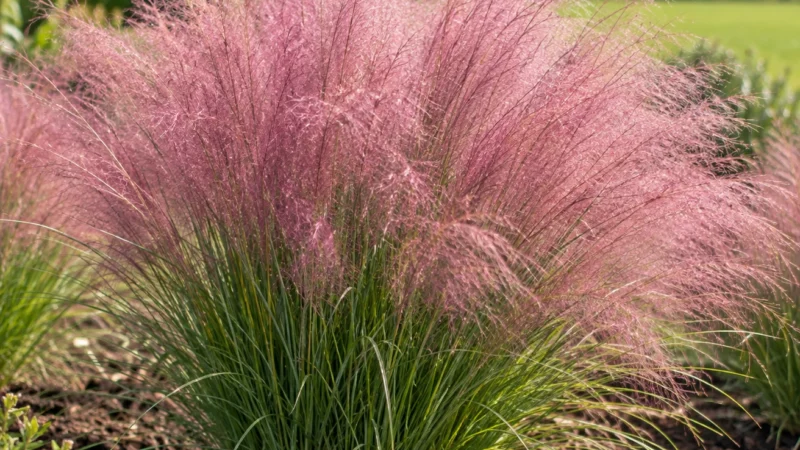
Muhly grass is not a lawn. You can’t mow it weekly or walk on it, and treating it like turf is the fastest way to ruin it. What it does well is frame your lawn with clouds of pink or white plumes every fall, while asking for very little in return.
Plant it in full sun and soil that drains fast. Space the clumps about 24 to 36 inches apart. Water while the roots settle in, then keep it on the dry side. Trim only when the winter foliage looks tired, in late winter or early spring. That’s the short version, and the details below make it work beside a mowed lawn.
Muhly Grass Is a Border Plant, Not a Turf Grass
Why does this matter so much? Because muhly grass grows in clumps, not as a spreading carpet. Turf grasses like Bermuda or tall fescue send out runners or tillers that knit together into a surface you can mow at 2 to 4 inches. Muhly grass makes separate mounds that reach about 3 to 4 feet tall and just as wide.
If you mow it down to lawn height, it won’t bounce back into a smooth lawn. It also won’t handle kids, dogs or foot traffic. Think of it as a living edge: a strip along the driveway, a band between lawn and patio, or a group of plants near the mailbox.
The plant you’ll find in most garden centers is Muhlenbergia capillaris, often called pink muhly, Gulf muhly or hairawn muhly. In spring and summer it looks like a neat clump of fine, dark-green grass. Then, from late summer into early fall, it sends up airy flower heads that float above the leaves like pink smoke.
Muhly grass is a clumping ornamental grass. The LSU AgCenter named it a Louisiana Super Plant for fall 2021, and it grows about 3 to 4 feet tall and wide.
The upside for a lawn owner is that the whole thing sits outside your mowing pattern. Your mower runs along its edge, not through it. Get the placement right once and you’ve got a border that needs one cleanup a year, at most.
Where to Plant Muhly Grass: Sun, Soil and Climate
The best spot for muhly grass is a sunny, open area with soil that never stays soggy. Aim for at least 6 to 8 hours of direct sun a day. It survives in part shade, but it flowers less and grows slower there. Drainage matters even more than sun.
Climate and Native Range
Muhly grass is native to the eastern half of the United States. Its wild range runs from Florida west to Texas and Kansas and north into Massachusetts. It grows best in USDA zones 7 through 11 and is hardy in zone 6 with some winter protection. In zone 6, plant it near a south-facing wall or mulch the crown lightly after it goes dormant.
North of zone 6, treat it as a gamble. A cold, wet winter is what usually kills it, more than cold alone.
Soil Drainage Beats Soil Type
Here’s the trap. Muhly grass tolerates sand, loam, clay, acid and alkaline soil, salt spray and poor ground. Many people read that list and plant it in a low, damp corner. Don’t. The tolerance only holds as long as the water drains away. Wet soil slows growth and causes root rot, and wet winters are the worst time for it.
Test your spot before you plant. Dig a hole about 12 inches deep, fill it with water and time it. If it takes more than a few hours to empty, pick another spot or build a raised mound 6 to 8 inches high.
Quick Site Check
Use this table to judge a spot in your yard before you buy plants.
| Factor | Ideal | Workable | Avoid |
|---|---|---|---|
| Sunlight | 6-8+ hours direct sun | 4-6 hours, part shade | Under dense trees or a building’s shadow |
| Drainage | Water gone within a few hours | Slow but no standing water | Puddles after rain, low wet spots |
| Soil type | Sandy or loamy | Clay that drains well | Heavy clay that stays wet |
| Climate | USDA zones 7-11 | Zone 6 with protection | Zone 5 and colder |
| Salt and wind | Coastal yards are fine | Roadside strips with de-icing salt | No real limit here |
Sunny driveway edges, sidewalk strips and slopes are often perfect, because water runs off them quickly.
How to Plant Muhly Grass Step by Step
Want a border that looks full in its first fall? Planting well is most of the work. Plan on about 15 minutes per plant once the bed is ready.
When to Plant
Spring and early fall are both good. In spring, plant after your last frost date, when the soil has warmed. That’s roughly March in the Gulf states and April to May farther north. In fall, plant at least 6 weeks before your first expected frost so the roots can settle. Spring planting is the safer choice in zone 6 and cooler parts of zone 7.
Spacing and Mature Size
Space clumps 24 to 36 inches apart, center to center. Use 24 inches for a dense, solid band of color. Use 36 inches if you want each mound to stand on its own, or if you’re in the warm South where plants reach full size.
Here’s a worked example. Say you want to line a 30-foot driveway edge. That’s 360 inches. At 30 inches apart you need 12 plants in a single row, plus one extra so both ends are covered, so 13 plants in total. At 24 inches apart you’d need 16 plants.
Now add mower clearance. A mature clump spreads to about 3 feet wide, so its outer edge sits about 18 inches from its center. Set the row’s center line at least 24 inches back from the lawn edge. That leaves about 6 inches of open space for your mower deck or trimmer line, and the plumes won’t get sucked into the blade.
The Planting Process
Start by clearing weeds, turf and rocks from the bed. Kill or strip the existing grass first, because Bermuda or St. Augustine will creep straight into the clumps and you’ll never get it out.
Next, dig each hole two to three times as wide as the root ball. Make it no deeper than the root ball is tall. The top of the root ball should sit level with the soil, or slightly above it in clay. Burying the crown invites rot.
Loosen any circling roots with your fingers, set the plant in, and backfill with the soil you removed. Skip rich compost in the hole. Muhly grass prefers lean soil, and too much organic matter holds water.
Water each plant deeply right away. Then spread 1 to 2 inches of mulch around the bed, keeping it a couple of inches clear of the crown. Pine straw or fine bark works well.
Seeds Versus Nursery Plants
Can you grow it from seed? Yes, but it’s slow. The seed is tiny and needs light to sprout, so you press it onto the soil surface and don’t cover it. Seedlings often take two seasons to flower well.
Nursery plants in 1-gallon or 3-gallon pots are the better choice for a border. They usually bloom the first fall if you plant in spring. Seed makes sense only for a large meadow area where you don’t mind waiting.
Watering: Drought Tolerant Only After It’s Established
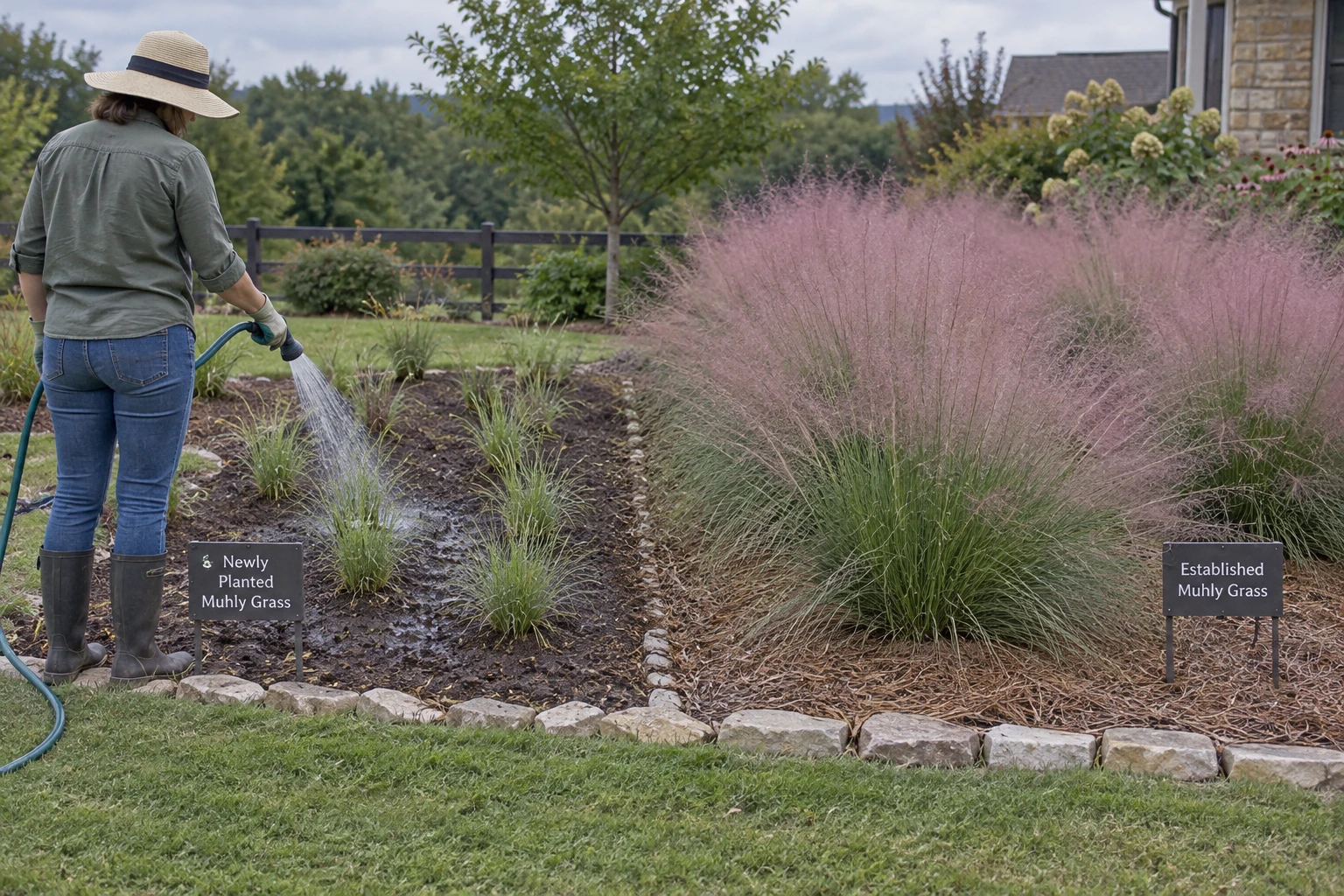
“Drought tolerant” is one of the most misread labels on a plant tag. Muhly grass has deep roots that let it ride out dry spells, but a new plant hasn’t grown those roots yet.
For the first few months, keep the soil lightly moist, not wet. In practice that means watering about twice a week in mild weather and up to three times a week in summer heat, if it hasn’t rained. Push a finger 2 inches into the soil. If it’s dry there, water deeply. If it’s damp, wait.
Establishment usually takes one growing season. You’ll know it’s ready when the clump puts out new leaves and resists a gentle tug.
After that, rainfall covers it in most of the East and South. Give it a deep soak only during long stretches of heat and drought, say three or four weeks without rain. A plant that gets an occasional drink in a dry August blooms more heavily than one left to struggle.
One warning if your border sits next to irrigated lawn. Sprinkler heads set for turf will soak the clumps several times a week, and that’s how muhly grass gets crown rot. Adjust or cap the heads that hit the bed, or switch that zone to drip. Fertilizer is simple too: one light feeding of an all-purpose fertilizer in spring is plenty, and many plants never need it.
Trimming Muhly Grass Is Different From Mowing
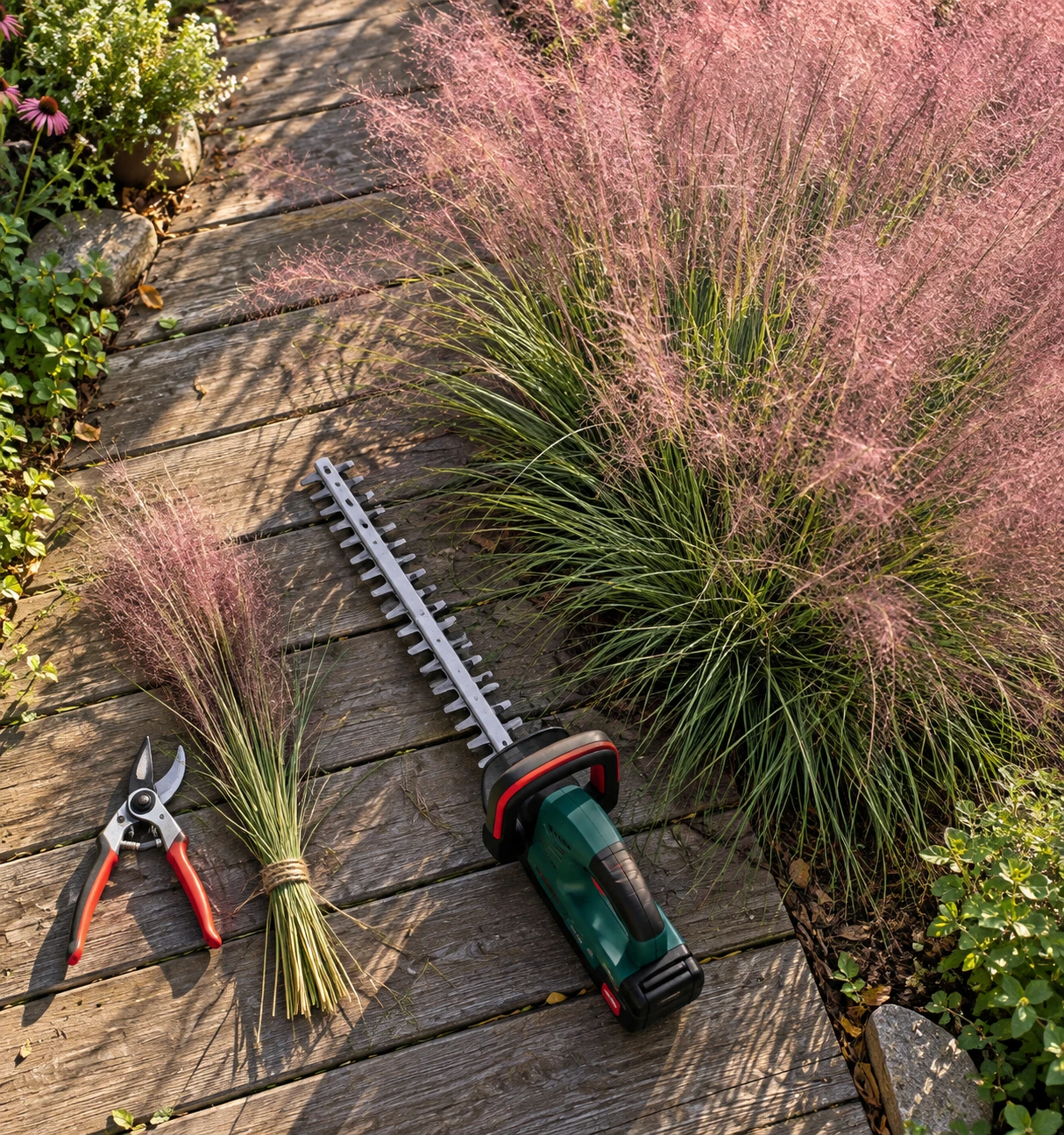
Does muhly grass need to be cut back every year? No. Trimming depends on your climate and how the plant looks in late winter. Your lawn wants regular cuts all season. Muhly grass wants one decision a year, made by looking at it.
Read the Winter Foliage First
After its fall show, the plumes fade to a soft tan. In colder areas the whole clump goes dormant and turns brown. In mild southern winters it stays partly green, which is called semi-evergreen.
Leave it standing through winter either way. The dry clump still looks good, it protects the crown from cold, and birds eat the seeds and shelter inside it. The Lady Bird Johnson Wildflower Center says trimming native muhlies is more a matter of personal preference than necessity.
Option 1: The Hard Cutback
If the clump is fully brown, flattened or messy by late winter, cut it back. Do it in February or early March, before new green shoots appear. Cut to about 4 to 6 inches above the ground with hedge shears or a string trimmer.
Don’t run your mower over it. The clumps are too tough and tall, the debris clogs the deck, and you can scalp the crown. Cutting too late chops off the tips of new leaves and leaves the plant looking blunt all summer.
Option 2: The Comb-Out
If the clump is still mostly green, skip the cutback. Put on gloves, run your fingers through the base, and pull out the loose dead blades. A stiff lawn broom or rake works too. In warm climates this is often the better choice, because hard pruning a mature, semi-evergreen clump can weaken it.
Either way, rake up the clippings. Dry muhly grass blades blowing across a freshly mowed lawn look messy, and loose clumps can wrap around a mower blade.
Fall Color: Pink, White and What to Plant Around It
Who wouldn’t want a lawn edge that looks like cotton candy in October? The bloom is the reason to grow muhly grass, so it pays to know the options.
Pink and White Selections
Pink muhly is the classic. Its plumes start to show in late summer and peak in October across most of the South, staying showy for several weeks before they fade.
White-flowering selections are sold too, such as ‘White Cloud’. They give the same airy texture in creamy white. White works well next to a red brick house where pink can clash, and it glows at dusk. You can mix the two in one bed for a softer blend.
Companion Plants
Muhly grass looks best planted in groups of 3 to 5, or in long sweeps, rather than as a single plant. Pair it with plants that like the same dry, sunny soil.
Good partners include coneflowers and black-eyed Susans for summer color before the plumes arrive. Asters and goldenrod bloom at the same time and add purple and yellow. Evergreen shrubs like dwarf yaupon holly or rosemary give the bed some structure in winter. For a border edge, liriope gives a tidy, low front row.
Contrast is what makes it work. Fine, feathery muhly beside coarse leaves or dark evergreens stands out much more than muhly beside other fine grasses. Avoid pairing it with thirsty plants that need frequent watering, or you’ll end up overwatering the grass.
Common Problems: Poor Flowering, Crown Rot and Invasive Concerns
What are the downsides of pink muhly grass? There aren’t many. It has few pests, deer mostly leave it alone, and diseases are rare. The problems that do show up almost always trace back to site choices.
Why Isn’t It Blooming?
Too much shade is the usual cause. A clump in 4 hours of sun may look healthy and produce few plumes. Too much fertilizer is another, since it pushes leaves over flowers. Late cutting can also play a part: cutting after new growth starts, or trimming in summer, removes the stems that would flower.
Crowding is the fourth cause. Over the years the clumps get bigger and fill in, and flowering drops off. Dig and divide them about every three years, in early spring or fall. Slice the clump into two to four pieces with a sharp spade and replant the healthiest outer sections.
Crown Rot and Floppy Plants
A clump that turns brown and mushy at the center in spring, or pulls up with dark, soft roots, has crown rot. It comes from wet soil, buried crowns, or sprinkler overspray. There’s no cure for a badly rotted clump. Replace it and fix the drainage first.
Plants that flop open in the middle are usually getting too much water, fertilizer or shade. Moving them to a leaner, sunnier spot fixes it.
Is It Invasive?
In its native range, pink muhly grass is not considered invasive. It’s a native plant, and it spreads mainly by clumps slowly widening, not by aggressive runners. It can drop some seedlings in loose soil, which you can pull easily.
Be careful with other ornamental grasses sold beside it. Some non-native grasses, such as certain fountain grasses and miscanthus, have spread into the wild in parts of the mid-Atlantic and elsewhere. Your state’s native plant society or invasive species council lists the grasses to avoid. Choosing the native Muhlenbergia capillaris keeps you on the safe side.
If you’re also planning how your mower will run along the new bed, The Mowers Guide has plenty of mowing and edging advice to keep that border edge crisp. Get the spacing right this year, and next October your lawn will have the prettiest frame on the street!
Frequently Asked Questions
Can I mow muhly grass like a regular lawn?
No. Muhly grass is a clumping ornamental grass that grows 3 to 4 feet tall and does not recover from repeated low mowing or foot traffic. Use it as a border beside turf, and cut it back once in late winter only if it needs it.
How fast does muhly grass grow?
It grows quickly once the weather warms. A nursery plant from a 1-gallon pot usually fills out and blooms in its first fall when planted in spring. It reaches full size in about two to three seasons.
Can muhly grass grow in a container?
Yes, it grows well in pots with drainage holes on a sunny deck or patio. Choose a container at least 14 to 16 inches wide and use a gritty, fast-draining potting mix. Potted plants dry out faster, but they rot quickly if the pot stays wet in winter.
Is pink muhly grass safe for pets?
Pink muhly grass is generally considered non-toxic to dogs and cats. A pet that chews a lot of any grass may still get an upset stomach, so discourage heavy grazing.
References
- Muhly grass adds class, texture to landscapes
- Pink Muhly Grass Care
- How To Grow Muhly Grass
- 5 Tips for Growing and Caring for Pink Muhly Grass
- How to Grow and Care for Pink Muhly Grass
- Pink Muhly Grasses for Sale
- Muhly Grass – UF/IFAS Gardening Solutions
- Think Ahead with Pink Muhly
- Trimming of native muhly grasses | NPIN
- A Dirty Dozen: 12 Invasive Plants to Avoid (and What .


Comments are closed.