Your riding mower doesn’t care what month it is. It cares how many hours are on that engine and whether you drained the fuel before it sat for four months in the garage. Most homeowners plan maintenance riding lawn mower tasks around a once-a-year checklist, and that’s exactly why so many machines end up at the repair shop every spring with a gummed-up carburetor or a dead battery.
The fix isn’t complicated. Track hours, not dates, and treat the end-of-season shutdown as the single most important job you do all year.
Why Engine Hours Matter More Than the Calendar
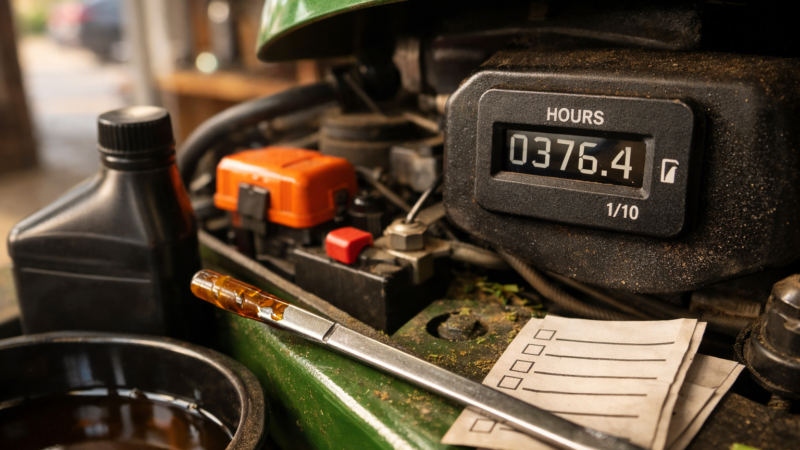
Your mower’s hour meter tells you more than any date on the calendar ever could. An engine that’s mowed 20 hours in a wet spring has worked harder than one that’s mowed 20 hours over a dry summer, but hours still beat guessing. Engine hours are the real measure of wear, and most manufacturers, including Briggs & Stratton and Kohler, build their service intervals around them.
Reading Your Hour Meter the Right Way
Check it before every mowing season starts, and jot the number down somewhere you’ll actually see it — a magnet on the garage wall works fine. If your mower doesn’t have a built-in meter, estimate based on mowing time: a half-acre lawn cut weekly runs roughly 20 to 25 hours a season.
The Schedule That Actually Works
Service Task
Interval (Engine Hours)
Notes
Check oil level
Every 8 hours or before each use
Use a dipstick, not a guess
Change oil and filter
Every 50 hours or once a season
Sooner if hauling heavy loads
Clean/replace air filter
Every 25 hours (clean), 100 hours (replace)
More often in dusty conditions
Replace spark plug
Every 100 hours or once a season
Gap it to spec, usually 0.030 inch
Inspect drive belts
Every 50 hours
Look for cracks and glazing
Sharpen/balance blades
Every 25 hours of cutting
Balance after every sharpening
A mower sitting at 40 hours for the season doesn’t need the same attention as one pushing 120. That’s the whole point of tracking hours instead of just doing “spring service” out of habit.
The Fluids and Filters You’re Probably Getting Wrong
Using automotive motor oil in a riding mower is one of the most common mistakes homeowners make, and it’s an easy one to fix. Small engines need oil rated for small engines — look for SAE 30 or 10W-30 with the API service symbol, and check your owner’s manual for the exact spec.
Automotive oil often contains detergent packages and viscosity modifiers tuned for water-cooled engines running at steady highway RPMs. Riding mower engines are air-cooled and run at wildly different loads, so they need oil formulated for that kind of stress. Using the wrong oil won’t destroy the engine overnight, but it accelerates wear on camshafts and lifters over a season or two.
Matching Filters to the Job
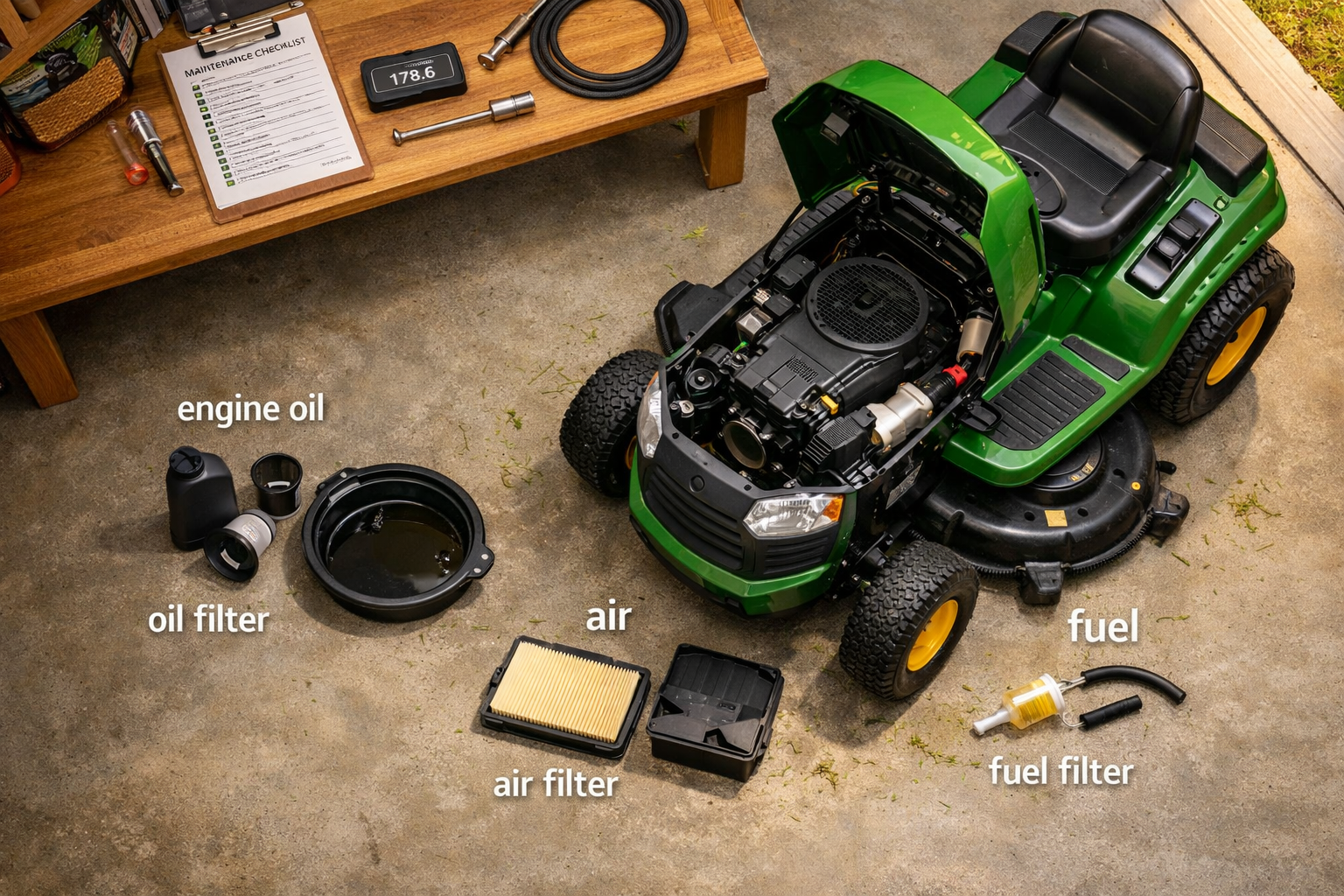
Paper air filters handle average conditions fine, but if you mow near gravel or dusty fields, a foam pre-filter over the paper element extends its life. Fuel filters are cheap, usually $3 to $6, and worth replacing every season if your mower sees more than 50 hours of use.
Fuel Stabilizer Isn’t Optional
Ethanol-blended gas breaks down fast, sometimes in as little as 30 days, and it absorbs moisture that corrodes carburetor components. Add a stabilizer like Sta-Bil at the recommended ratio (usually 1 ounce per gallon) any time fuel will sit longer than a few weeks.
Deck, Blades, and Tires: The Parts People Forget
The underside of the mower deck takes the most abuse and gets the least attention. Grass clippings pack into the deck’s underside, trap moisture against the metal, and rust it out from the inside over a couple of seasons. This is one of the most overlooked spots on the entire machine.
Cleaning the Deck Properly
Run the engine for a few minutes to warm the oil, then shut it off, disconnect the spark plug wire, and tip the mower according to your manual’s instructions (some decks shouldn’t be tipped more than 15 to 20 degrees to avoid oil or fuel leaks). Scrape off caked grass with a putty knife, then hose it down. A deck-washing port, if your mower has one, makes this a five-minute job with a garden hose attachment.
Blade Sharpening and Balancing
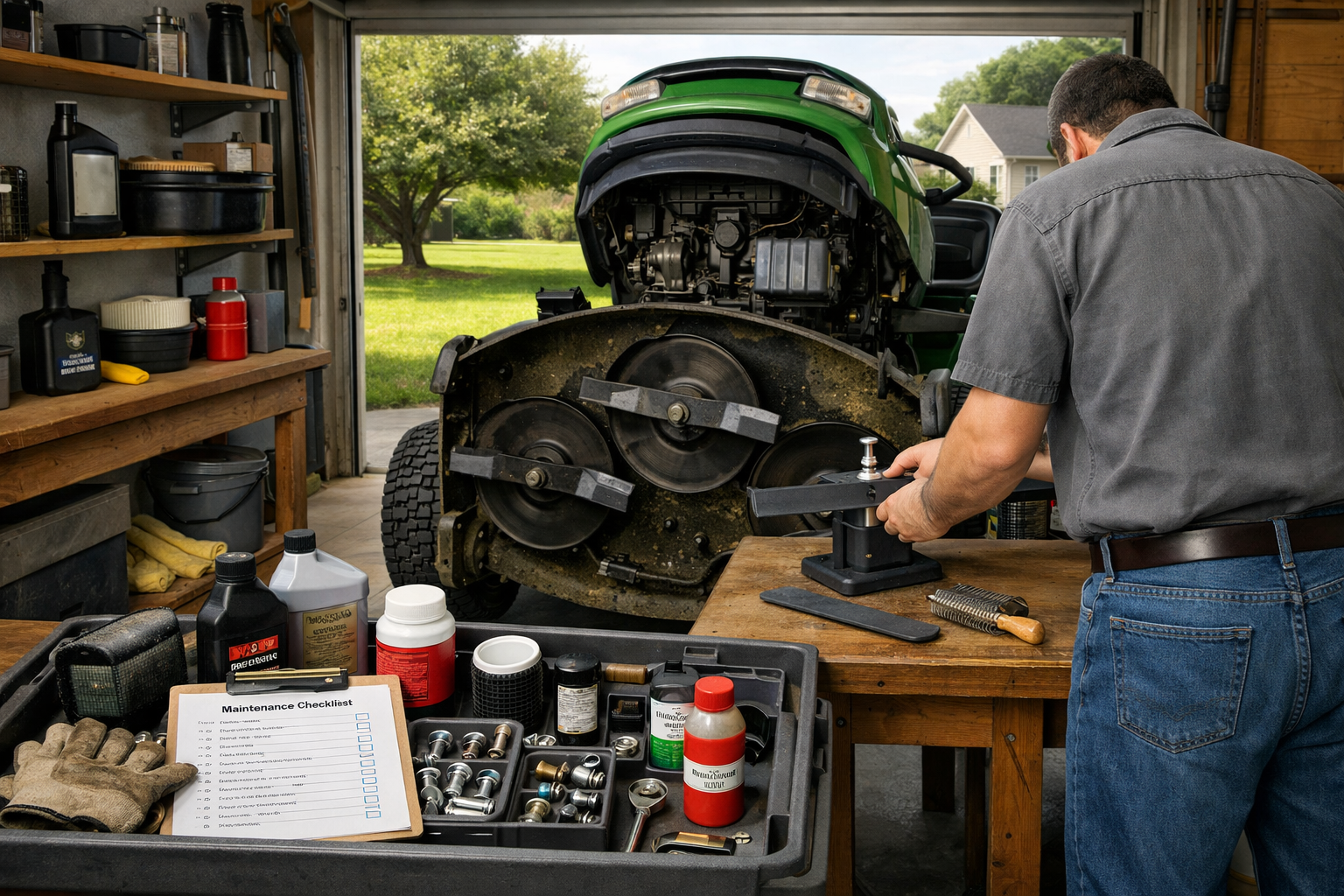
A dull blade tears grass instead of cutting it, which leaves lawns looking gray and stressed within a day or two. Sharpen blades every 25 hours of cutting time, and always rebalance them afterward on a cone balancer — an unbalanced blade vibrates the spindle bearings loose faster than almost anything else on the machine.
Tire Pressure Isn’t Set-and-Forget
Check tire pressure monthly during mowing season. Most riding mowers run 10 to 14 PSI in the front and 10 PSI in the rear, but confirm the exact number on the tire sidewall. Under-inflated tires cause uneven cutting height and premature wear on the front spindles.
The Shutdown Routine That Prevents Spring Breakdowns
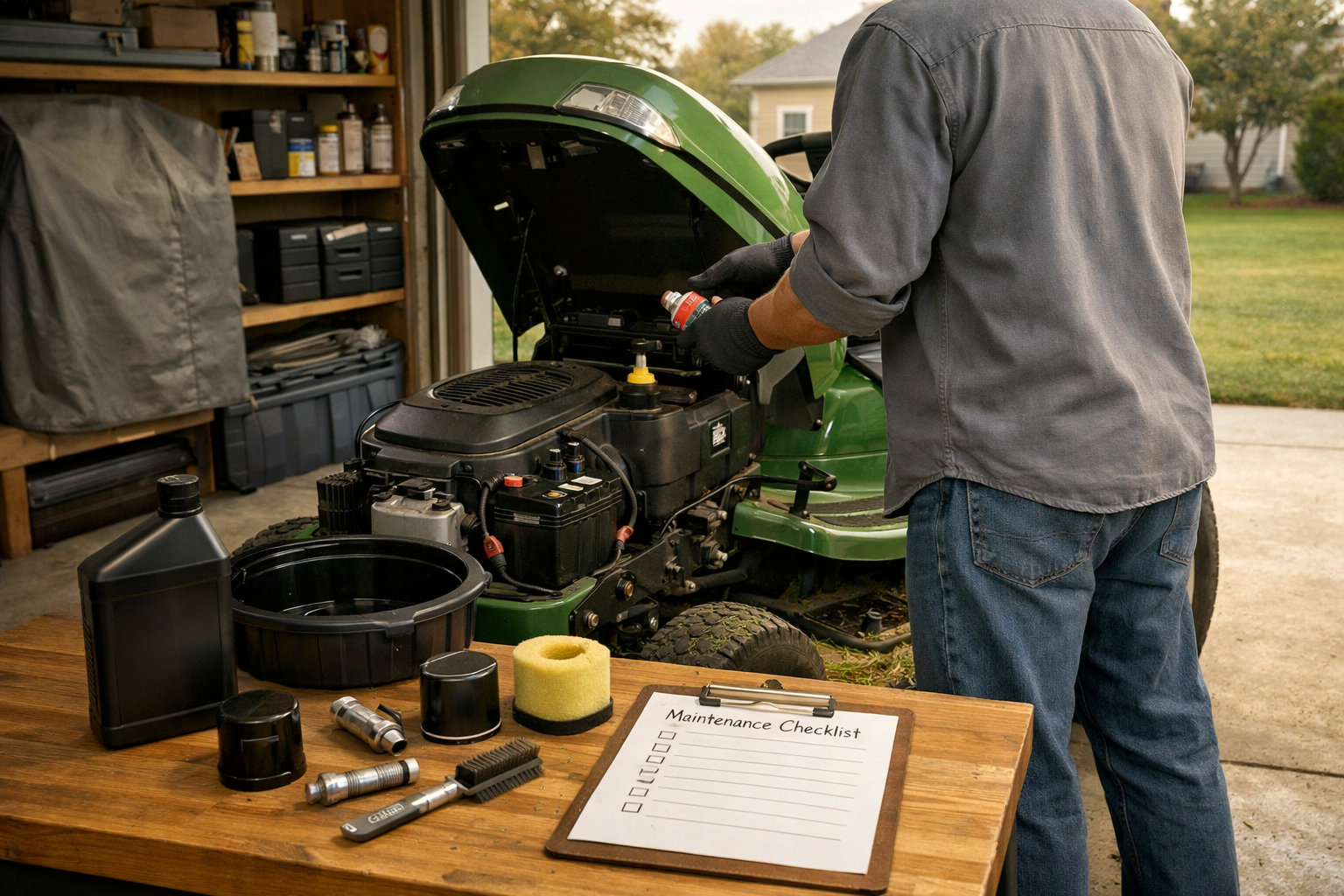
Skipping the pre-storage routine causes more mower damage than skipping a single oil change ever will. Before your mower sits for winter, or even a few months of off-season storage, run through a proper shutdown instead of just parking it and walking away.
A small engine sitting with untreated ethanol fuel for several months is the number one cause of no-start complaints seen at small-engine repair shops each spring.
Follow this sequence every time the mowing season ends:
Run the tank down low, then add fresh fuel treated with stabilizer and run the engine for 10 minutes so treated fuel reaches the carburetor.
Change the oil while it’s warm — old oil holds acids and moisture that sit against internal parts all winter.
Remove the spark plug, add a teaspoon of oil into the cylinder, and crank the engine a few times to coat it, then reinstall the plug.
Disconnect the battery and store it in a cool, dry place on a trickle charger or battery maintainer, not directly on concrete.
Clean the deck completely and touch up any bare metal spots with rattle-can paint to stop rust before it starts.
Grease all fittings according to the owner’s manual, usually found near the spindles and steering components.
Never skip disconnecting the battery or the spark plug wire before doing any of this work. A mower blade can engage unexpectedly if the key is bumped or a wire gets crossed, and that’s a serious injury risk, not just a maintenance inconvenience. For anyone troubleshooting a specific no-start problem after storage, model-specific guides on sites like themowersguide.com can help narrow down whether it’s a fuel issue, a battery issue, or something electrical.
Frequently Asked Questions
How often should I really change the oil on a riding mower?
Change it every 50 hours of engine use or once per season, whichever comes first. If you mow rough or dusty terrain often, cut that interval to 25 hours since oil breaks down faster under heavier loads.
Can I leave the battery connected over winter?
No — disconnect it and store it on a trickle charger or battery maintainer. A battery left connected in a cold garage can drain and freeze, cracking the case and ruining it by spring.
What happens if I leave old gas in the tank all winter?
Ethanol-blended gas separates and gums up the carburetor jets within a few months, often causing a no-start or rough-idle problem. Draining the tank or treating fuel with stabilizer before storage prevents this entirely.
I’ve been searching for the best lawn mower for my home. My team has tested over 20 top-rated lawn mower brands. We’ve tried walk-behind, riding, electric, and robotic mowers on yards...
Wrong bagger, wrong bolt pattern, wasted money. That’s what happens when you order a grass catcher for Craftsman riding mower by guessing deck size alone. Craftsman changed hands, rebadged parts, and...
29 September 2026
The Mowers Guide is reader-supported. When you buy through links on our site, we may earn an affiliate commission.





Comments are closed.