Husqvarna’s Automower line has been around since 1995, making it one of the oldest robotic mower systems still in production today. That kind of longevity matters, because it means three decades of field data on blade wear, boundary wire failures, and winter storage habits. If you’re weighing an automower robot against a traditional push mower or riding tractor, the decision isn’t really about laziness versus effort. It’s about whether your yard’s shape, slope, and budget match what these machines are actually built to do.
This guide walks through the real installation work, the ongoing maintenance an automower robot still demands, and the specific yard conditions where it performs poorly. It also covers pricing tiers, GPS-based models, and theft protection, so you can decide with your eyes open rather than sold on a fantasy of zero-effort mowing.
What Is an Automower Robot, and How Is It Different From Other Robot Mowers?
Automower is Husqvarna’s trademarked product name, not a generic term for robotic mowers. Other brands, including Worx Landroid and Segway Navimow, make competing robot mowers, but calling any of them an “automower” is like calling every tissue a Kleenex — technically wrong, though common in casual conversation.
The distinction matters when you’re shopping, because Husqvarna’s boundary-wire and EPOS (Exact Positioning System) technology are specific to their engineering, and parts or app features won’t transfer across brands.
The Core Mechanism
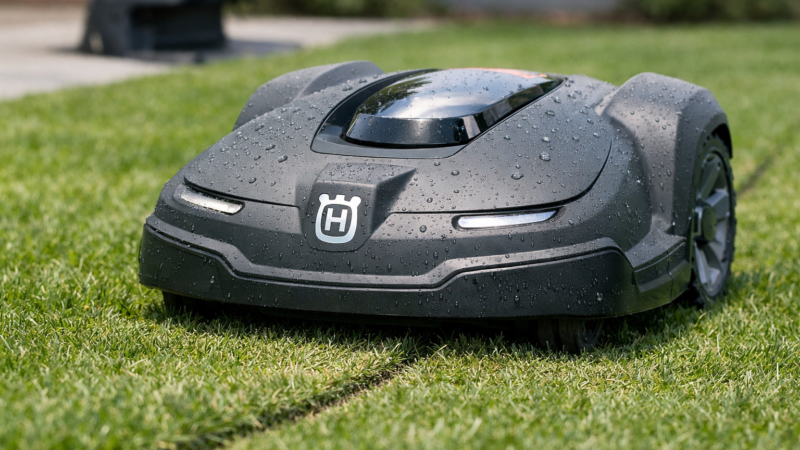
An automower robot cuts grass using a floating cutting deck with three or four small pivoting blades, spinning at high RPM to slice grass tips rather than shear them like a rotary blade does. It runs on a schedule, guided either by a buried perimeter wire or by satellite-based positioning, and returns to a charging dock when its battery runs low or rain begins.
The mower doesn’t bag or collect clippings. Instead, it mulches constantly, dropping tiny clippings back into the turf almost every day. Over a season this actually improves soil nitrogen content slightly, since the frequent, fine clippings decompose fast instead of sitting on top of the lawn.
Why the Brand Name Confusion Happens
Husqvarna popularized robotic mowing in North America and Europe well before most competitors entered the market. That first-mover position is why so many buyers use “automower” the way people say “Coke” for any soda. It’s worth knowing the difference before you start comparing specs, because Husqvarna-specific terms like EPOS and Automower Connect won’t appear in a Worx or Navimow spec sheet, even though those brands offer similar features under different names.
Boundary Wire vs. GPS Navigation: What Installation Actually Involves
Installation is the single most underestimated part of owning an automower robot. Traditional models need a physical boundary wire buried or pinned around the entire lawn perimeter and around every fixed obstacle, which typically takes a full weekend for a quarter-acre yard with moderate landscaping.
Boundary Wire Setup
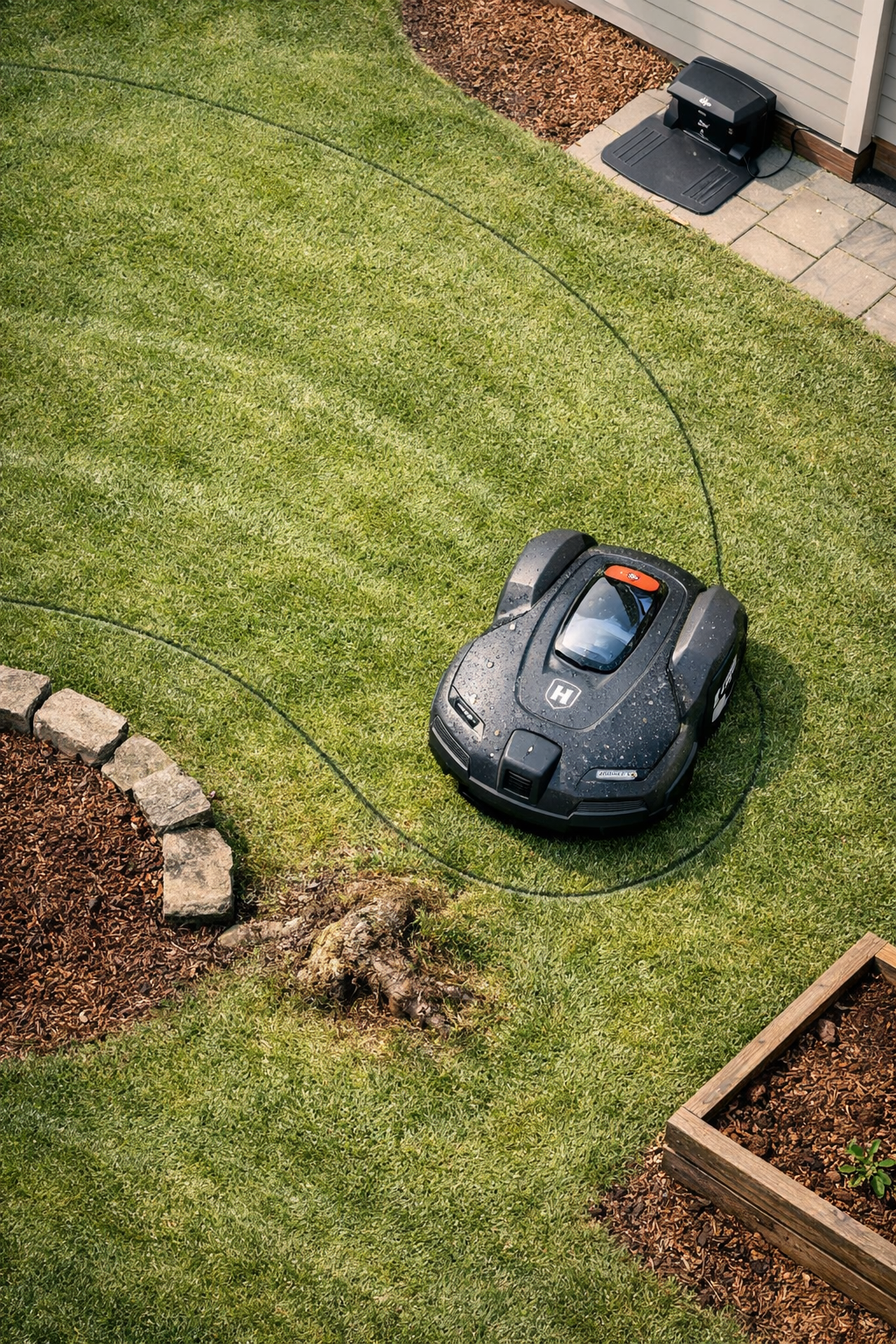
The wire runs along the edge of your lawn, staked into the ground with plastic pins every 3 to 5 feet, then either left on the surface (mowed over until grass covers it) or buried 1 to 2 inches deep with an edging tool. You also need a wire loop around trees, garden beds, ponds, and any playground equipment, plus a connection back to a charging station wired to household power.
For a typical suburban lawn around 0.25 acres, expect 300 to 500 feet of wire and a full day of labor if you’re doing it yourself, longer if the yard has lots of curves, narrow passages, or multiple separate zones. Professional installation through a Husqvarna dealer generally runs $300 to $800 depending on lawn complexity, on top of the mower’s purchase price.
GPS-Assisted Models (EPOS)
Husqvarna’s EPOS system uses reference stations and satellite positioning instead of a physical wire, which cuts installation time dramatically for larger or irregular properties. You still walk the perimeter once with a handheld device or app to teach the mower the boundary, but there’s no trenching, no pins, and no wire to repair after a garden fork or aerator slices through it.
EPOS models cost more upfront, generally starting around $2,500 to $3,500 more than comparable wire-guided units, but they make sense for properties over half an acre or lawns split across multiple zones separated by driveways or gravel paths. For a small, simple rectangular yard, the wire system is often the more practical value.
Which Husqvarna Automower Model Fits Your Lawn Size?
The right automower robot model depends almost entirely on lawn area and slope, not on brand loyalty or feature lists. Husqvarna sells more than a dozen Automower variants, but they group into a few clear tiers by cutting capacity.
The table below outlines common tiers as of recent Husqvarna lineups. Prices are approximate street prices and vary by dealer and region.
Model Tier
Coverage Area
Max Slope
Navigation
Approx. Price
Entry (e.g. 305/310 Mark II)
Up to 0.4 acres
40% (22°)
Wire-guided
$1,500–$2,000
Mid-range (e.g. 415X)
Up to 0.5–0.6 acres
40–45%
Wire-guided, GPS-assisted
$2,500–$3,200
High-capacity (e.g. 450X, 550)
Up to 1.25 acres
45–70% depending on model
Wire-guided, GPS-assisted
$3,800–$6,500
EPOS models (e.g. 435X AWD, 550 EPOS)
0.5 acres to several acres
Up to 70% (35°) with AWD
Satellite-based, no wire
$5,000–$10,000+
Buying too small a model for your lawn is a common and costly mistake. A mower rated for 0.4 acres running daily on a 0.7-acre lot will wear its blades and battery faster, and it may not finish full coverage cycles between charges, leaving patchy strips of longer grass.
Matching Model to Yard Shape
Simple rectangular or gently curved lawns do fine with entry or mid-range wire-guided models. Lawns split by driveways, side yards, or gated sections need either multiple boundary wire loops with guide wires connecting zones, or an EPOS model that can be taught each zone independently without physical wiring runs between them.
Slopes, Obstacles, and Terrain: Where Performance Breaks Down
Slope is the most common reason an automower robot underperforms after purchase. Most entry and mid-tier models top out around 40% grade, which is roughly a 22-degree slope, and struggle with wet grass traction above that even if the spec sheet technically allows it.
Reading the Slope Spec Correctly
A 40% slope sounds moderate, but it means the ground rises 4 feet for every 10 feet of horizontal distance. If any section of your yard is steeper, especially near drainage swales or berms, the mower can lose traction, spin its wheels, or in worse cases tip on wet grass. High-capacity models like the 450X or AWD-equipped EPOS units handle up to 70% grade (about 35 degrees), but that jump in capability comes with a matching jump in price.
Obstacles That Confuse Boundary-Wire Systems
Trees, garden beds, fire pits, and swing sets all need individual wire loops if you’re running a wire-guided system, which multiplies installation time. Narrow passages under 24 inches wide between obstacles can trap the mower or require a guide wire to route it through reliably. EPOS models handle irregular shapes more gracefully since there’s no wire to route, but dense tree cover can occasionally weaken GPS signal accuracy near the edges of a coverage zone.
I’d recommend walking your yard with a measuring wheel before buying anything. If you find slopes over 30 degrees or passages narrower than 2 feet, that alone should push you toward a higher-tier model or make you reconsider whether a robot mower fits your property at all.
Battery Life, Charging, and Weatherproofing
A typical automower robot runs 60 to 90 minutes per charge, then returns to its dock automatically for a charge cycle of roughly 60 to 90 minutes before heading back out, cutting on a near-continuous schedule across the week rather than in one long session like a gas mower.
Charging Dock Placement
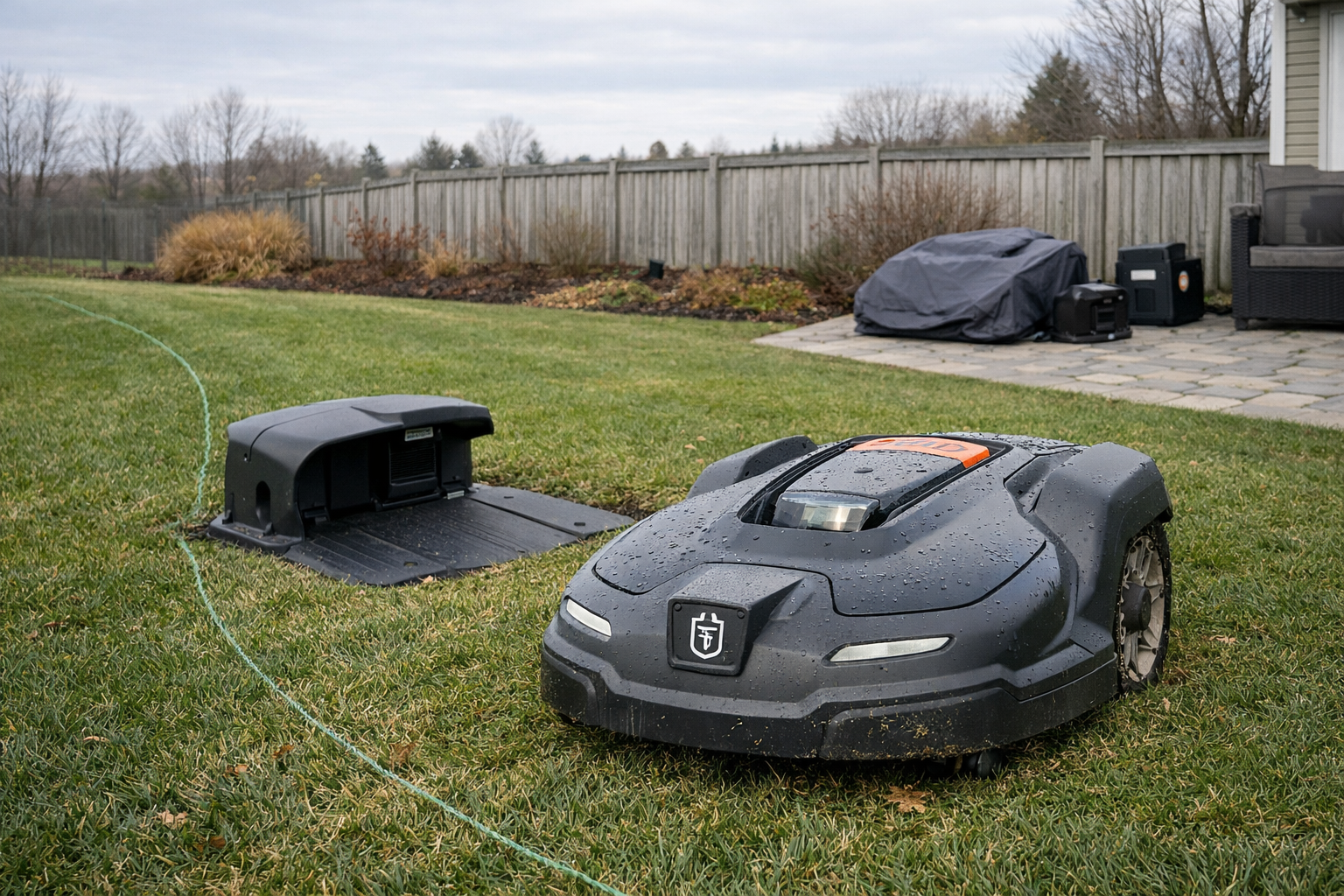
The charging station needs a flat, shaded spot with access to a standard outdoor-rated outlet, plus enough clearance for the mower to dock straight-on without obstruction. Poor placement, like putting the dock at the bottom of a slope or in a spot that floods after rain, is a frequent cause of docking failures and error alerts.
Rain Sensors and Wet-Grass Behavior
Most Automower models include a rain sensor that halts mowing and sends the unit home when moisture hits a threshold, since wet clippings clog the cutting deck and reduce blade efficiency. This is a genuine feature, not a marketing gimmick.
A robotic mower’s rain sensor exists mainly to protect the cutting deck and traction, not the mower’s electronics — most units are IPX4-rated or better and can handle light rain without damage.
That said, running an automower robot in consistently wet climates means more frequent deck cleaning, since damp clippings stick to the underside far more than dry ones. If you live somewhere with regular morning dew and afternoon storms, expect to hose off the deck weekly instead of monthly.
Maintenance and Winterizing: The Work You Still Have to Do
An automower robot is not maintenance-free. Blades need replacing roughly every 4 to 8 weeks during active mowing season, since the small pivoting blades are thin and dull quickly compared to a rotary mower’s single thick blade. A pack of replacement blades typically costs $10 to $20 for a set of nine to eighteen.
Seasonal Tasks
Check and tighten or replace blades every 4 to 8 weeks during the mowing season.
Clean the underside cutting deck monthly, more often in wet climates, to remove packed clippings.
Wipe down the rain sensor and charging contacts to prevent corrosion buildup.
Inspect boundary wire connections at the start and end of the season for breaks from aerating or edging.
Bring the mower and battery indoors for winter storage once temperatures drop consistently below freezing.
Update the mower’s firmware through the connected app before the season restarts.
Test the charging dock’s outlet and connections before the first mow of spring.
Winterizing the Battery
Lithium-ion batteries in Automower units degrade faster if stored fully charged or fully drained through a cold winter. Husqvarna recommends storing the battery at roughly 30 to 60% charge in a dry space above freezing, ideally a garage or basement rather than an unheated shed. Skipping this step is one of the more common reasons owners report a noticeably shorter mowing session the following spring.
For anyone getting into troubleshooting these systems more deeply — diagnosing a mower that won’t leave the dock, or one throwing loop signal errors — a dedicated maintenance walkthrough on a resource like themowersguide.com can save a service call by narrowing down whether the issue is the wire, the blade sensor, or the battery itself.
When Not to Buy an Automower
An automower robot is a poor fit for lawns under roughly 1,000 square feet, since the fixed cost of the mower and installation rarely pays off compared to a $200 push mower on a small plot. It’s also a bad fit for yards with slopes exceeding the model’s rated grade, heavy obstacle density, or irregular multi-zone layouts that would require extensive wire routing.
Small or Simple Lawns Don’t Justify the Cost
If your whole lawn takes 15 minutes to cut with a standard push mower, an automower robot costing $1,500 or more plus installation isn’t solving a real problem. The economics only start making sense as lawn size and mowing frequency climb, particularly for owners who currently pay a lawn service $40 to $60 per visit weekly.
Steep or Heavily Obstructed Terrain
Yards with retaining walls, drop-offs, ponds without solid perimeter access, or slopes beyond 35 degrees push these machines past their design limits regardless of model tier. Forcing a robot mower onto terrain it wasn’t rated for leads to premature wheel motor wear, tipping risk, and warranty claims that dealers often deny once they see slope measurements exceeding spec.
Renters and Uncertain Tenure
Since boundary wire installation is semi-permanent and the mower itself represents a real investment, renters or anyone planning to sell their home within a year or two should think twice. Pulling wire back up and patching the lawn before a move adds cost and hassle that a traditional mower simply doesn’t carry.
Don’t buy an automower robot expecting it to replace all lawn work either. Edging, trimming around fence lines the wire can’t reach, and leaf cleanup in fall still fall to you or a separate tool.
Theft Protection, App Controls, and Ongoing Costs
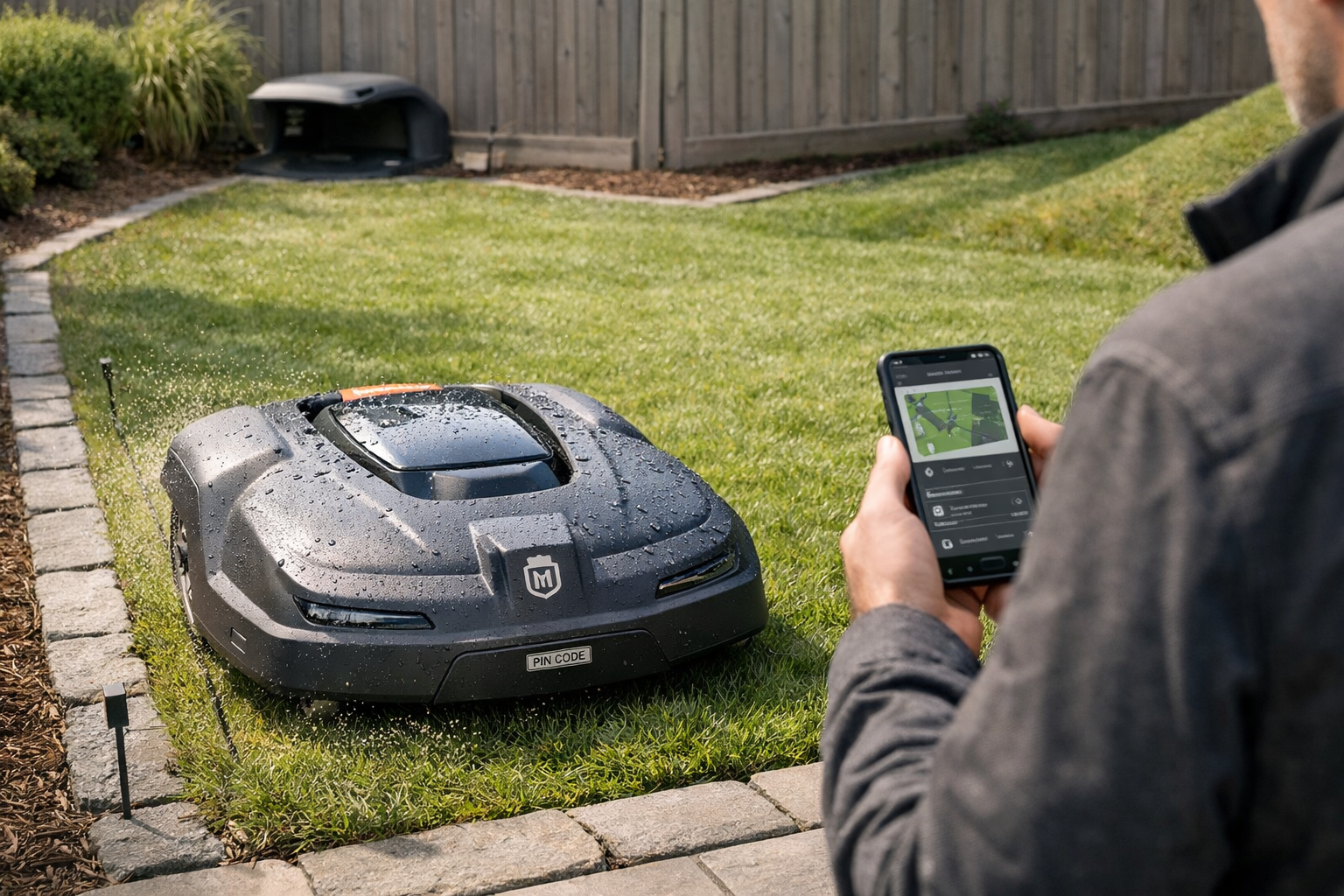
Automower units include GPS tracking and PIN-code locking as standard on most current models, addressing a real concern since these mowers sit outside, often visible from the street, for hours at a time. The Automower Connect app lets owners set a geofence alert that triggers if the mower is lifted or moved outside its normal working area.
What the App Actually Controls
Beyond theft alerts, the app lets you adjust cutting height, set no-mow schedules around outdoor gatherings, and check battery status remotely. Cutting height on most models adjusts between roughly 0.8 and 3.5 inches depending on the model, controlled through the app or a dial on the mower itself rather than the manual lever adjustment on a push mower.
Subscription and Ongoing Fees
Some GPS and connectivity features run through a data connection that may involve a small annual fee, generally under $50 per year, depending on region and model. Replacement blades, occasional wire repair kits (roughly $30 to $50 for a splice kit), and battery replacement after 3 to 5 years of use (often $200 to $400 for a new battery pack) are the recurring costs buyers most often forget to budget for when comparing an automower robot’s price against a traditional mower’s simpler, cheaper upkeep.
Frequently Asked Questions
How much does a Husqvarna Automower cost installed?
Total cost including professional installation typically runs $1,800 to $9,000+, depending on model tier and lawn complexity. Entry models with wire installation land near $1,800 to $2,800; large EPOS systems on multi-acre properties can exceed $10,000 with installation.
Can an automower robot handle a lawn with a steep slope?
Only up to its rated grade, generally 40% (22 degrees) for entry and mid-tier models, up to 70% (35 degrees) for high-capacity AWD units. Wet grass reduces traction further, so a slope near the spec limit performs worse in rainy climates than on paper.
Do robot mowers work in the rain?
Most Automower models keep working in light rain and are IPX4-rated or better, but built-in rain sensors typically send the unit back to its dock once moisture crosses a set threshold to protect the cutting deck.
How long does an Automower battery last before replacement?
Batteries generally hold a useful charge for 3 to 5 years of regular seasonal use before capacity drops enough to warrant replacement, which typically costs $200 to $400 for a new pack depending on model.
Is your snow blower cranking but not catching, or surging and dying after summer storage? Reaching for carb cleaner snow blower fixes is a fair instinct, but it shouldn’t be your...
Discover essential lawn mower safety tips for beginners. I’ll guide you through proper equipment use, protective gear, and safe mowing techniques to keep your lawn care accident-free.
6 March 2025
The Mowers Guide is reader-supported. When you buy through links on our site, we may earn an affiliate commission.






Comments are closed.