Centipede grass earned the nickname “lazy man’s grass” back when it was first promoted for Southern lawns in the mid-1900s, and that reputation still holds up. It needs roughly a third of the nitrogen that Bermuda grass needs per year, which sounds like a small detail until you realize most lawn problems with centipede grass come from owners feeding it like it’s Bermuda. If you just planted or inherited a centipede lawn, the fastest way to kill it is kindness: too much fertilizer, too much lime, too much water. This guide covers what actually keeps it alive — and what to stop doing.
What Makes Centipede Grass Different From Other Warm-Season Turf
Centipede grass (Eremochloa ophiuroides) is a warm-season lawn grass native to Southeast Asia, introduced to the U.S. in the 1910s and now common from coastal North Carolina down through the Gulf Coast into East Texas. It spreads by above-ground stems called stolons, forming a dense, light-to-medium green mat that stays low without much mowing. Unlike Bermuda or zoysia, it has a shallow, coarse root system and slow growth rate, which is exactly why it tolerates neglect but punishes over-management.
That shallow root system is the whole story. Centipede grass roots rarely go deeper than a few inches, so it can’t chase down nutrients or water the way deeper-rooted grasses can. It compensates by growing slowly and requiring very little from the soil. Push it with nitrogen or frequent watering and you force top growth the roots can’t support, which is when the lawn starts thinning out or yellowing in patches.
Growth Habit and Color
Centipede grass has a coarser texture than St. Augustine but finer than Bermuda, with a natural light apple-green color that some homeowners mistake for a nutrient deficiency. It isn’t. That paler green is normal and doesn’t mean the lawn needs iron or nitrogen. Forcing a darker color with extra fertilizer is one of the most common mistakes new centipede owners make.
Where It Grows Best
It performs best in USDA hardiness zones 7b through 10a, generally the coastal Southeast and Gulf states. North of that range, winterkill becomes a real risk in hard freezes below about 5°F without snow cover. South of that range, in South Florida for instance, St. Augustine or Bermuda usually outcompete it in the heat and humidity.
Soil pH: Why Acidic Soil Matters More Than Fertilizer
Centipede grass wants soil pH between 5.0 and 6.0, noticeably more acidic than the 6.0-7.0 range most turf grasses prefer. This single fact explains more lawn problems than any other factor, because homeowners routinely apply lime out of habit, pushing pH up into a range where centipede grass can’t take up iron properly.
That iron lockout is the mechanism behind a lot of “yellow lawn” complaints. When soil pH climbs above 6.5, iron becomes chemically bound in a form the roots can’t absorb, even if plenty of iron is present in the soil. The grass shows classic interveinal chlorosis — yellow leaves with green veins — that looks exactly like a nitrogen problem but responds to fertilizer with nothing but faster decline.
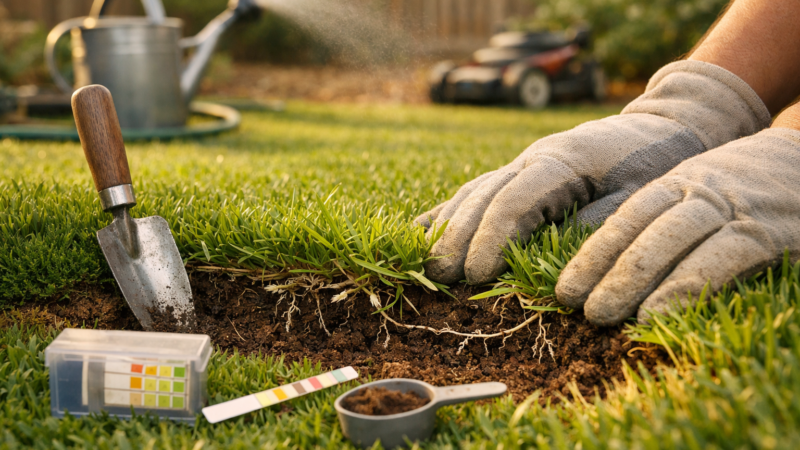
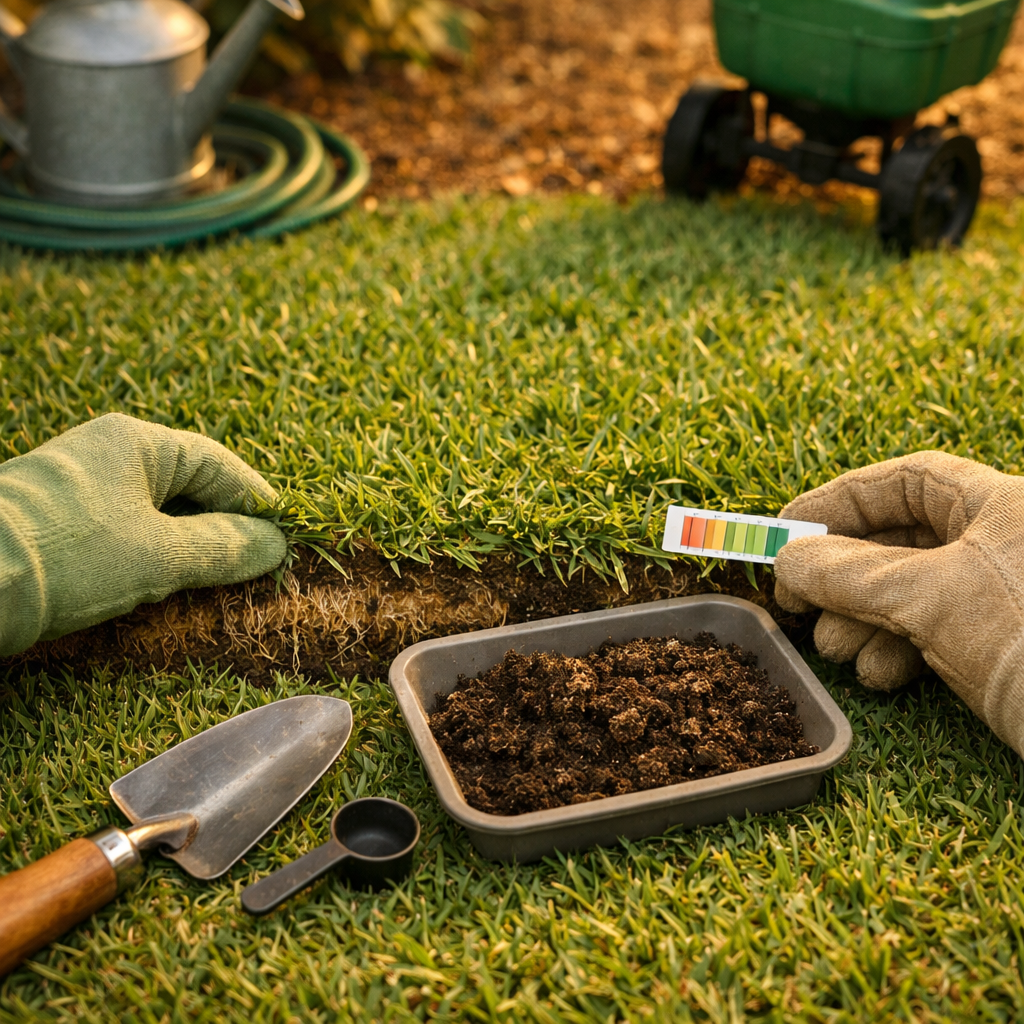
A soil test, not a calendar reminder, should be the only reason you ever apply lime. If the test shows pH already in the 5.0-6.0 range, skip the lime entirely.
Get a soil test every two to three years from your county extension office or a private lab; it typically costs $10 to $25 and takes one to two weeks for results. Only add lime if the test specifically calls for it. If your pH is already sitting at 5.5, adding lime “just because the neighbor does it every spring” is how a healthy lawn turns yellow within a season.
Reading a Soil Test Report
Look for two numbers: the pH value and the buffer pH (sometimes called SMP buffer index), which tells a lab how much lime is actually needed if pH is low. Ignore generic bagged lime recommendations on a bag label — they’re not calibrated to your soil.
If Your Soil Is Too Alkaline
If a test shows pH above 6.5, the fix isn’t dramatic. Elemental sulfur applied at label rates over one to two growing seasons will gradually lower pH. Don’t try to fix it all at once with a heavy single application, which can scorch the lawn and won’t hold anyway without follow-up testing.
Mowing Height and Frequency: The Single Biggest Lever You Control
Mow centipede grass at 1.5 to 2 inches, and never remove more than one-third of the blade height in a single cutting. This is the most important maintenance decision you make all season, because the shallow root system depends on enough leaf surface to photosynthesize and support itself.
Cutting centipede grass too short is one of the most common and most damaging mistakes homeowners make, right alongside over-fertilizing. Scalping the lawn down to an inch or less stresses the root system, opens bare soil to sunlight, and gives weeds like doveweed and dollarweed room to move in. A centipede lawn mowed too short doesn’t bounce back the way Bermuda does — it thins permanently in patches.
During active growing season, roughly April through September depending on your latitude, plan to mow every 7 to 10 days. Centipede grass grows slowly compared to Bermuda or zoysia, so weekly mowing is often overkill; letting it go 10 days between cuts is normal and won’t hurt it, as long as you’re not letting it get shaggy and then scalping it back down.
Rotary mowers handle centipede grass fine at these heights — you don’t need a reel mower’s precision here. What matters more is blade sharpness. A dull blade tears the grass tip instead of slicing it, and torn tips turn brown and invite fungal issues in humid Southern summers. Sharpen or swap blades every 20 to 25 hours of use, and if you’re shopping for a mower suited to low, infrequent cutting on a smaller warm-season lawn, a resource like themowersguide.com has model comparisons worth checking before you buy.
Set the mower deck to 1.5-2 inches before the first cut of the season.
Mow when the grass reaches roughly 3 inches, not on a fixed weekly schedule.
Never cut more than one-third of the blade height at once.
Sharpen blades every 20-25 hours of cutting time.
Leave clippings on the lawn if they’re not clumping — they return nitrogen you don’t need to buy in a bag.
Reduce mowing frequency in late summer as growth naturally slows before dormancy.
Fertilizer Program: Less Is the Whole Strategy
Centipede grass needs only 1 to 2 pounds of nitrogen per 1,000 square feet per year, compared to 3 to 5 pounds for Bermuda grass lawns. That’s the number to anchor everything else to. Most lawn fertilizer bags are formulated with Bermuda and fescue in mind, which means using them at label rate on centipede grass is already too much.
Centipede grass decline, sometimes just called centipede decline, is the umbrella term for the yellowing, thinning, and dieback that shows up in late spring after a lawn has been over-fertilized, over-limed, or otherwise pushed too hard the previous year. It’s not caused by one pathogen — it’s a stress response, and high-nitrogen or high-phosphorus fertilizer is the single most common trigger.
A Realistic Annual Schedule
Apply a single light feeding in late spring, once the lawn has fully greened up after winter dormancy, using around 0.5 to 1 pound of nitrogen per 1,000 square feet. A second light application in early summer is optional and only needed if the lawn looks thin or pale beyond its normal light-green color. Skip fall fertilizing entirely — feeding centipede grass going into fall pushes tender growth right before winter, which increases winterkill risk.
Phosphorus and Potassium
Most Southern soils already have adequate phosphorus, and excess phosphorus has been directly linked to centipede decline symptoms. If your soil test doesn’t call for phosphorus, choose a fertilizer with a 0 in the middle number of the N-P-K ratio. Potassium in early fall (not nitrogen) can help improve cold tolerance heading into winter dormancy.
Grass Type
Nitrogen (lbs per 1,000 sq ft/year)
Feedings per Season
Centipede grass
1-2
1-2
St. Augustine grass
2-4
3-4
Bermuda grass
3-5
4-6
Zoysia grass
2-3
2-3
That table alone explains why so many centipede lawns decline within two or three years of installation: new owners follow generic Southern lawn advice built around Bermuda’s appetite, and the centipede grass simply can’t handle it.
Watering Deeply, Not Often, and Managing Sun-Shade Balance
Centipede grass needs about 1 inch of water per week during active growth, applied in one or two deep sessions rather than daily light sprinkles. Frequent shallow watering is the second-biggest killer after over-fertilizing, because it trains roots to stay near the surface and creates the damp conditions fungal diseases like large patch thrive in.
Once established — generally after the first full growing season — centipede grass is fairly drought-tolerant and will go dormant and brown in extended dry spells rather than dying outright. It’s tempting to rescue a browning lawn with daily watering, but that’s usually unnecessary. Deep watering once or twice a week, enough to moisten the top 4 to 6 inches of soil, is far better than watering every day for ten minutes.
Sun Requirements
Centipede grass wants full sun to light shade, ideally 6 or more hours of direct sun daily. It tolerates partial shade better than Bermuda but worse than St. Augustine, and in deep shade under mature trees it thins out and gets outcompeted by moss and weeds regardless of how well you fertilize or water it.
Signs of Underwatering vs. Overwatering
Underwatered centipede grass folds its blades lengthwise and takes on a dull gray-blue cast before browning — that’s your cue to water, not a lawn already dying. Overwatered centipede grass, by contrast, often shows yellowing with a spongy feel underfoot and may develop fungal patches, especially in humid weather with poor drainage. If you’re watering on a fixed schedule and seeing yellow patches, cutting back the frequency is usually the fix, not adding more.
Establishing a New Lawn: Seed, Sod, or Plugs
Sod is the fastest and most reliable way to establish centipede grass, giving you a usable lawn in about 2 to 3 weeks, though it costs considerably more than seed or plugs. Seed is the cheapest option but by far the slowest, since centipede grass seed germinates unevenly and can take a full season or two to fill in completely.
Plugs sit in between: small squares or sprigs of established centipede grass planted on a grid, typically 12 to 18 inches apart, that spread via stolons to fill in over one to two growing seasons. This method costs less than sod and fills in faster than seed, but it leaves bare soil exposed to weeds during the fill-in period, which means more spot-weeding in year one.
Best Planting Windows
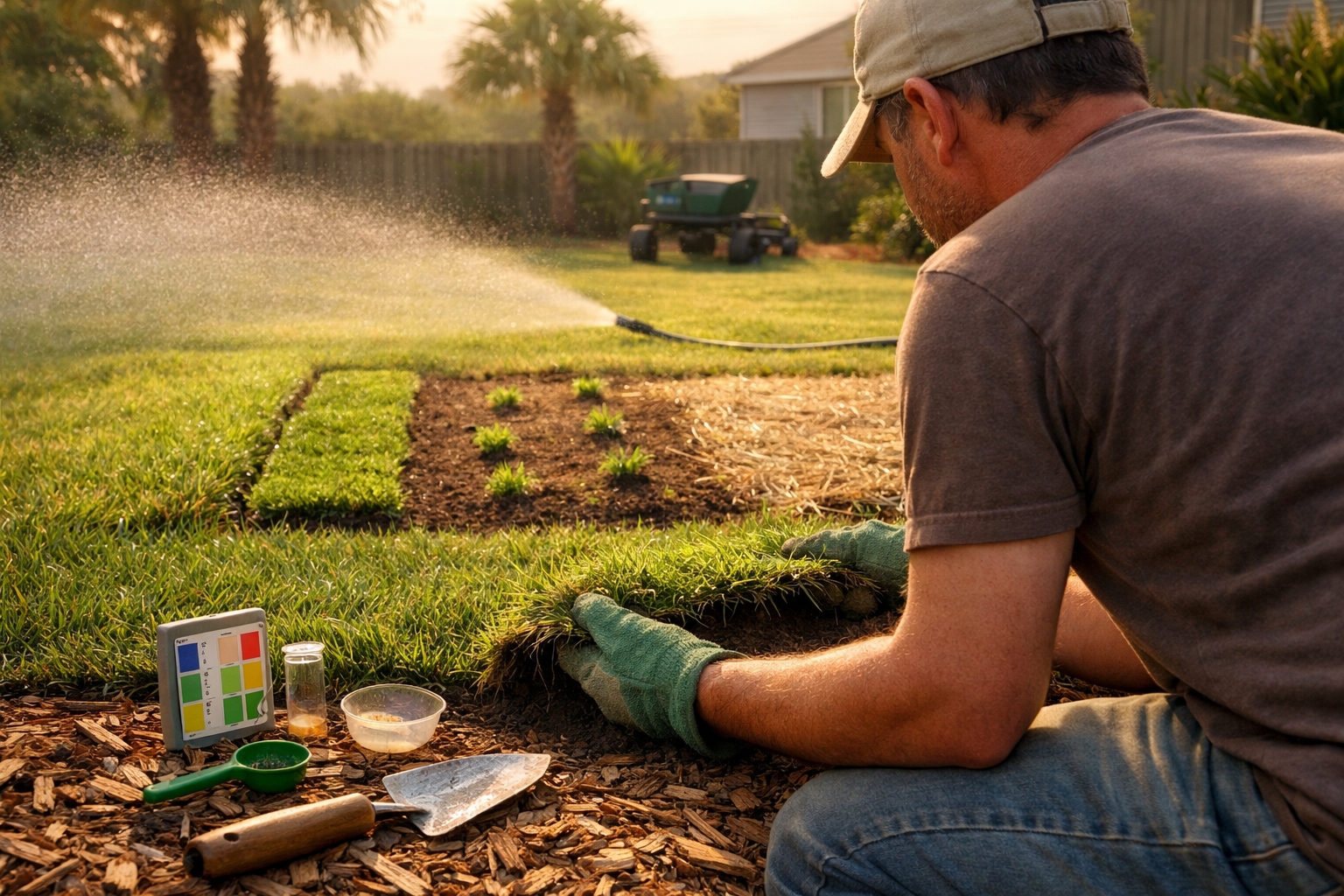
Plant centipede grass — by any method — in late spring through early summer, once soil temperatures are consistently above 65°F. Planting too early in cool soil stalls root establishment, and planting too late into fall doesn’t give the lawn enough time to root in before dormancy, raising the risk of winterkill in its first year.
New Lawn Care in the First 60 Days
New sod or plugs need more frequent, lighter watering than an established lawn — daily light watering for the first 10 to 14 days, then tapering to deep watering twice a week as roots take hold. This is the one phase where centipede grass genuinely needs more attention than usual; the “do less” rule kicks in fully only after the lawn is established, generally by the end of the first growing season.
Diagnosing Yellowing, Thinning, and Dieback
If your centipede lawn is yellowing in patches, the most likely causes, in order of frequency, are iron chlorosis from high soil pH, centipede decline from over-fertilizing, and thatch buildup restricting root oxygen. Each has a different fix, and treating the wrong one usually makes things worse.
Iron Chlorosis vs. Nitrogen Deficiency
Iron chlorosis shows yellow leaves with green veins, worse in spots with alkaline soil, and doesn’t improve with nitrogen fertilizer. True nitrogen deficiency shows uniform pale yellow-green across the whole lawn, not vein-patterned, and does respond to a light feeding. Confusing the two is exactly why so many homeowners over-fertilize a lawn that actually needs a pH correction, not more nitrogen.
Managing Thatch Without Overdoing It
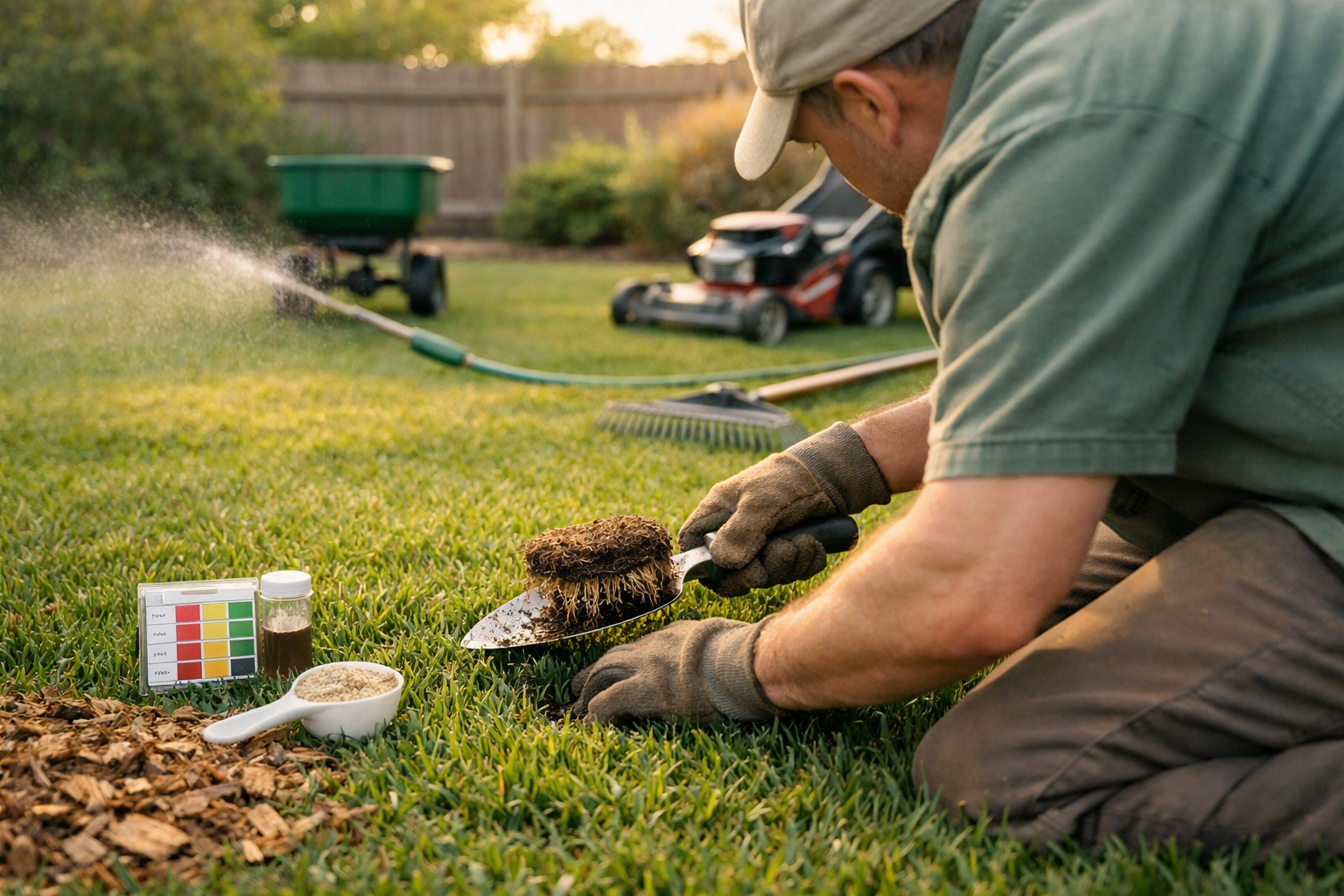
Thatch — the layer of dead stems and roots between the soil and green growth — builds up slowly in centipede grass because it’s a low-growth-rate species, so heavy dethatching is rarely needed and can do real damage if done aggressively. Check thatch depth by cutting a small wedge of turf; if the brown layer between soil and green blades exceeds about 0.5 inch, a light dethatching in late spring, after green-up, is worth doing. Skip dethatching machines rated for aggressive removal — a light pass with a dethatching rake attachment or a core aerator is usually enough.
Common Pests and Diseases
Ground pearls are one of the few pests specific to centipede grass, small scale insects that feed on roots and cause circular dead patches that don’t respond to any watering or fertilizing — there’s no effective chemical control, and the practical response is overseeding or replugging affected spots rather than fighting the insect directly. Large patch disease, a fungal issue favored by excess moisture and nitrogen, shows up as roughly circular brown patches in cooler, wet weather in fall or spring; reducing watering frequency and skipping fall fertilizer are the first line of defense before reaching for a fungicide.
Weed Control, Winterization, and Late-Season Care
Pre-emergent herbicides for crabgrass and other annual weeds are compatible with centipede grass when applied at label rate in early spring, roughly when soil temperatures hit 55°F for several consecutive days. Post-emergent broadleaf herbicides need more caution — centipede grass is sensitive to certain 2,4-D formulations at high rates, so check the label specifically for centipede grass tolerance rather than assuming any “lawn weed killer” is safe.
Doveweed is the weed most specific to centipede lawns, thriving in the same damp, shaded conditions that stress centipede grass itself. It resembles grass at a glance but has fleshy, succulent stems and shows up mid-summer in thin or overwatered areas. Because it germinates later than crabgrass, a single early spring pre-emergent application often misses it — a second application in late spring targeted at doveweed’s germination window is usually necessary in lawns with a history of it.
Preparing for Dormancy
Centipede grass goes dormant and turns tan-brown after the first hard frost, typically once nighttime temperatures drop into the mid-30s consistently. This is normal, not a sign of a dying lawn, and no fertilizer or extra watering will change it or should be attempted. Mowing height can be lowered slightly for the final cut of the season, but only by a small amount — scalping before dormancy removes protective leaf tissue and increases winterkill risk.
Winter Traffic and Cold Damage
Keep foot traffic and equipment off dormant centipede grass as much as practical, since the crown and shallow roots are more vulnerable to compaction damage when the plant isn’t actively growing to recover. In the northern edge of centipede’s range, an unmowed slightly taller canopy going into winter (within reason, not shaggy) can offer a little extra insulation against hard freezes, though this matters less in milder coastal zones where winterkill is rarely a serious risk.
Frequently Asked Questions
Why is my centipede grass turning yellow even though I fertilize it regularly?
Yellowing after fertilizing is usually iron chlorosis from high soil pH, not a nutrient shortage. Fertilizer adds nitrogen the grass doesn’t need while the real problem — locked-up iron — goes uncorrected. Get a soil test before adding more of anything.
How often should I water centipede grass in summer?
Water about 1 inch per week in one or two deep sessions, not daily. Once established, centipede grass tolerates short dry spells by going dormant rather than dying, so daily light watering does more harm than good.
Can I use regular lawn fertilizer on centipede grass?
Not at the label rate printed for general lawns. Most bagged fertilizers are formulated for Bermuda or fescue, which need 2 to 3 times more nitrogen than centipede grass. Use a product labeled for centipede grass or cut the standard rate significantly.
What does centipede grass decline look like and can it be reversed?
Centipede decline shows up as spring yellowing and thinning following a season of over-fertilizing or over-liming. It can often be reversed by stopping the excess input, correcting soil pH if needed, and letting the lawn recover over one to two growing seasons without pushing it further.
Which countries buy the most lawn mowers? These are the nations around the world that mow the most lawns each year. The global lawn mowers market was worth $32.31 billion in...
Discover the pros and cons of gas, electric, and battery-powered lawn mower engines. I’ll help you choose the perfect engine for your yard maintenance needs.
3 May 2025
The Mowers Guide is reader-supported. When you buy through links on our site, we may earn an affiliate commission.






Comments are closed.