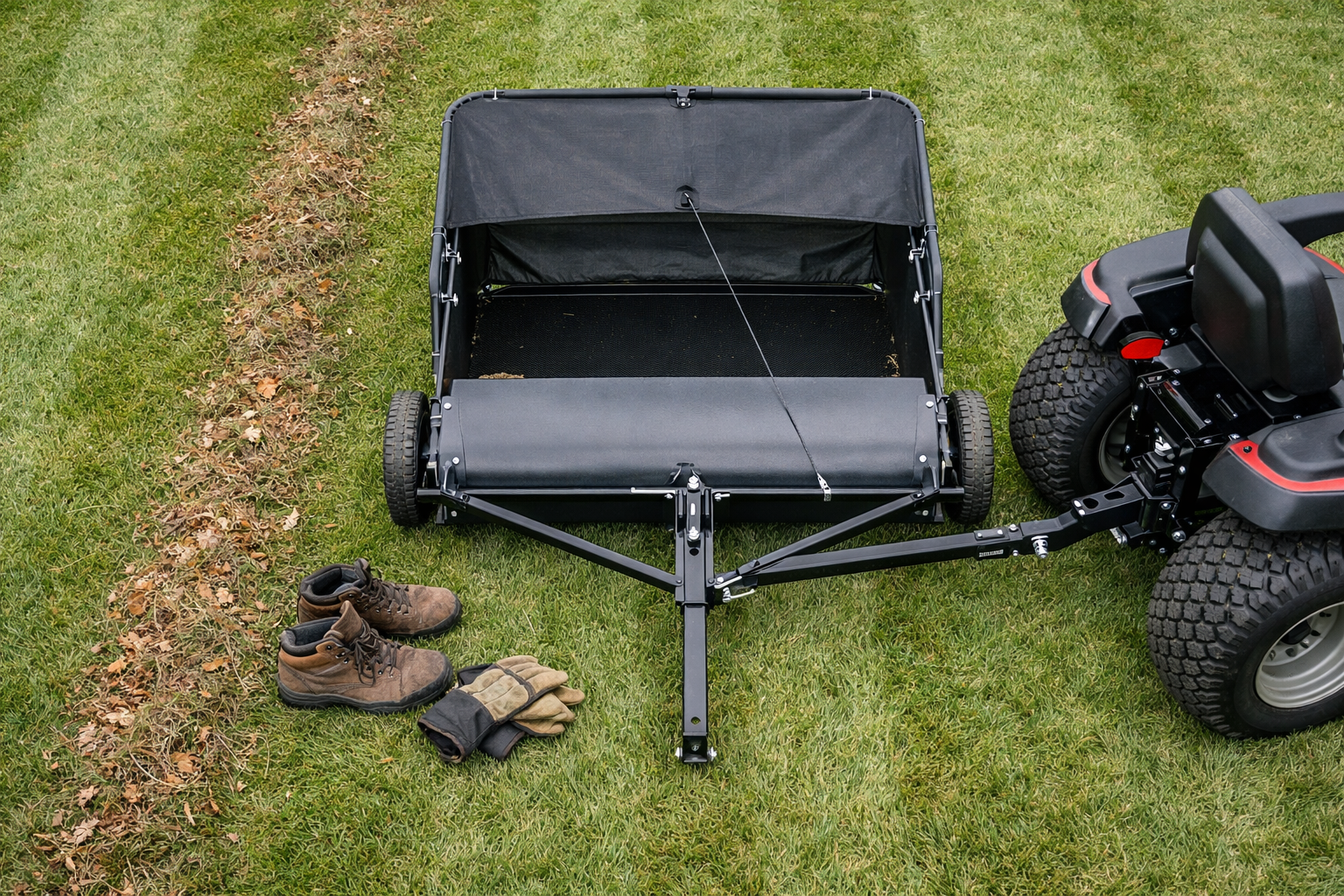
A 26-inch tow-behind lawn sweeper with a 17-cubic-foot hopper can weigh over 90 lbs empty and close to 300 lbs full of wet leaves. That’s more than some garden tractors are rated to pull safely on hills. A grass sweeper only performs as well as the machine dragging it, and most buying guides skip that math entirely. This one doesn’t — the picks below are sorted by towing power and yard size first, brand name second.
How a Grass Sweeper Actually Picks Up Debris
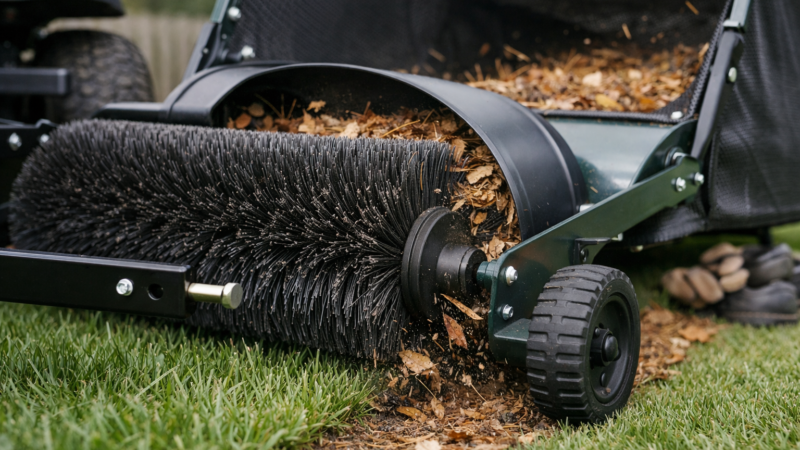
A grass sweeper is not a vacuum. It has no fan, no suction, and no motor pulling air through a filter. It works by mechanical brush action: a cylindrical brush spins as the wheels turn, flicking grass clippings, leaves, and light debris up a chute and into a hopper.
This matters because it explains both the strengths and the limits of the tool. Since pickup depends on wheel rotation driving the brush through a gear-and-chain or belt system, a sweeper moving too slowly (or being dragged instead of rolled) picks up almost nothing. Speed and brush contact do the work, not vacuum pressure.
Why People Expect Suction and Get Disappointed
Reviews sometimes complain a sweeper “doesn’t pick up wet leaves well” or “leaves a trail.” That’s rarely a defect — it is the mechanical limit of brush-and-hopper design. Wet, matted leaves resist the brush’s flick action because they cling to the turf instead of lifting free.
A leaf blower or vacuum with true suction handles soggy, matted leaf piles better. A sweeper handles dry-to-slightly-damp lawn debris, pine needles, and grass clippings faster and with less physical effort, since you’re riding or pushing rather than swinging a blower for an hour.
Brush Height Is the Setting Most Owners Never Touch
Almost every grass sweeper has a height adjustment, usually a crank or a set of pin holes on each wheel bracket, that raises or lowers the brush relative to the ground. Set it too low and you scalp the lawn or gouge bare dirt in soft spots. Set it too high and the brush skims over debris without touching it.
The correct setting depends on grass length and ground evenness, not a fixed number. On a lawn mowed to 2.5 inches, most brushes need to sit close enough to just graze the tips. Recheck the setting every few uses, especially after rain softens the soil or after you drop your cutting height for the season.
The 5 Best Grass Sweepers of 2026, Ranked by Towing Fit
These five sweepers cover the realistic range of home yards, from quarter-acre push jobs to multi-acre tractor properties. Each entry notes the pull weight your mower or tractor needs to handle, because that’s the detail most roundups leave out.
Agri-Fab 45-0492 52-Inch Tow Sweeper — Best for Large Properties with a Real Tractor
This is the sweeper for anyone running a lawn tractor or a small compact utility tractor on two acres or more. The Agri-Fab 45-0492 has a 52-inch sweep width and a 25-cubic-foot poly hopper, and empty weight runs close to 150 lbs. Full of damp leaves, that easily climbs past 350 lbs, which is why Agri-Fab recommends at least a 13-horsepower tractor to tow it without bogging down on grades.
Dump is a rope-pull mechanism from the driver’s seat, which saves a lot of getting on and off. The catch: this unit is genuinely too wide and heavy for anything under 300 lbs of drawbar capacity, so a small riding mower with a rated tow limit around 250 lbs will strain the hitch, spin its rear wheels on wet grass, or both.
Agri-Fab 45-0218 44-Inch Tow Sweeper — Best Middle Ground for Half-Acre to One-Acre Yards
The 45-0218 sweeps a 44-inch path with a 17-cubic-foot hopper and weighs around 92 lbs empty, making it the realistic pick for a mid-size riding mower or a lighter garden tractor in the 10 to 12-horsepower range. It’s the volume seller in this category for a reason: wide enough to cut down pass count, light enough that most 42-inch-deck riding mowers tow it without complaint.
Brush height adjusts through a simple pin system on both wheels, and the hopper dumps by lifting a lever that tips it backward. On a half-acre lawn with moderate leaf cover, expect to empty the hopper two to four times per full cleanup, depending on how dry the leaves are.
Brinly SS-40BH 42-Inch Sweeper — Best Brinly Alternative for Zero-Turn and Riding Mower Owners
Brinly‘s SS-40BH covers a 42-inch width with a 12-cubic-foot hopper, and it’s built with a lower profile that clears zero-turn mower decks more easily than some competing tow bars. Weight sits around 76 lbs empty, which keeps it towable behind mowers with lighter drawbar ratings, including many 500cc-class riding mowers.
The hopper on this model has a lower lip, which speeds up dumping into a yard bag but also means it fills faster on heavy leaf days. For a quarter-acre to half-acre yard with moderate tree cover, that trade-off rarely matters. For anyone under a lot of oak or maple canopy, plan on more frequent stops.
Agri-Fab 45-0320 26-Inch Push Sweeper — Best for No-Tractor Yards Under a Quarter Acre
Not every yard has a mower capable of towing anything, and this is where a push sweeper earns its place. The 45-0320 has a 26-inch sweep width, a walk-behind push handle, and a 6-bushel hopper, weighing about 40 lbs. It suits small front yards, townhouse lots, or anyone maintaining a lawn with a walk-behind mower and no tractor at all.
Because it relies entirely on the push force you generate, brush contact and speed are more directly under your control than with a towed unit. That’s an advantage on uneven ground where a tow sweeper might bounce and skip. The downside is obvious: a half-acre yard on a push sweeper is a genuine workout, and most owners switch to a tow model once their lot exceeds roughly 0.3 acres.
Ohio Steel 4048H-SWP 48-Inch Sweeper — Best for Heavy Pine Needle and Leaf Volume
Ohio Steel‘s 4048H-SWP sweeps 48 inches with a 20-cubic-foot hopper and a hydraulic dump option on some configurations, which lets you raise the hopper without leaving the seat. Empty weight runs close to 130 lbs, putting it in the same towing class as the Agri-Fab 45-0218, needing roughly 11 to 13 horsepower to handle hills without wheel spin.
The brush assembly on this model uses a slightly stiffer bristle mix, which holds up well against pine needles and small twigs that tend to wrap around softer brushes. If your yard sits under a lot of pine cover, that stiffness difference is the reason to pick this over a lighter-duty sweeper built mainly for grass clippings.
Model
Sweep Width
Hopper Capacity
Empty Weight
Min. Tractor HP
Best Yard Size
Agri-Fab 45-0492
52 in
25 cu ft
~150 lbs
13 hp
2+ acres
Agri-Fab 45-0218
44 in
17 cu ft
~92 lbs
10-12 hp
0.5-1 acre
Brinly SS-40BH
42 in
12 cu ft
~76 lbs
8-10 hp
0.25-0.5 acre
Agri-Fab 45-0320 (push)
26 in
6 bushel
~40 lbs
none (push)
Under 0.3 acre
Ohio Steel 4048H-SWP
48 in
20 cu ft
~130 lbs
11-13 hp
1-2 acres
Matching Sweeper Width and Weight to Your Mower’s Real Towing Capacity
The single most common mistake buyers make is picking a sweeper based on lawn size alone and ignoring what their mower can actually pull. A 52-inch tow sweeper is oversized for a riding mower rated to tow 250 lbs, no matter how big the yard is. Match capacity first, width second.
Check your mower’s owner’s manual for a stated towing or drawbar limit; it’s often listed alongside the mower’s hitch specifications, typically somewhere between 250 and 500 lbs for consumer riding mowers. If that number isn’t published, a rough rule of thumb: sub-compact riding mowers under 400cc generally handle push sweepers or the lightest tow models only, while 500cc-plus riding mowers and true garden tractors can handle the 42 to 48-inch class.
Signs Your Sweeper Is Too Big for Your Mower
Wheel spin on wet grass, the mower struggling to maintain speed uphill, and the hitch visibly flexing or lifting are the clearest warning signs. If you see any of these, you’re overloading the drawbar, and continued use risks damaging the mower’s transmission or hitch bracket.
A lighter, narrower sweeper that you empty more often is almost always the better call than a wide one your mower can barely drag. Undersizing the sweeper costs you time; oversizing it risks the mower.
When a Full Hopper Changes Everything
An empty 17-cubic-foot hopper weighs maybe 92 lbs, but fill it with wet leaves and it can top 250 lbs fast. That’s the number that actually matters for towing math, not the empty spec sheet weight most listings advertise. Budget for the full-hopper weight when judging whether your mower can handle a given model, especially early in fall when leaf moisture content is highest.
Push vs. Tow-Behind: Which Fits Your Yard Size and Equipment
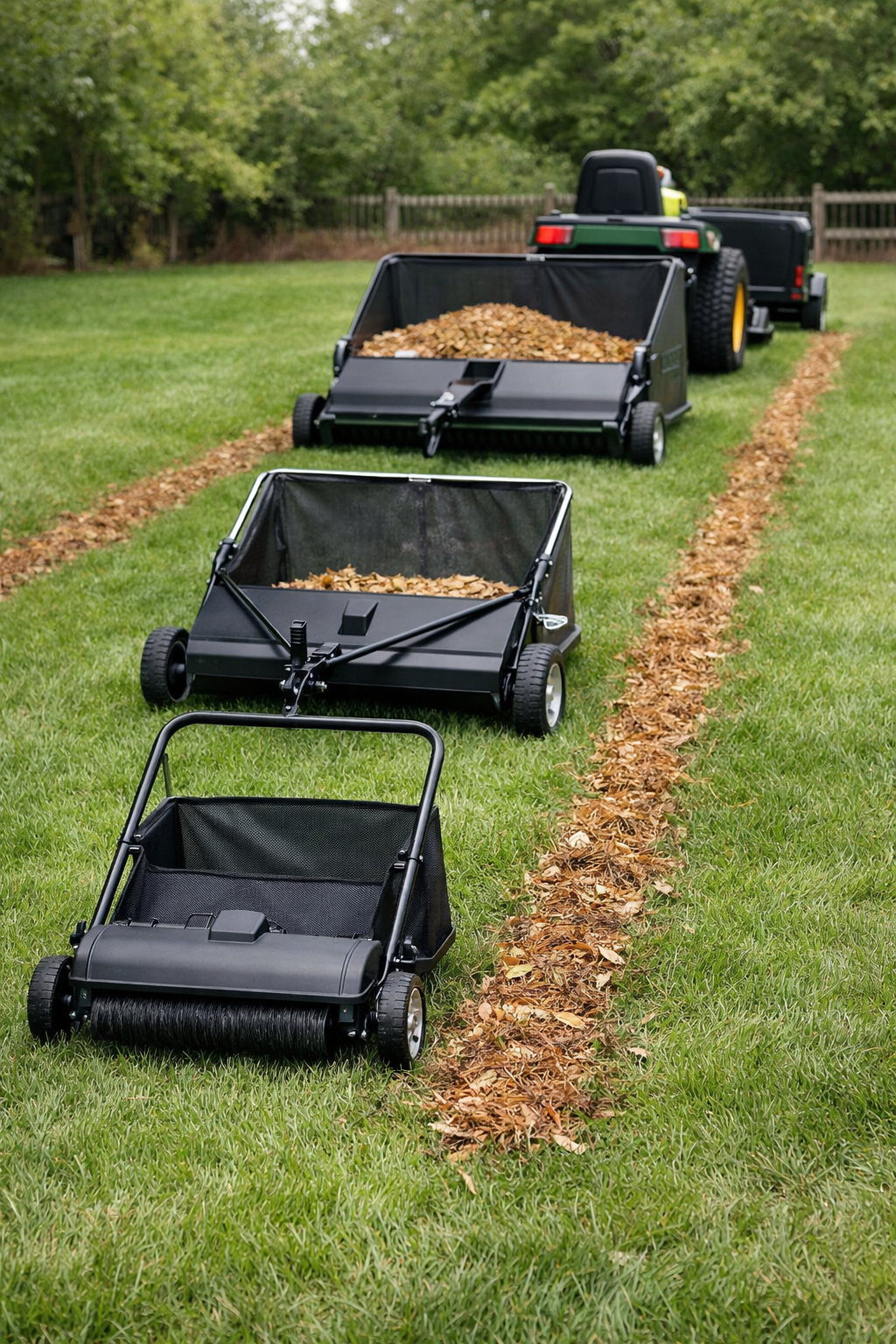
Push sweepers suit yards under roughly a quarter acre or anyone without a riding mower or tractor at all; tow-behind sweepers suit larger properties where a mower or tractor is already doing the mowing work. The decision usually comes down to whether you already own something capable of towing.
If you’re mowing with a walk-behind push mower, there’s no towing vehicle in the picture, so a push sweeper like the Agri-Fab 45-0320 is the only sweeper option that makes sense, short of buying a tractor just to pull a sweeper. That’s rarely worth it for a small yard.
If you already run a riding mower or garden tractor, a tow-behind model turns lawn cleanup into a ride-along task instead of a walking chore. On a one-acre yard, that difference can cut cleanup time from over an hour of pushing to 15 or 20 minutes of towing at a normal mowing pace.
There’s a middle case worth naming honestly: some yards are better served by neither. A property with heavy, wet leaf drop under mature trees, where debris is matted rather than loose, often clears faster with a leaf blower and vacuum combo, or even a rake and tarp, than with any sweeper. Brush-and-hopper mechanics need debris that’s loose enough to flick upward; matted wet leaves defeat that mechanism regardless of brand or price.
A grass sweeper moves debris by brush contact and gravity into a hopper — it has no fan and no suction, which is why wet, matted leaves are its weak point compared with a vacuum-style leaf collector.
Hopper Capacity and Emptying: The Spec Everyone Underrates
Hopper capacity determines how many stops you make per cleanup, and on a large property that number adds up fast. A 12-cubic-foot hopper on a Brinly SS-40BH might need emptying six or more times on a one-acre lawn with heavy fall leaf drop, while a 25-cubic-foot Agri-Fab 45-0492 hopper might only need two or three stops for the same job.
More capacity isn’t free, though. Bigger hoppers add weight, both empty and full, which pushes you back into the towing-capacity conversation from the section above. The right hopper size is the largest one your mower can still tow comfortably when that hopper is full, not the largest one available.
Dump Mechanisms Vary More Than People Expect
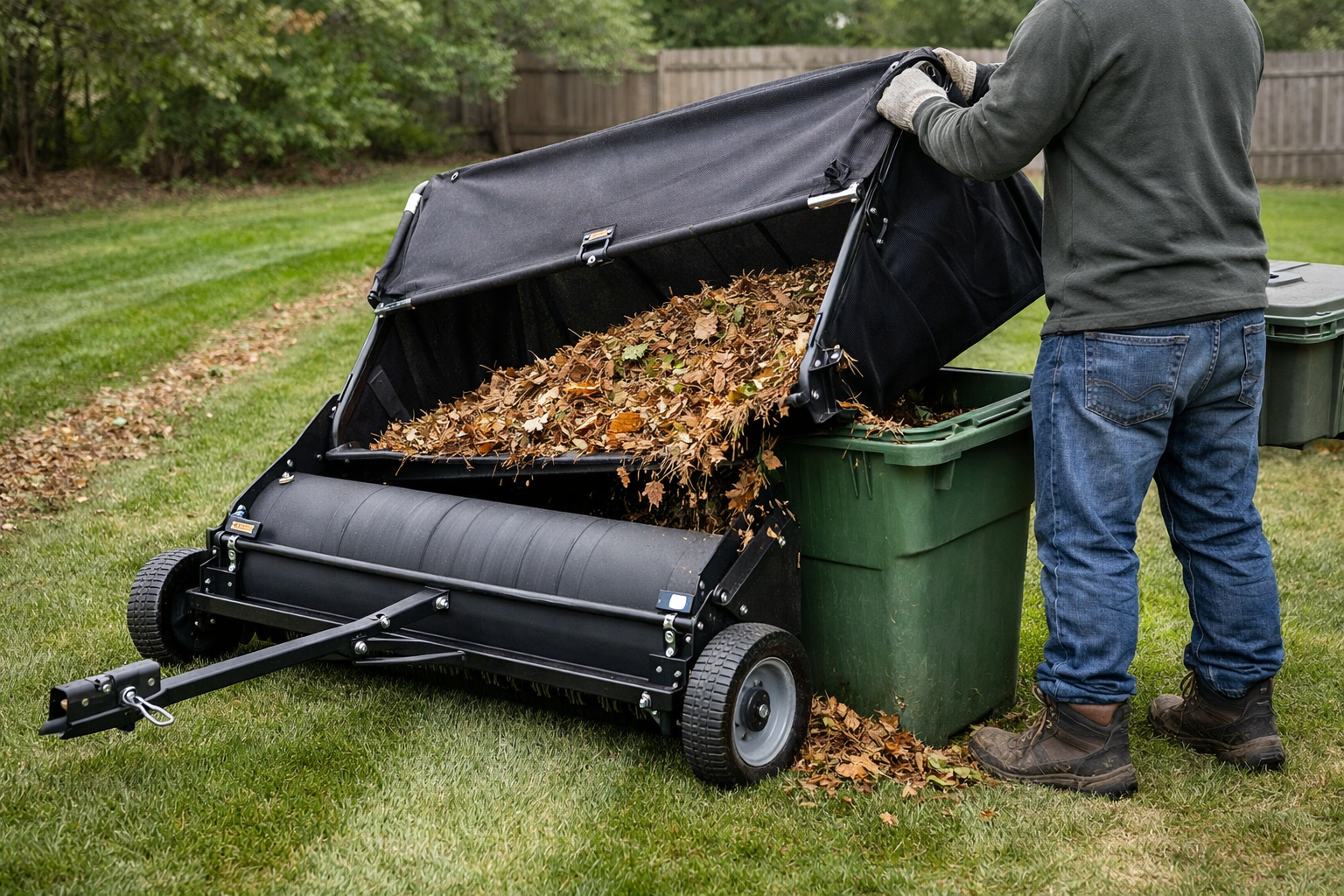
Some sweepers dump by a simple rope pull from the seat, tipping the hopper backward. Others use a lever system you operate on foot, and higher-end models offer hydraulic assist. On a large property with dozens of dump cycles per session, a seat-operated rope dump saves real time and effort compared with dismounting each time.
Check this spec before buying if your property is large enough that you’ll be dumping more than four or five times per session. It’s a detail that rarely shows up in headline marketing copy but shows up constantly in how the machine feels to use.
A Practical Emptying Routine
Sweep in overlapping passes, working from the yard’s perimeter toward a central dump point to cut travel distance.
Watch hopper fill level through the mesh or poly window most models include, rather than waiting for it to overflow.
Dump onto a tarp or directly into a leaf bag staging area, not loose on the lawn, to avoid re-collecting the same debris.
Clear the brush of any wrapped debris (long grass, string, vines) every two or three dumps to keep pickup efficiency steady.
On the final pass, lower the brush slightly if pickup seemed thin earlier, since grass often stands more upright by the end of a session.
Assembly, Storage, and Brush Maintenance
Most tow sweepers ship partially disassembled, and the honest time estimate for a first-time build is 45 minutes to just over an hour with basic hand tools. The Agri-Fab and Brinly models in this roundup use bolt-together frames with pre-drilled holes, so it’s straightforward, but the brush and axle assembly steps benefit from a second set of hands to hold parts steady.
Storage is the part people forget to plan for. A 44 to 52-inch sweeper doesn’t fold down small, and it needs to sit somewhere dry over winter, since damp storage speeds up rust on the frame and mildew on the poly hopper. A garage corner or a shed with at least 5 feet of clear width is usually enough.
Keeping the Brush Effective Season to Season
The brush is a wear part, not a lifetime component. Bristles flatten and shorten with use, and a sweeper that picked up cleanly in its first year may start leaving a visible trail by year three or four as bristle length drops. Replacement brush cartridges are sold by most manufacturers, including Agri-Fab and Brinly, and swapping one takes under 30 minutes with a socket wrench.
Between seasons, pull out anything wrapped around the brush shaft, since twine, long grass, and thin branches wind tight around the core and reduce contact with the ground over time. A quick check every few uses catches this before it becomes a real pickup problem.
Off-Season Storage Checklist
Rinse the hopper out before storing it, especially after wet leaf season, since dried leaf matter left in a poly hopper can stain and, in some cases, hold moisture against the plastic long enough to encourage mildew. Loosen tension slightly on any belt-driven models if the manual recommends it, since a belt held under tension all winter can develop a flat spot that causes vibration the next spring.
Readers looking for a deeper walkthrough on winterizing towed attachments and mower decks together can find equipment-specific maintenance guides on themowersguide.com, which cover the same seasonal upkeep principles across different mower and tractor models.
Price Ranges and What You’re Actually Paying For
Grass sweepers run from roughly $180 for a basic push model to $600 or more for a wide tow-behind unit with a large hopper and steel-reinforced frame. The price difference mostly tracks sweep width, hopper capacity, and frame durability, not brand prestige, since Agri-Fab, Brinly, and Ohio Steel all compete in overlapping price bands for comparable specs.
A push sweeper like the Agri-Fab 45-0320 typically lands between $180 and $230. Mid-size tow models in the 42 to 44-inch class, including the Brinly SS-40BH and Agri-Fab 45-0218, generally run $280 to $400. Larger 48 to 52-inch models with bigger hoppers, like the Ohio Steel 4048H-SWP and Agri-Fab 45-0492, run $450 to $650 depending on retailer and whether a hydraulic dump option is included.
Paying more for a wider sweeper only pays off if your mower can tow the extra weight. A $600 sweeper towed by an underpowered mower performs worse in practice than a $300 sweeper matched correctly to that same mower, because wheel spin and hitch strain cut effective brush contact regardless of hopper size. Buy for your equipment, not for the biggest spec sheet number.
Frequently Asked Questions
Does a lawn sweeper work on wet leaves and grass?
Poorly, compared with dry debris. A sweeper relies on brush contact flicking material upward into the hopper, and wet, matted leaves cling to turf instead of lifting free, so pickup drops noticeably compared with dry conditions.
Can I tow a lawn sweeper with a small riding mower?
Only a lighter model. Most sub-500cc riding mowers handle push sweepers or the lightest tow-behind units around 76 lbs empty, like the Brinly SS-40BH, but struggle with 44-inch-plus sweepers once the hopper fills with wet debris.
How often do I need to empty the hopper?
It depends on hopper size and debris volume, but expect two to six stops per session on a half-acre to one-acre lawn during heavy fall leaf drop, fewer with a 20-plus-cubic-foot hopper like the Ohio Steel 4048H-SWP.
Is a grass sweeper better than a leaf blower for fall cleanup?
For dry leaves and grass clippings on flat lawns, a tow-behind sweeper is faster and less physically demanding. For wet, matted leaf piles or debris under dense tree cover, a blower and vacuum combo generally clears more effectively.
Brown patches showing up on your St. Augustine lawn even though you’re watering it every single day? That’s the first clue something’s off with your routine. Good care of St. Augustine...
A slit seeder rental runs about $70 to $100 for a half-day at most equipment centers, while a decent broadcast spreader costs $40 to $60 and lasts a decade. That gap...
23 July 2026
The Mowers Guide is reader-supported. When you buy through links on our site, we may earn an affiliate commission.






Comments are closed.