Bermuda grass seed needs soil temperatures of 65°F or higher at a 2-inch depth before it will germinate reliably, and full germination can take 21 to 28 days compared to the 10 to 14 days homeowners expect from cool-season seed. That gap trips up a lot of first-time planters. If you’re reading this because you want a green Cynodon dactylon lawn fast, bermuda lawn seeds are not the shortcut some garden center displays make them look like. They work well, but only on the calendar and process this grass actually runs on.
Seed or Sod: Why Timing Should Decide for You
If your growing season south of a hard frost line runs less than 100 days, seed is probably the wrong call. Bermuda seed needs a sustained warm window to germinate, establish roots, and thicken up before fall dormancy, and gambling that window against seed is a bad bet in short-season climates.
Sod and sprigs give you an established root system on day one. Seed gives you bare dirt for three to five weeks, then a thin, uneven stand that needs another six to eight weeks of mowing and feeding before it looks like a lawn. That’s a real trade-off, not a minor inconvenience.
Cost is the reason most people choose seed anyway. Bermuda seed runs somewhere in the range of $5 to $12 per pound depending on hulled versus unhulled and coated versus raw, and a typical quarter-acre lawn might need 25 to 50 pounds. Sod for the same area, delivered and installed, often costs three to five times more.
When Seed Makes Sense
Seed is the right choice if you’re in USDA zones 7 through 10, you have at least 90 to 120 frost-free days ahead of you from planting, and you’re not in a rush for a finished look this season. It also makes sense if you’re overseeding an existing thin lawn rather than starting from bare soil, since the existing turf covers for the slow early weeks.
When Sod or Sprigs Win
If you’re in the upper edge of bermuda’s range — parts of Kansas, Virginia, or similar transition zones — or if you need a usable lawn for a home sale, a backyard event, or erosion control on a slope, sod solves the timing problem seed cannot. You pay more upfront, but you’re not exposed to a late cold snap wiping out a seedbed you just spent a month establishing.
Choosing Between Hulled and Unhulled Bermuda Lawn Seeds
Hulled bermuda seed has had its outer husk removed, which lets it absorb water and germinate in about 7 to 14 days. Unhulled seed still has that husk intact, and it can take 21 to 28 days or longer because the coating has to break down naturally first. Mixing up which one you bought — or expecting hulled speed from unhulled seed — is one of the most common planting mistakes.
Unhulled seed exists because it survives longer in storage and tolerates a wider planting window, including slightly cooler soil, since the husk protects the embryo. It’s often used for late-season or dormant seeding in fall, where the seed sits through winter and germinates once soil warms the following spring.
Hulled seed is the better choice for a standard spring or early summer planting where you want visible germination within two to three weeks. Most bags sold for homeowner lawn establishment, including common varieties like Common Bermuda and hybrid-adjacent seeded types such as those marketed under names like Princess 77, come hulled for this reason.
Coated seed is a third option worth knowing about. It’s hulled seed with a clay or polymer coating that holds moisture around the seed and sometimes includes a starter fertilizer charge. It costs more per pound of actual seed, but it can improve germination consistency in sandy soils or during a dry spring.
Hulled seed germinates faster because the hard outer hull — which normally slows water uptake — has been mechanically removed, exposing the seed to moisture immediately.
Read the bag label closely before buying. It will list the percentage of hulled versus unhulled seed in the blend, along with a germination rate percentage and a “sell by” or test date. A germination rate below 85% on a fresh test date suggests older stock, and you should either buy more pounds to compensate or find a fresher bag.
If you’re not sure which type your local supply carries, ask directly rather than guessing from the bag color or texture — hulled and unhulled seed can look nearly identical to the eye.
Soil Temperature and Calendar Timing
Plant when soil temperature at a 2-inch depth holds at 65°F or above for several consecutive days, which typically lands in late spring through early summer depending on your region. Air temperature is not the same thing as soil temperature, and this is where a lot of early plantings fail.
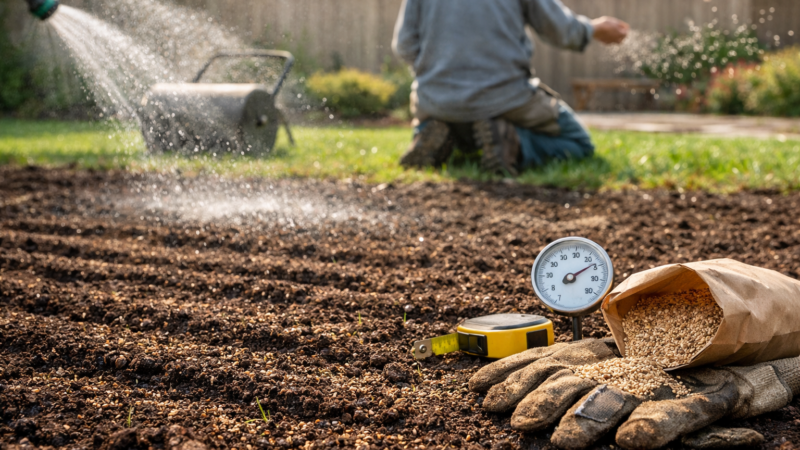
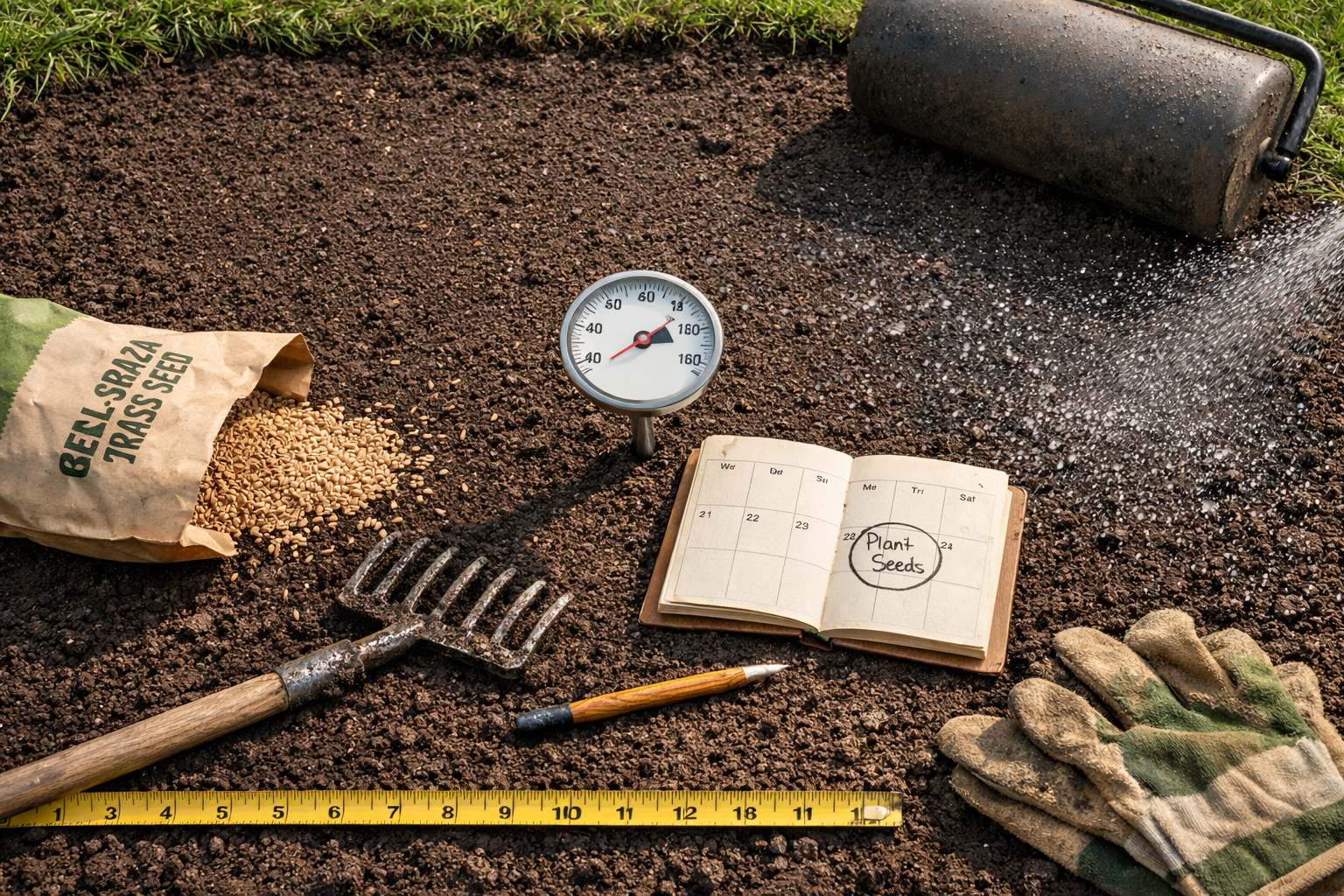
A $10 to $15 soil thermometer, checked in the morning over a few consecutive days, gives you a far more reliable answer than the calendar or the weather app. Push it 2 inches down in a spot that gets normal sun exposure, not against a foundation or under a shade tree, since those microclimates skew warm or cool relative to the rest of the yard.
In the Deep South — Gulf Coast Texas, Florida, southern Georgia — soil often hits 65°F by mid-April. In the transition zone further north, that same threshold might not arrive until late May or early June. Planting three weeks early because the air feels warm enough is one of the most common and most costly mistakes in bermuda establishment.
Why Early Planting Backfires
Seed sown into cold soil doesn’t just germinate slowly, it often rots or gets outcompeted by cool-season weeds like Poa annua that are still active in that temperature range. You end up reseeding in June anyway, having lost a month and the cost of the first bag of seed.
The Ideal Planting Window
Most transition zone and southern lawns do best planted between mid-May and mid-July. That gives the grass a long enough runway of warm weather to germinate, root, and thicken before day length and temperature drop in September, which is when bermuda naturally slows growth and heads toward dormancy.
Soil Preparation: What Actually Happens Before Seed Goes Down
Bare, loose soil with good seed-to-soil contact and a pH between 6.0 and 6.5 gives bermuda seed its best shot at germinating evenly. Skipping prep and just scattering seed over existing turf or hard-packed dirt is the single biggest reason new lawns come in patchy.
Start by killing off existing vegetation and weeds with a non-selective herbicide, then wait the label-specified interval — usually 7 to 14 days — before disturbing the soil. Tilling live weeds into the ground just gives them a fresh start alongside your new grass.
Once the area is dead and dry enough to work, till to a depth of 4 to 6 inches. This breaks up compaction, which matters because bermuda roots can extend 6 inches or deeper in loose soil but stall out hard against a compacted layer. Rake out rocks, roots, and old thatch as you go.
A soil test at this stage is worth the $15 to $30 it usually costs through a state extension office, and it tells you your actual pH and nutrient levels instead of leaving you to guess at fertilizer rates. Guessing tends to mean either underfeeding a thin lawn or overfeeding and burning tender seedlings — both common outcomes when people skip this step.
Grade the soil so water drains away from the house and doesn’t pool in low spots, which would otherwise wash seed into piles during the first few waterings. A light final rake should leave the surface loose but relatively level, with no clods bigger than a golf ball.
Apply lime or sulfur at this point if your soil test calls for a pH adjustment, since it’s much easier to work amendments into loose soil now than to correct pH after the lawn is established. Lime raises pH, sulfur lowers it, and the amount needed depends entirely on your test results and soil type.
How Much Seed to Use and How to Get It Into the Ground
For a new lawn from bare soil, apply bermuda lawn seeds at a rate of 1 to 2 pounds per 1,000 square feet. For overseeding an existing thin bermuda lawn, cut that back to roughly 0.5 to 1 pound per 1,000 square feet, since you’re filling gaps rather than starting from zero.
Going heavier than the recommended rate doesn’t get you a thicker lawn faster. It gets you overcrowded seedlings competing for the same water and nutrients, which often produces a weaker stand than a properly calibrated rate would.
Lawn Situation
Seeding Rate (per 1,000 sq ft)
Typical Bag Size Needed (1/4 acre, ~10,890 sq ft)
New lawn, bare soil
1–2 lbs
11–22 lbs
Overseeding thin lawn
0.5–1 lb
5.5–11 lbs
Bare spot repair
2–3 lbs (spot rate)
Varies by patch size
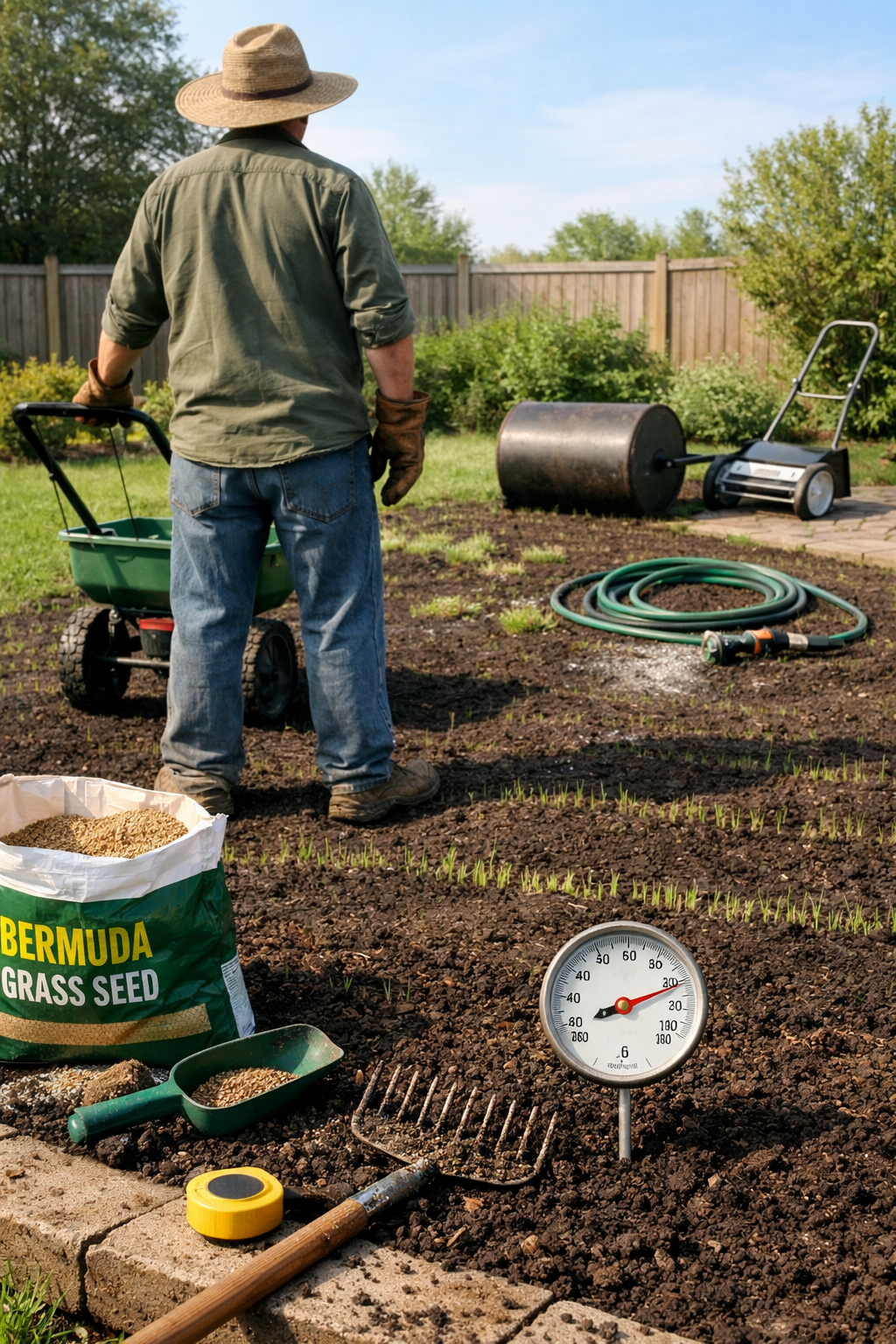
A broadcast spreader, the same kind used for granular fertilizer, gives the most even distribution over a full lawn. For small yards, a handheld crank spreader works fine and costs $15 to $25 at most hardware stores.
Split your total seed into two equal batches and make two passes over the yard in perpendicular directions — one north-south, one east-west. This cross-hatch pattern is standard practice for even coverage and it catches gaps that a single pass tends to leave, especially along curved bed edges.
After spreading, rake lightly to work seed into the top 1/8 to 1/4 inch of soil. Seed sitting fully exposed on the surface dries out fast and can wash away in the first rain or watering; seed buried too deep may not have the energy reserves to push a shoot to the surface.
Follow raking with a light rolling using a lawn roller, which can be rented for $20 to $30 a day from most equipment rental counters. Rolling presses seed firmly against soil particles, and that seed-to-soil contact is what actually drives germination rate, more than almost any other single factor in the process.
Watering Bermuda Lawn Seeds From Germination to Establishment
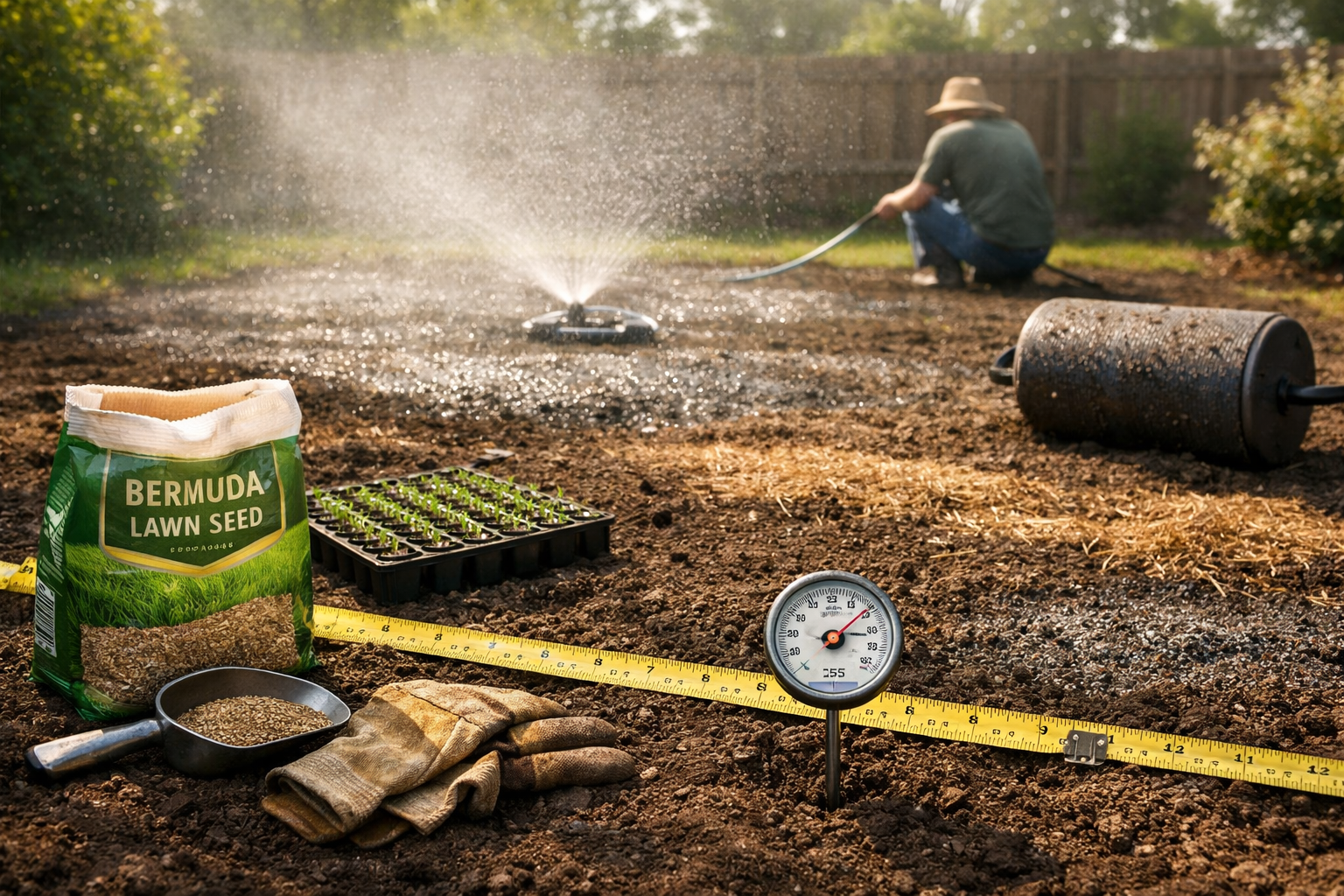
Water lightly and frequently for the first two to three weeks: two to four short sessions a day, enough to keep the top half-inch of soil consistently moist without pooling water on the surface. This is the single most failure-prone stage of the entire process.
Newly germinating seed has no root system to draw on reserves from deeper soil. If the surface dries out for even a few hours on a hot, windy day, the emerging root hair can die and that seed is done — it won’t get a second chance to sprout.
The First Three Weeks
Run short cycles, five to ten minutes each, rather than one long soak. A long single watering session tends to run off before it penetrates evenly and leaves long dry gaps between waterings that stress the seedbed. Early morning and late afternoon sessions work well; avoid watering into the evening in humid climates, since prolonged surface wetness overnight favors damping-off fungus.
Weeks Three Through Six
Once you see uniform green shoots across most of the seeded area, start stretching the interval between waterings and increasing the duration. Move to once-daily watering for about 10 to 15 minutes, then taper to every other day as roots extend deeper into the soil profile.
Established Lawn Watering
By week six to eight, transition to a normal bermuda watering schedule: about 1 inch of water per week total, delivered in one or two deep sessions rather than daily light ones. This trains roots to grow downward searching for moisture instead of staying shallow near a wet surface.
Overwatering during the germination phase causes its own problems, including seed rot and a condition sometimes called “damping-off,” where seedlings emerge, then collapse and die within a day or two. The fix isn’t less water overall, it’s shorter, more frequent applications instead of infrequent heavy ones during weeks one through three specifically.
Fertilizing, Weed Control, and the First Few Mowings
Apply a starter fertilizer with a higher phosphorus ratio, something like a 10-20-10 or similar, at planting time to support root development, following the rate on the bag rather than guessing. Skip the nitrogen-heavy “weed and feed” products at this stage entirely, since most pre-emergent herbicides in those blends will also stop your grass seed from germinating.
Pre-Planting Weed Control
Handle weeds before you seed, not after. A non-selective herbicide application 7 to 14 days ahead of tilling clears the field, and a pre-emergent herbicide should not go down within 60 to 90 days of seeding unless the product label specifically states it’s safe for use with new bermuda seed — most aren’t.
Post-Germination Weed Control
Once the lawn has been mowed two to three times, most post-emergent broadleaf herbicides become safer to use, though you should always check the product label against “newly seeded bermuda” tolerance windows. Hand-pulling scattered weeds during the first six weeks is tedious but avoids any risk of herbicide stress on young grass.
The first mowing should happen once grass reaches about 1.5 to 2 inches tall, cutting no more than one-third of the blade height in that pass. For bermuda, that usually means mowing down to around 1 to 1.5 inches, but never scalp a new lawn — removing too much leaf tissue too early stresses a root system that isn’t established yet.
Wait until seedlings reach 1.5 to 2 inches tall before the first pass.
Use a sharp blade — dull blades tear young grass rather than cutting it cleanly.
Mow dry grass only; wet seedlings pull out of loose soil instead of cutting.
Remove no more than one-third of the blade height in a single mowing.
Bag clippings for the first two to three mowings to avoid smothering thin new growth.
A reel mower or a rotary mower with the deck set high for that first cut both work, but make sure the blade is sharp; a dull blade on soft, shallow-rooted seedlings can uproot whole clumps instead of trimming them. For readers dialing in deck height and blade settings on a specific mower model, the equipment guides at themowersguide.com cover adjustment specs for a range of rotary and reel mowers if you’re not sure what your machine allows.
Continue with regular nitrogen fertilization on a four to six week cycle once the lawn is established, generally starting about four weeks after germination is complete and the lawn has had two or three mowings behind it.
Frequently Asked Questions
How long does it take for bermuda grass seed to fill in a lawn?
Full coverage typically takes 60 to 90 days from planting: germination in 7 to 28 days depending on hulled versus unhulled seed, then another 6 to 10 weeks of thickening growth before the lawn looks complete.
Can I plant bermuda lawn seeds in the fall?
Fall seeding works only in warm southern climates with a long enough window before frost; otherwise unhulled seed dormant-seeded in late fall can germinate the following spring once soil hits 65°F.
Why is my bermuda seed not germinating even though I’m watering it?
The most common cause is soil temperature still below 65°F, followed by seed buried too deep (over 1/4 inch) or surface drying out between waterings. Check soil temp with a thermometer before assuming a watering problem.
Do I need to fertilize bermuda seed at planting, or wait until it germinates?
Apply a phosphorus-heavy starter fertilizer at planting, not after; phosphorus supports root establishment during germination itself. Hold off on regular nitrogen feeding until about four weeks after germination and two to three mowings in.
Measure your gate before you fall in love with a deck size. A 30 inch mower sounds like it’ll clear anything wider than 30 inches, but that number is deck width...
Not every John Deere push mower comes ready for a bagger, and that trips up more buyers than you’d think. Some models discharge only, some mulch only, and the John Deere...
2 September 2026
The Mowers Guide is reader-supported. When you buy through links on our site, we may earn an affiliate commission.






Comments are closed.