A Husqvarna dealer will tell you the same thing most spec sheets leave out: a $2,500 lawn tractor running daily on a hilly, half-acre lot with tree roots and drainage ditches often racks up more in belt, spindle, and transmission repairs over five years than a $4,500 zero-turn built for that exact terrain. Horsepower and price get all the attention, but they’re not what determines whether a husqvarna riding mower actually holds up on your property.
This overview breaks down Husqvarna’s three riding mower lines, the engines and transmissions under the hood, and how deck size and terrain should actually drive your decision, not the other way around.
Husqvarna’s Three Riding Mower Lines: YTH, Z, and GTH/TS
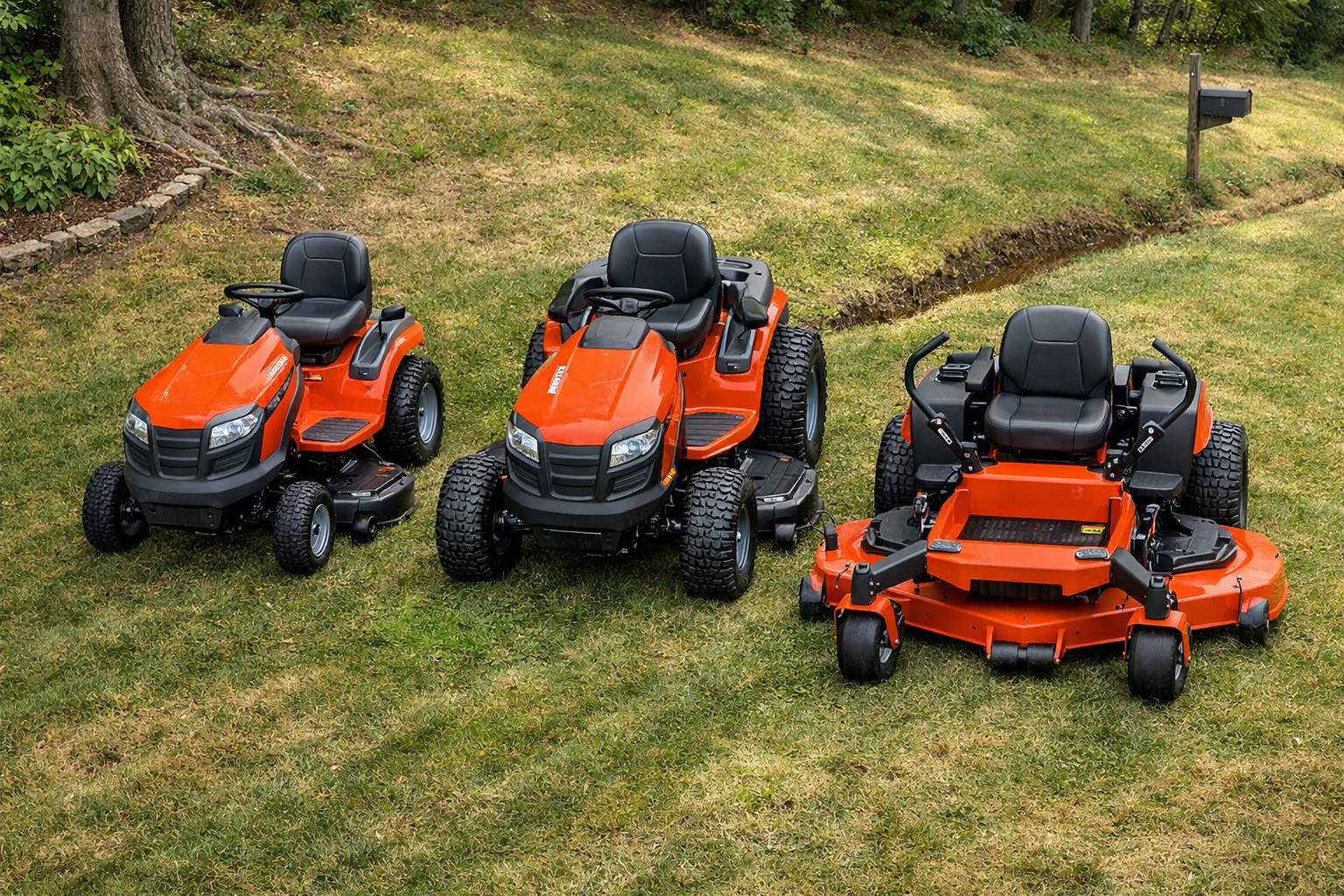
Husqvarna organizes its riding mowers into three distinct product families, and each one is built for a different job, not just a different budget. Knowing which family you’re shopping in matters more than comparing individual model numbers side by side.
YTH Series: The Standard Lawn Tractor
The YTH line is Husqvarna’s conventional lawn tractor lineup, with a front-mounted engine, rear-wheel drive, and a steering wheel setup familiar to anyone who’s driven a riding mower before. These are the models most homeowners picture when they think “riding mower.” Deck sizes in this line typically run from 42 to 54 inches, and engines range from around 18 to 24 horsepower depending on the model.
YTH tractors are the most affordable entry point into Husqvarna’s riding lineup, generally priced between $1,900 and $3,200. They handle flat to moderately sloped yards well, but they’re not designed for tight turning around obstacles or steep grades. A yard full of trees, flower beds, and property line curves will make a YTH tractor’s turning radius feel like a real limitation fast.
Z Series: Zero-Turn Maneuverability
The Z series covers Husqvarna’s zero-turn mowers, which use dual lap-bar or steering-wheel controls (depending on model) to pivot the rear wheels independently. This lets the mower turn in place, essentially on its own axis, instead of needing a wide arc like a tractor. Z series decks range from 42 inches on entry models up to 61 inches on commercial-grade units.
Zero-turns cost more than a YTH tractor of similar deck size, typically landing between $3,000 and $8,000 depending on engine and deck. But they cut mowing time by 20 to 30 percent on properties with lots of obstacles, because you’re not backing up and repositioning around every tree and mailbox. On a large, open lawn, that speed advantage matters less. On a half-acre lot with landscaping features, it matters a lot.
GTH and TS Series: Garden Tractors for Heavy Work
The GTH and TS lines are Husqvarna’s garden tractors, built heavier than the YTH series and rated for towing, tilling, and attachment work beyond basic mowing. These models run larger engines, often 24 horsepower and up, and use reinforced frames and transmissions to handle continuous load. Garden tractors in this range typically cost $2,800 to $4,500.
If your property includes a garden you till every spring, a cart you tow to haul mulch, or a small acreage that needs a snow blade in winter, a garden tractor earns its higher price. For a property that’s just lawn, though, a GTH model is more machine than you need, and you’ll pay for capability you never use.
Cutting Deck Size: Matching Width to Your Actual Yard
Deck size determines cutting width, and cutting width determines how many passes it takes to mow your yard, which is the single biggest factor in total mowing time. A 42-inch deck versus a 54-inch deck on the same size lawn can mean the difference between 45 minutes and 25 minutes per mow.
The math is straightforward: a wider deck covers more ground per pass, but it also gets harder to maneuver around tight corners, garden beds, and narrow gates. A 54-inch deck won’t fit through a standard 48-inch gate at all. Before you get excited about a bigger deck cutting your mow time down, measure your gates and the narrowest path between obstacles on your property.
Yard size should guide deck size more directly than most buyers assume. Husqvarna’s own model lineup reflects this: entry-level YTH models with 42-inch decks are aimed at properties under half an acre, while 54-inch decks on GTH tractors and larger Z series units target one acre and up.
Here’s a rough guide for matching deck width to property size:
Yard Size
Recommended Deck Width
Typical Mow Time (approx.)
Under 0.5 acre
42 inches
30-45 minutes
0.5 to 1 acre
46-48 inches
40-60 minutes
1 to 2 acres
50-54 inches
50-75 minutes
2+ acres
54-61 inches (zero-turn)
60-90 minutes
A yard with a lot of trees, beds, or fence lines will run longer than these estimates regardless of deck size, because obstacle density slows you down more than raw acreage does. That’s another reason a zero-turn often beats a tractor with a similar deck size on an obstacle-heavy lot: the turning radius, not the width, is what’s actually costing you time.
Don’t buy the biggest deck you can afford just because it sounds efficient. A 54-inch deck on a quarter-acre lot with a narrow side yard is a mower you’ll fight with every week.
Engine Options: Kawasaki, Briggs & Stratton, and Husqvarna-Branded Units
Not every Husqvarna riding mower runs a Husqvarna engine, and that surprises a lot of first-time buyers. Husqvarna sources engines from Kawasaki and Briggs & Stratton for many of its mid- and upper-tier models, alongside its own Husqvarna-branded engines on select tractors.
This matters for parts and service. A Kawasaki FR or FS series engine, common on higher-end Z series zero-turns, has parts and service support through Kawasaki’s small engine network in addition to Husqvarna dealers. A Briggs & Stratton Intek or Professional Series engine, common on entry and mid-tier YTH tractors, taps into one of the largest small-engine parts networks in the country, which usually means cheaper, faster-to-find replacement parts.
Horsepower Ratings Across the Lineup
Horsepower in Husqvarna’s lineup runs from about 17.5 HP on entry-level YTH tractors up to 26 HP or more on higher-end Z series and GTH models. Higher horsepower helps most when you’re running a wider deck, towing attachments, or mowing thick, tall grass, because the engine needs reserve power to keep blade speed consistent under load.
Here’s the correction worth making plainly: more horsepower does not mean faster or better mowing on a small yard. A 24 HP engine turning a 42-inch deck on a quarter-acre lot is not going to cut grass any better than an 18 HP engine on the same deck. It’ll just burn more fuel doing it. Horsepower needs to scale with deck width and workload, not stand alone as a bragging point on a spec sheet.
Fuel Tank Capacity and Runtime
Fuel tanks on Husqvarna riding mowers generally range from 2.5 to 5 gallons, depending on the model. Entry-level YTH tractors tend to sit around the 2.5 to 3-gallon mark, while larger Z series and GTH models often carry 4 to 5 gallons.
A larger tank means fewer refueling interruptions on big properties. On a 2-acre lot, a 2.5-gallon tank might run dry mid-mow, which is a genuine inconvenience nobody mentions until they’re standing next to a stalled mower with a gas can 100 yards away.
Transmission Types: Hydrostatic, Automatic, and Manual Gear Drive
Transmission type affects how the mower drives, how much daily effort it takes to operate, and how much it’ll eventually cost you in repairs. Husqvarna offers three main types across its lineup: hydrostatic, automatic (a simplified hydrostatic variant), and manual gear-drive.
Hydrostatic transmissions use fluid pressure to vary speed smoothly, with no clutching or shifting required. You just push a pedal, and speed adjusts continuously, forward or reverse. This is standard on Z series zero-turns and most mid-to-upper YTH and GTH models. It’s the smoothest and most convenient option to operate, especially on uneven terrain where you’re constantly adjusting speed.
Automatic transmissions on Husqvarna’s entry-level tractors work similarly to hydrostatic in that there’s no manual shifting, but they’re a simpler, less expensive design underneath. They’re common on budget YTH models and get the job done for flat, straightforward lawns without the added cost of a full hydrostatic system.
Manual gear-drive transmissions, found on the most basic entry-level tractors, require you to shift through fixed gear ranges like a manual car, minus the clutch pedal in most cases. They’re the least expensive to buy and often the least expensive to repair, since there are fewer moving parts and no hydraulic fluid system to fail. But they’re also the least convenient day to day, especially if your yard has varied terrain that calls for frequent speed changes.
A hydrostatic transmission uses a variable-displacement pump and hydraulic motor to change ground speed without gears or a clutch, giving continuously variable speed control in both forward and reverse.
For hilly or obstacle-heavy yards, hydrostatic is worth the extra cost. The constant speed adjustments you’ll make going up and down grades or around beds are far less tiring with a pedal-controlled hydrostatic system than with a gear-shift manual.
Attachments and Implements: What Each Series Can Actually Run
Attachments extend what a riding mower can do beyond cutting grass, but not every mower can run every attachment, and that’s tied directly to engine power and frame construction. Matching attachments to the right series avoids buying equipment your mower can’t actually handle.
Common Attachments by Series
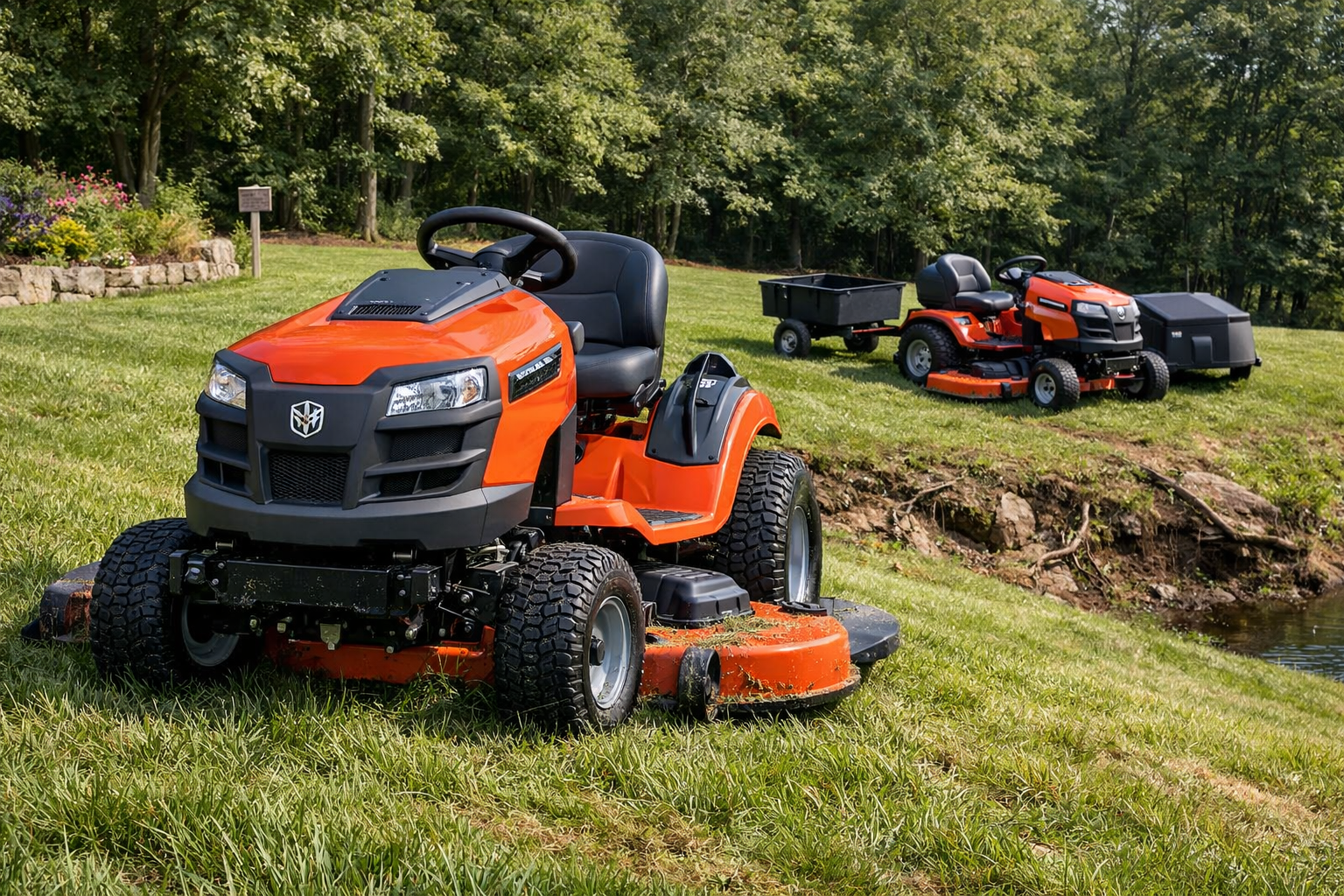
YTH tractors typically support a rear bagger for leaf and clipping collection, a tow-behind cart for hauling yard debris, and in some cases a front-mounted snow blade or plow. These attachments work fine within the tractor’s rated towing and load limits, but pushing a YTH tractor with a heavy-duty tiller or aerator attachment usually exceeds what the frame and transmission are built for.
GTH and TS garden tractors are the ones actually built for heavier implements: tillers, aerators, dethatchers, and heavier snow removal equipment. Their reinforced frames and higher-torque engines are designed with this kind of load in mind, which is the whole reason the garden tractor category exists separately from standard lawn tractors.
Z series zero-turns support baggers and occasionally a tow-behind cart, but they’re not built for heavy pulling or tilling attachments. Their frame geometry and independent-wheel steering system aren’t designed for the load and drag that heavier implements put on a hitch point.
A Practical Sequence for Choosing Attachments
If you’re planning to add attachments down the road, work through this order before you buy the mower itself:
List every task you want the mower to handle beyond mowing (bagging, hauling, snow removal, tilling).
Check each attachment’s weight and power requirement against the mower series’ rated towing capacity, usually listed in the owner’s manual or spec sheet.
Confirm the attachment is designed for that specific series, since Husqvarna attachments aren’t always cross-compatible between YTH, Z, and GTH lines.
Factor attachment cost into your total budget. Baggers typically run $150 to $400, and tow-behind carts run $100 to $300.
Buy the mower series rated for your heaviest planned attachment, not your lightest one.
Skipping step 5 is the most common mistake. Buying a YTH tractor because it’s cheaper, then discovering the tiller you wanted needs a GTH-rated frame, means either an unhappy compromise or a second purchase.
Price Range by Model Tier: What You’re Actually Paying For
Husqvarna riding mowers span roughly $1,900 to $8,000, and the differences between tiers aren’t just cosmetic. Each price jump generally buys you a heavier frame, a better transmission, a larger deck, or a more capable engine, sometimes all four at once.
Entry-level YTH tractors with 42-inch decks and automatic or manual transmissions sit at the bottom, typically $1,900 to $2,600. Mid-tier YTH models with hydrostatic transmissions and larger decks run $2,600 to $3,200. GTH garden tractors, built for towing and heavier implements, land between $2,800 and $4,500. Z series zero-turns start around $3,000 for entry models and climb to $8,000 for commercial-grade units with 61-inch decks and Kawasaki engines.
Model Tier
Typical Price Range
Deck Size
Transmission
Entry YTH
$1,900 – $2,600
42 inches
Manual or automatic
Mid YTH
$2,600 – $3,200
46-48 inches
Hydrostatic
GTH/TS Garden Tractor
$2,800 – $4,500
48-54 inches
Hydrostatic
Entry Z Series
$3,000 – $4,500
42-48 inches
Hydrostatic
Commercial Z Series
$5,000 – $8,000
54-61 inches
Hydrostatic
Price alone tells you almost nothing without matching it to terrain and yard layout. A $2,500 YTH tractor is a fine value on a flat, open half-acre lot. That same tractor on a hilly quarter-acre with retaining walls, tight turns, and drainage ditches will spend more time in the shop, chewing through belts, spindles, and steering components, than it spends cutting grass. In that scenario, a $4,000 zero-turn with better maneuverability and a simpler deck-to-ground relationship on slopes is often the cheaper option over five years, even though it costs more upfront.
Terrain, Yard Size, and Long-Term Maintenance: The Real Deciding Factors
This is where most Husqvarna comparisons fall short: they treat terrain as an afterthought instead of the primary variable. Two properties can be the exact same acreage and need completely different mowers because one is flat and the other is full of slopes, roots, and tight corners.
Matching Terrain to Mower Type
Flat, open lawns under an acre are well-served by a mid-tier YTH tractor with a hydrostatic transmission. There’s no maneuverability advantage a zero-turn offers that justifies the extra cost on that kind of property.
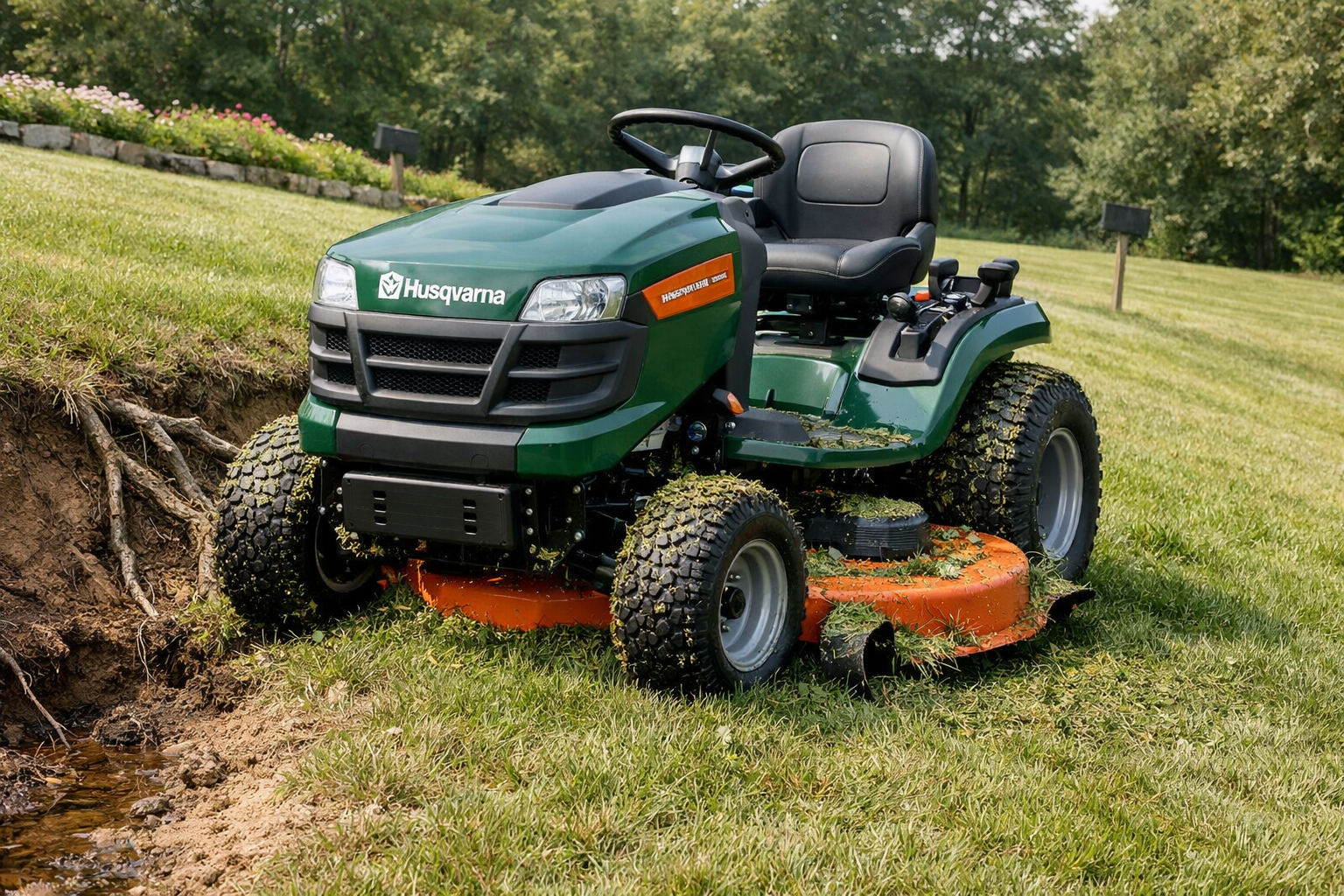
Hilly or uneven terrain changes the calculation entirely. Lawn tractors have a higher center of gravity and a wider turning radius, both of which become liability points on slopes over roughly 15 degrees. Husqvarna, like most manufacturers, generally advises against mowing slopes steeper than 15 degrees with a riding mower at all, tractor or zero-turn, and recommends mowing across a slope rather than up and down it when it’s within that range.
Obstacle-heavy yards, meaning lots of trees, beds, and irregular borders, are where a zero-turn’s turning radius pays for itself. You’ll spend less time backing up and repositioning, and less wear accumulates on steering components from constant tight-radius turning that a tractor’s front axle wasn’t really designed for.
Maintenance and Parts Availability
Maintenance cost and parts availability should factor into the purchase decision as much as the sticker price does. A mower with a Briggs & Stratton or Kawasaki engine benefits from parts networks that extend well beyond Husqvarna dealers, which usually means shorter wait times and lower part prices for filters, spark plugs, and belts.
Husqvarna-branded engines and deck components, on the other hand, often route parts orders through Husqvarna dealers specifically, which can mean longer lead times in a busy spring season. Deck belts, spindle assemblies, and hydrostatic transmission fluid are the parts you’ll replace most often across any riding mower’s life, typically every 2 to 3 seasons of regular use, so check local dealer stock and pricing on these specific parts before buying, not just the mower’s advertised price.
For anyone doing their own wrench work, a site like The Mowers Guide is worth bookmarking for model-specific troubleshooting once you’ve settled on a Husqvarna model, since belt routing, deck leveling, and transmission fluid specs vary enough between YTH, Z, and GTH series that generic advice often doesn’t apply cleanly.
Rough terrain amplifies whatever your mower’s weak points already are. A tractor with a marginal steering assembly will show it faster on uneven ground than on a flat lawn, and that’s the maintenance burden that rarely shows up in a showroom comparison.
Frequently Asked Questions
Is a Husqvarna riding mower better than a zero-turn for a small yard?
For yards under half an acre with few obstacles, a YTH lawn tractor is usually the better value, since a zero-turn’s speed advantage barely matters at that size. On obstacle-heavy small lots, a zero-turn’s turning radius still saves real time despite the higher price.
Do all Husqvarna riding mowers use Husqvarna engines?
No. Many models use Kawasaki or Briggs & Stratton engines, particularly in the Z series and mid-tier YTH tractors. Husqvarna-branded engines appear mainly on select tractor models, so check the spec sheet rather than assuming based on the brand name.
How long do Husqvarna riding mower engines typically last?
With regular oil changes, filter replacement, and blade maintenance, most Husqvarna riding mower engines run 500 to 1,000 hours before needing major work, roughly 8 to 12 years for typical residential use. Neglected maintenance cuts that lifespan significantly, especially on hydrostatic transmissions.
What’s the difference between the GTH and TS garden tractor lines?
Both are built for heavier towing and implement work, but the TS series generally sits at a higher horsepower and torque tier than GTH models, aimed at larger properties with frequent tilling, aerating, or hauling needs beyond basic mowing.
Bermuda grass seed needs soil temperatures of 65°F or higher at a 2-inch depth before it will germinate reliably, and full germination can take 21 to 28 days compared to the...
People are turning to sustainable lawn care trends to reduce water use and improve soil health. The latest lawn care trends include native landscaping, precision mowing, and high-tech solutions like robotic...
10 December 2024
The Mowers Guide is reader-supported. When you buy through links on our site, we may earn an affiliate commission.





Comments are closed.