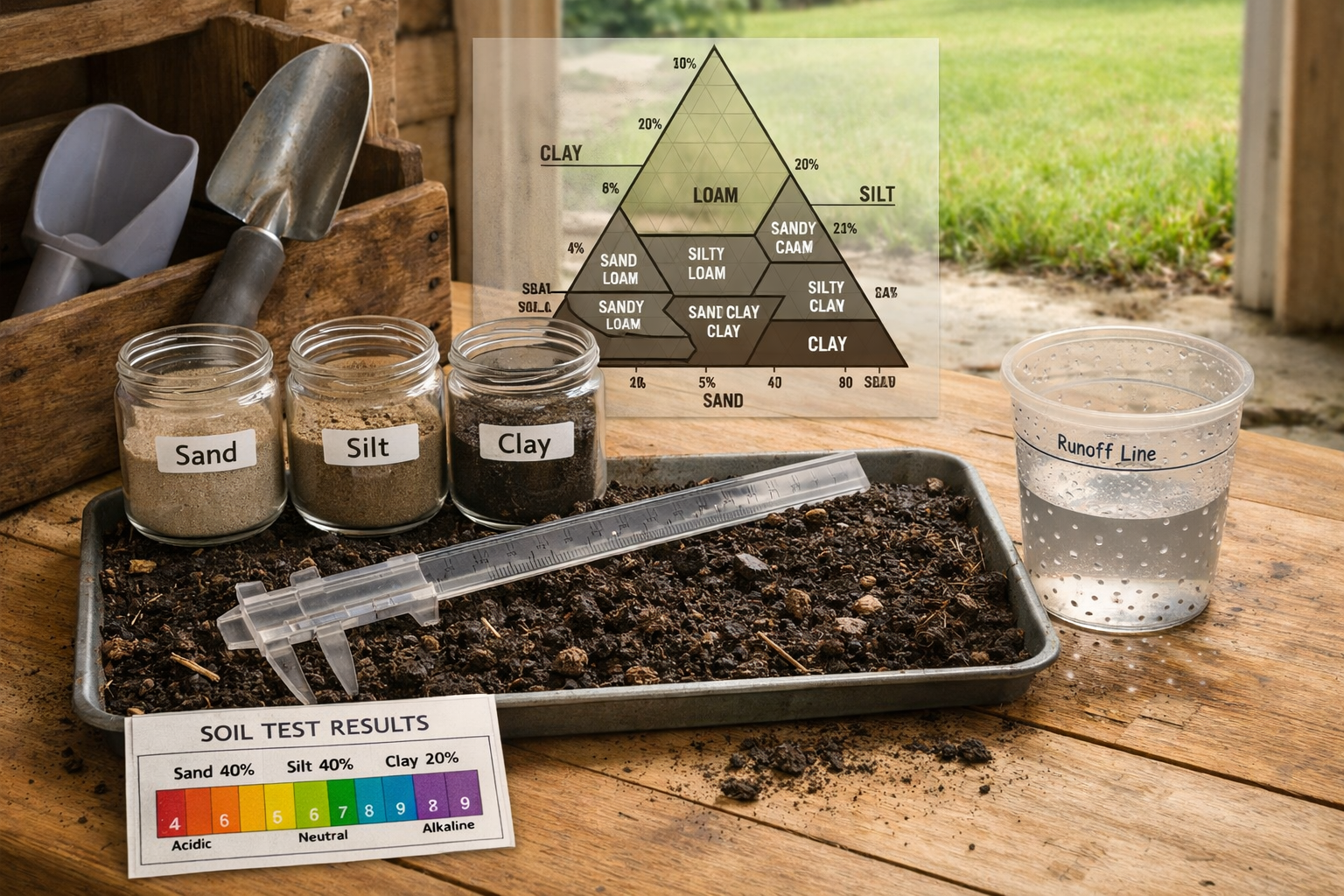
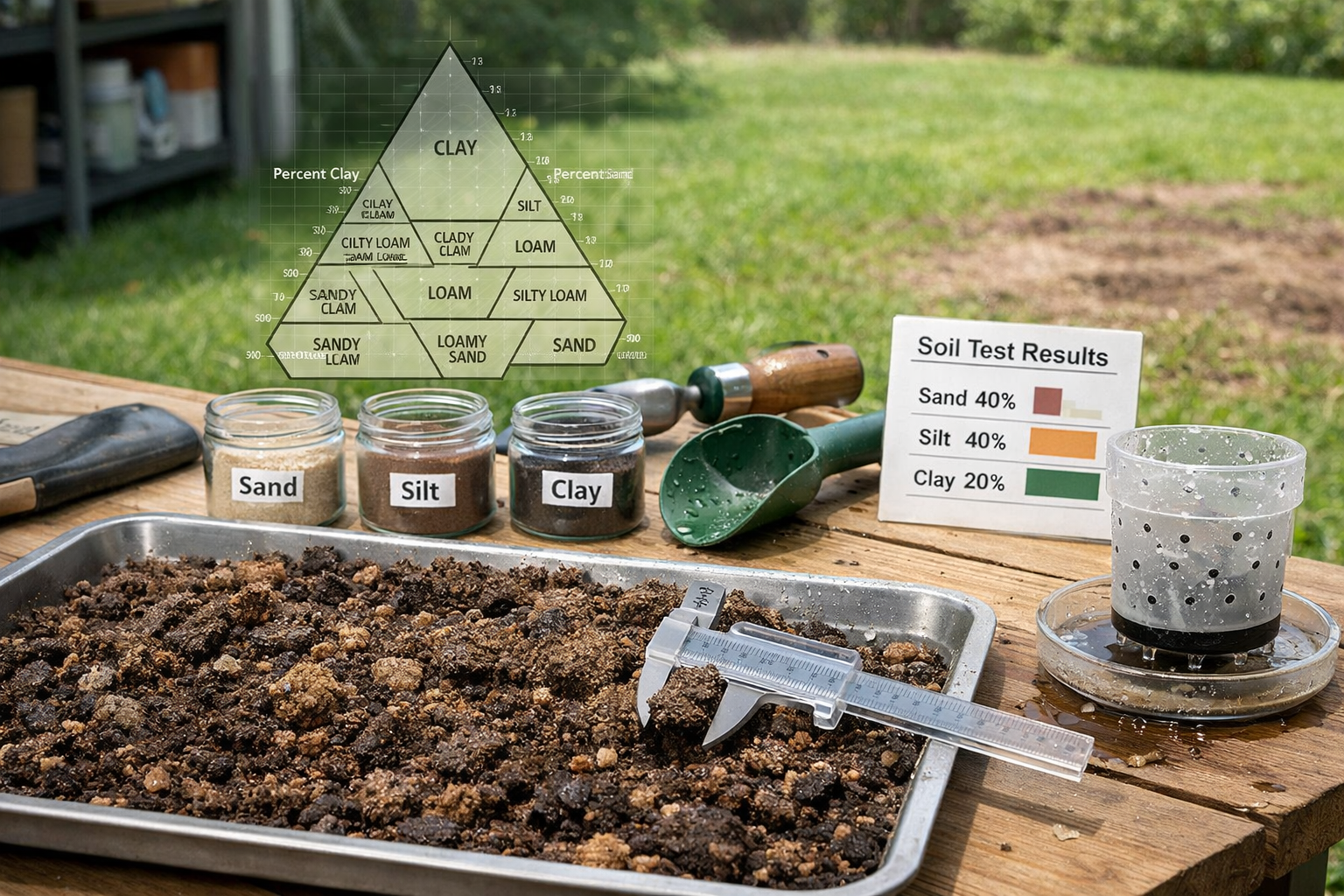
The USDA soil texture triangle defines loam as a specific mix: roughly 40% sand, 40% silt, and 20% clay. That precise balance is why agronomists and turf specialists treat it as the benchmark soil for growing anything, including a home lawn. If you’re asking what is loam soil because your grass is patchy or your mower keeps sinking in wet spots, the answer starts with that ratio and ends with what it does to your yard’s drainage, root depth, and mowing conditions.
What Is Loam Soil, Exactly?
Loam soil is a balanced mixture of sand, silt, and clay particles, roughly 40-40-20 by percentage, that combines the drainage of sand, the nutrient-holding of clay, and the moisture retention of silt. No single particle type dominates, which is exactly why it behaves so well under turfgrass.
Soil scientists classify texture using three particle sizes. Sand particles range from 0.05 to 2.0 millimeters, are gritty, and drain fast because water moves easily through the gaps between them. Silt particles are smaller, between 0.002 and 0.05 millimeters, feel smooth like flour when dry, and hold more water than sand. Clay particles are smaller still, under 0.002 millimeters, and pack tightly enough to hold both water and nutrients, sometimes too well.
Loam: soil composed of a relatively even mixture of sand, silt, and clay, classified by the USDA soil texture triangle as containing about 7-27% clay, 28-50% silt, and less than 52% sand.
That definition matters because loam isn’t a marketing term. It’s a measured classification. A bag labeled “garden soil” or “loam” at a home center may or may not match that ratio, which is one reason testing your own yard beats trusting a label.
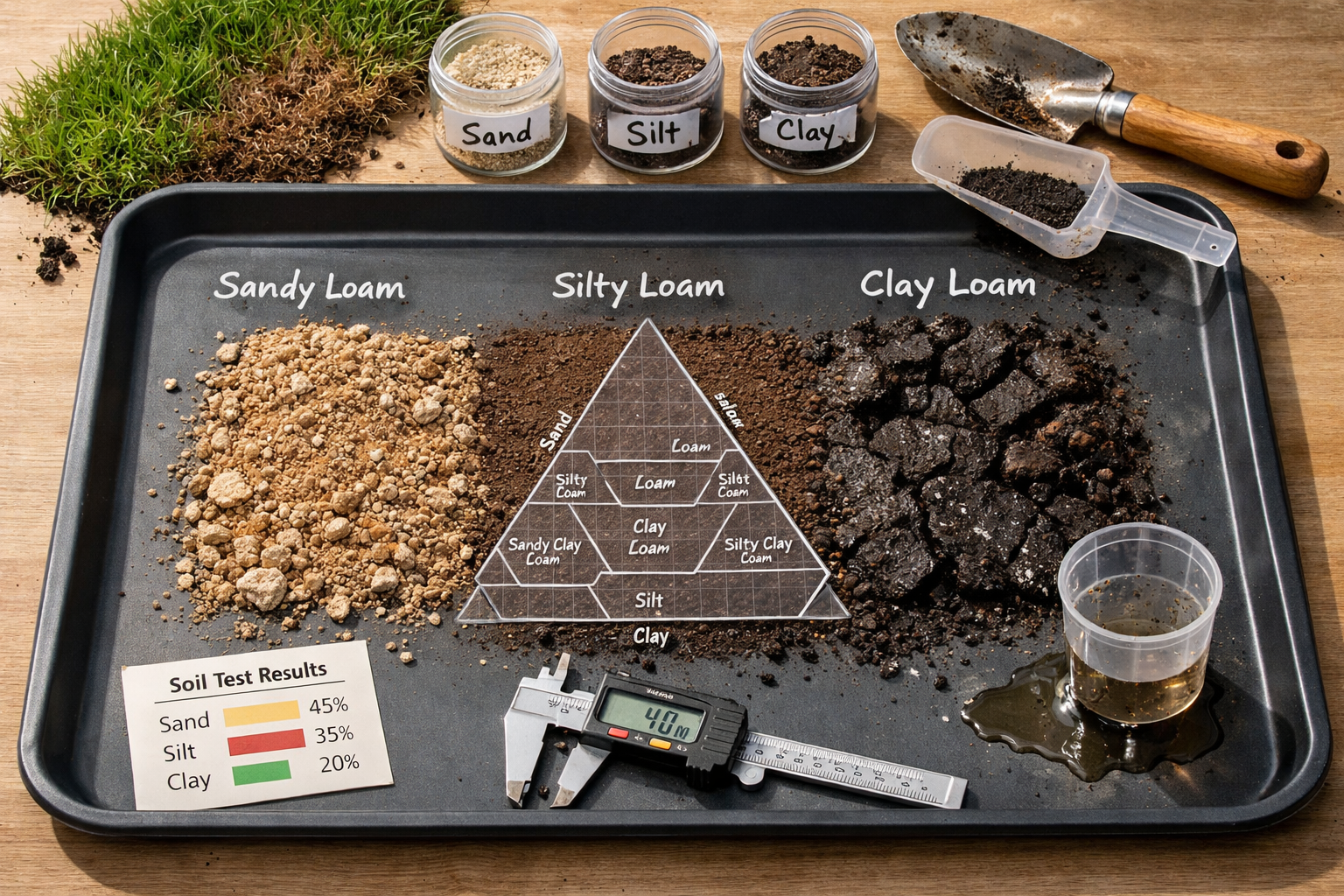
The texture triangle itself is a tool soil labs and county extension offices use daily. You plot your sand, silt, and clay percentages on the triangle’s three axes, and wherever those lines intersect tells you the textural class: sandy loam, silty clay, clay loam, and so on. Loam sits near the center, which is the point.
Here’s the part that trips people up: loam is defined by particle-size ratio, not color or feel alone. Dark, crumbly-looking soil can still be heavy in clay. You need an actual texture read to know what you have.
Grass doesn’t care what your soil looks like. It cares whether roots can push down, whether water sticks around long enough to be useful, and whether nutrients stay put instead of washing out. Loam checks all three boxes better than any single-particle soil.
Why Grass and Mowers Both Perform Better on Loam
Loam soil supports deeper grass roots, more even mowing conditions, and better mower traction than sandy, clayey, or silty soils. Roots in loam can extend 6 to 8 inches or more because the soil isn’t so dense it blocks penetration, and isn’t so loose it can’t hold the root in place.
Root depth is the number that predicts almost everything else about lawn health. Deeper roots reach more stored water and nutrients, which means the lawn tolerates dry spells without going brown as fast. In compacted clay, roots often stall out around 2 to 3 inches because the soil is too dense for the root tips to push through. In pure sand, roots go deep but the plant still struggles because water and nutrients drain past the root zone before the grass can use them.
How Soil Type Changes Mowing Height Decisions
Lawns on loam tolerate a wider range of mowing heights because the root system underneath is more resilient. On clay soil, scalping risk goes up. Shallow roots mean there’s less of a buffer if your deck height is off by even half an inch, and clay’s tendency to hold surface water can leave the crown of the grass sitting slightly proud, right where the blade catches it.
Sandy soil creates the opposite problem. Grass on sand often shows stress faster between waterings, and mowing too short compounds that stress by removing leaf area the plant needs to keep photosynthesizing during dry stretches. A general rule for most cool-season lawns is to never remove more than one-third of the blade height in a single cut, but on sandy soil that rule matters even more, since the plant has less of a moisture cushion to fall back on.
Mower Traction and Wheel Sink: The Overlooked Factor
Here’s the connection generic lawn care advice skips: soil texture directly affects how your mower handles the yard. Clay soil that’s wet holds water at the surface, and a riding mower or tractor can leave visible wheel ruts, sometimes an inch or more deep, because the compacted clay doesn’t let water drain into lower layers fast enough.
Sandy soil causes a different problem: wheel sink and traction loss, especially on slopes, because loose sand doesn’t give the tire tread anything firm to bite into. Loam splits the difference. It’s firm enough to support the mower’s weight without deep compaction, and it drains fast enough that you’re not fighting standing water on the surface after a normal rain.
If you’ve ever noticed your mower struggling for grip in one corner of the yard but not another, that’s often a soil texture difference within the same lawn, not a mower problem.
Soil Composition: Reading the Sand-Silt-Clay Ratio
The three-particle system (sand, silt, clay) determines almost every physical property of a soil: how it drains, how it holds nutrients, how it compacts, and how roots move through it. Loam’s advantage comes from proportion, not from any single ingredient being special.
Sand’s large particle size creates large pore spaces. Water moves through those pores quickly, which is good for drainage but bad for water retention. A lawn growing in soil that’s more than 70% sand, classified as sandy soil rather than sandy loam, often needs watering twice as often as one on loam during summer, because the water simply isn’t sticking around.
Clay’s tiny particles pack together with almost no air space between them. That’s why clay holds water and nutrients so well; there’s nowhere for either to escape to quickly. The tradeoff is compaction. Heavy clay compacts under foot traffic, mower weight, or even hard rain, squeezing out the oxygen roots need. A soil that’s more than 40% clay drains so slowly that puddles can sit for a day or more after a storm.
Silt behaves like a middle ground on its own, but it has a quirk: silt-heavy soils can seal at the surface, forming a light crust after rain that reduces how much water infiltrates on the next watering. That’s part of why silty soil alone isn’t the answer, and why blending matters more than any single particle type.
Soil Type
Sand %
Silt %
Clay %
Drainage Speed
Nutrient Holding
Sandy
70-100%
0-30%
0-10%
Fast (poor retention)
Low
Silty
0-20%
80-100%
0-12%
Moderate, can crust
Moderate
Clay
0-45%
0-40%
40-100%
Slow, poor drainage
High
Loam
23-52%
28-50%
7-27%
Balanced
Good
Loam’s percentages aren’t a single fixed number, which is worth remembering. The texture triangle allows a range, so two soils can both be classified as loam and still behave slightly differently depending on where they fall within that range.
Types of Loam: Sandy, Silty, and Clay Loam Compared
Not all loam behaves the same way, and treating “loam” as one uniform product is a common mistake. The USDA recognizes several loam subclasses depending on which particle type leans slightly higher within the loam range, and each one has different implications for a lawn.
Sandy Loam
Sandy loam contains enough extra sand to drain fast and warm up early in spring, which is why it’s often favored for lawns in wetter climates or areas prone to spring flooding. The tradeoff is that it dries out faster in summer, so a lawn on sandy loam typically needs more frequent, lighter watering than one on straight loam.
Silty Loam
Silty loam holds moisture better than sandy loam and feels smooth rather than gritty when you rub it between your fingers. It’s common in river valley regions with historic flood deposits. The risk here is surface crusting after heavy rain, which can reduce how much water and air reach the root zone if you don’t aerate periodically.
Clay Loam
Clay loam leans toward the clay side of the range, holding more nutrients but draining more slowly than sandy or silty loam. Lawns on clay loam benefit from core aeration more often, generally once a year in fall, to counter the natural tendency toward compaction under regular mower traffic.
Knowing which loam subtype you have changes practical decisions: how often you water, whether you aerate once or twice a year, and how much organic matter you’d want to work in if drainage feels sluggish. Two neighbors with “loam” listed on their soil test can still need different lawn care routines.
Testing Your Own Soil Type at Home
You don’t need a lab to get a working answer to what is loam soil in your own yard. A simple jar test, run over 24 to 48 hours, gives you a visual read on your sand-silt-clay ratio using nothing but a mason jar, water, and dish soap.
Here’s the process most extension offices recommend for a do-it-yourself texture check:
Dig a soil sample from 4 to 6 inches deep, avoiding the top inch of thatch or mulch.
Break up clumps and remove rocks, roots, or grass, then fill a clear quart jar about one-third full with the sample.
Add water until the jar is nearly full, plus one teaspoon of dish soap to help particles separate.
Shake the jar hard for 2 to 3 minutes, then set it on a flat surface and don’t disturb it.
Mark the layers at 1 minute (sand has settled), 2 hours (silt has settled), and 48 hours (clay has fully settled).
Measure the height of each layer and divide by the total height to get rough percentages.
Compare your percentages against a soil texture triangle to find your classification.
This method won’t give you lab-grade precision, but it’s accurate enough to tell you whether you’re dealing with something close to loam or something clearly skewed toward sand or clay. For a more exact reading, including pH and nutrient content, a local university extension office typically offers soil testing for $10 to $30, and results usually come back within two to three weeks.
Don’t confuse this texture test with a pH test strip or a basic nutrient kit from a hardware store. Those tell you chemistry, not particle composition. You need the jar test, or a lab texture analysis, to answer the structural question of what your soil actually is.
Nutrient Content, Organic Matter, and Soil pH
Texture is only half the loam story. The other half is chemistry: organic matter content, nutrient availability, and pH, all of which interact with texture to determine how well grass actually grows.
Good loam typically carries 3% to 5% organic matter by weight, from decomposed roots, thatch, and microbial activity. Organic matter acts almost like glue, binding sand, silt, and clay particles into small clumps called aggregates. Those aggregates create pore space for air and water even in soils that lean slightly heavier on clay, which is part of why organic matter is often the fastest lever homeowners can pull to improve a soil’s behavior without changing its underlying texture class.
Most turfgrasses grow best in a soil pH range of 6.0 to 7.0, slightly acidic to neutral. Loam doesn’t guarantee correct pH; a loam soil can still test at 5.2 or 7.8 depending on regional geology, past fertilizer use, or nearby concrete and masonry leaching lime into the soil over years. A pH test, either through a home kit or the same extension lab that runs your texture test, tells you whether nutrients already in the soil are actually available to grass roots. Iron and phosphorus, for example, become harder for roots to absorb once pH climbs above 7.5, even if the soil test shows plenty of both nutrients present.
This is where a common misconception causes real damage: assuming that dark, rich-looking soil is automatically loam, or automatically fertile. Dark color often comes from organic matter or moisture content, not texture. You can have dark clay that’s dense, poorly drained, and still needs amendment. A quick way to check yourself: if a shovel goes in easily to 6 inches when the soil is moist but not wet, and the soil crumbles rather than forming a slick ribbon, that’s a decent field sign of loam-like texture, but it’s not a substitute for the jar test.
Amending Soil to Build Something Closer to Loam
You can’t change your fundamental sand-silt-clay ratio overnight, but you can shift a struggling lawn’s soil meaningfully closer to loam-like behavior over one to two growing seasons through consistent organic matter additions. This is where most DIY lawn improvement projects actually live.
Fixing Clay-Heavy Soil
For clay-heavy lawns, the standard approach is topdressing with compost, applied at roughly a quarter-inch layer after core aeration, once or twice a year. Aeration first is not optional here; without the holes an aerator creates, compost mostly sits on the surface instead of working into the compacted layer where it’s needed. Avoid the old advice of adding straight sand to clay soil. Mixed in the wrong ratio, sand and clay can bind into something closer to concrete than loam, a mistake that’s hard to undo once it sets.
Fixing Sandy Soil
Sandy lawns benefit from the same compost topdressing strategy, plus occasionally working in peat moss or aged manure to boost water-holding capacity. Because sandy soil drains so fast, organic matter breaks down and washes through faster too, so expect to repeat topdressing annually rather than treating it as a one-time fix.
It’s worth correcting another assumption here: loam soil, once established, still needs upkeep. Organic matter depletes over time from mowing, foot traffic, and natural decomposition, typically losing some percentage of its organic content every few years without replenishment. Even a lawn sitting on naturally good loam benefits from annual compost topdressing and occasional aeration to keep that structure from drifting back toward compaction.
If you’re working through a soil improvement plan for the first time, pairing a texture test with a basic pH test gives you the clearest picture of where to start, and a resource like themowersguide.com is a reasonable place to cross-check aeration timing against your specific grass type before you commit to a schedule.
Realistic expectations matter here. Amending soil is a gradual process, not a weekend fix. A heavily compacted clay lawn typically needs two full seasons of aeration and topdressing before the difference is obvious underfoot, let alone in root depth.
Frequently Asked Questions
Is loam soil the same as topsoil?
No. Topsoil is simply the uppermost layer of soil, regardless of its sand-silt-clay ratio, while loam is a specific texture classification. Bagged topsoil can be loam, clay-heavy, or sandy depending on where it was sourced.
Can I buy loam soil instead of testing my yard?
You can buy bagged or bulk “loam,” but quality varies widely between suppliers, and there’s no regulation guaranteeing the bag matches the USDA texture definition. Run a jar test on any purchased loam before spreading it over an existing lawn.
How long does it take to improve clay soil toward loam?
Expect one to two growing seasons of consistent aeration and compost topdressing before you notice a real difference in drainage and root depth. Full textural change, if it happens at all, can take several years of consistent organic matter input.
Does loam soil need fertilizer if it’s already balanced?
Yes. Loam’s balanced texture affects drainage and root access to nutrients, but it doesn’t create nutrients on its own. Grass growing in loam still needs a regular fertilizing schedule based on a current soil nutrient test, not just texture.
What Are Zero-Turn Mowers and Why Choose John Deere John Deere has spent over 185 years earning the trust of landowners, farmers, and lawn care professionals — and their zero-turn mowers...
Forget the spec sheets for a second. What actually matters is whether the mower you buy matches the lawn you own. A quarter-acre flat yard and a hilly half-acre lot need...
22 August 2026
The Mowers Guide is reader-supported. When you buy through links on our site, we may earn an affiliate commission.





Comments are closed.