Forget the spec sheets for a second. What actually matters is whether the mower you buy matches the lawn you own. A quarter-acre flat yard and a hilly half-acre lot need two completely different machines, and the best walk-behind push mower for one is often a poor fit — or a waste of money — for the other.
This guide breaks down real 2026 options by lawn size, terrain, and how much yard work you actually want to do, not just by horsepower and price tag.
Match the Mower to Your Lawn, Not the Ad Copy
Most roundups rank mowers by price and horsepower alone. That’s backwards. The right question is: how big is your lawn, how bumpy is it, and how much sweat are you willing to trade for a lower price?
Lawn Size Changes Everything
A push mower with a 21-inch deck works fine on anything under a third of an acre. Once you cross into a half-acre or more, that same mower turns a 20-minute chore into an hour of walking back and forth. At that size, a self-propelled model with a wider 22-inch deck starts paying for itself in saved time.
Terrain Isn’t the Dealbreaker You Think It Is
Here’s a common myth: people assume push mowers can’t handle hills. That’s not true. Plenty of gas push mowers and even some battery models handle moderate 10-15 degree slopes just fine, as long as the tires have real tread and the deck height adjusts easily. Steep terraced yards are a different story — that’s when a self-propelled or rear-wheel-drive mower earns its keep, since it pulls itself uphill instead of making your legs do it.
Effort Tolerance Is the Missing Variable
Some homeowners genuinely don’t mind pushing a mower for 45 minutes on a Saturday. Others want the job done in 15 minutes with minimal fuss. Be honest about which one you are before you spend $400 on a mower that either bores you or wears you out.
Gas, Battery, Corded, or Reel: Which Power Source Actually Fits Your Yard
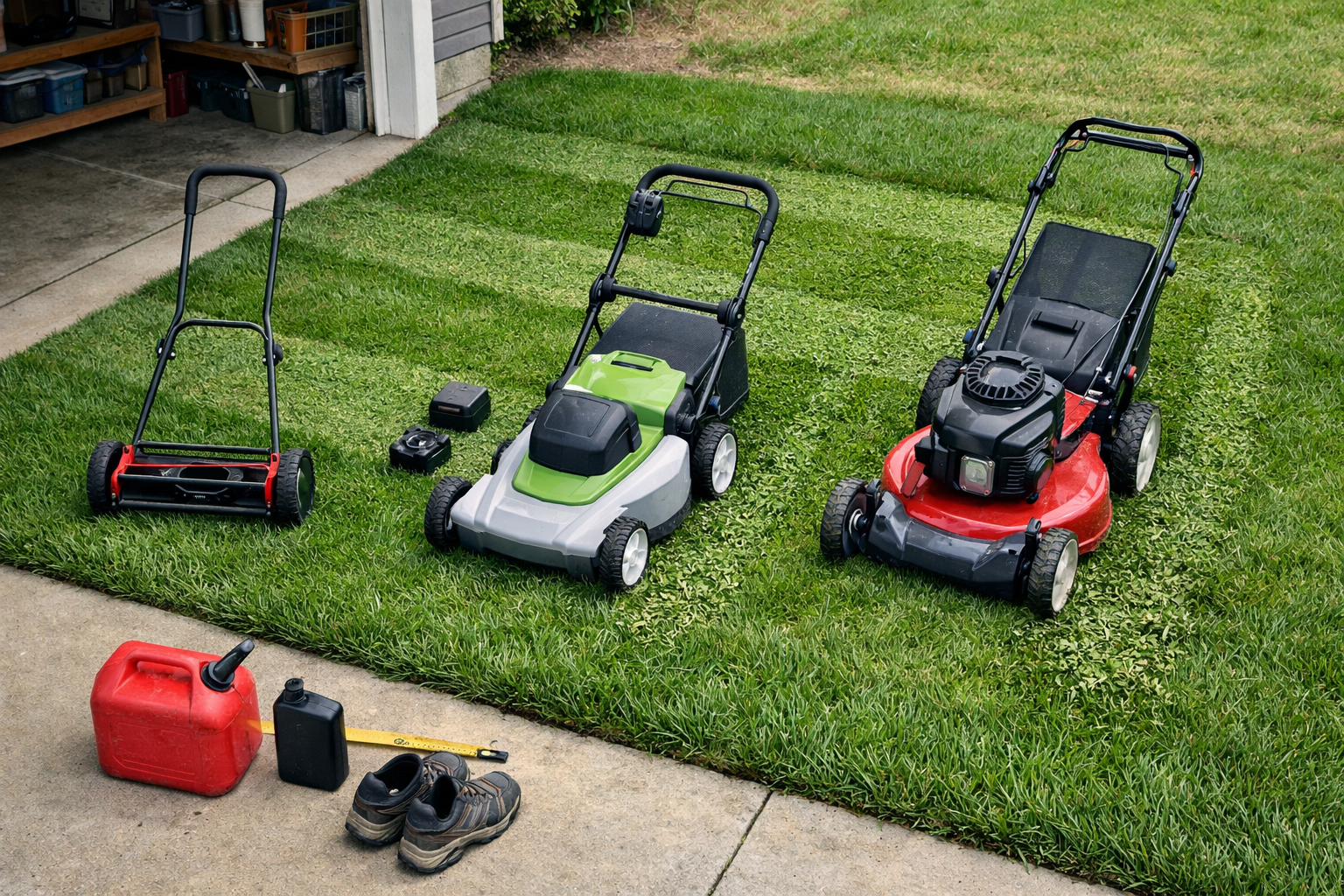
Power source decides your ongoing costs and your weekend routine more than any other spec. Gas still wins on raw runtime, battery wins on quiet convenience, and reel mowers win on price and simplicity for tiny lawns.
Gas Push Mowers Still Make Sense for Bigger Yards
A gas mower with a 150cc to 170cc engine (common in models from Honda and Toro) cuts through thick grass without stalling and never worries about battery charge. Expect to spend on gas, oil changes every 25 hours of use, and annual blade sharpening. Upfront prices run $300-$500, but ongoing costs of roughly $40-$60 a year in fuel and oil add up over a mower’s 8-10 year lifespan.
Battery-Electric Push Mowers Are the Right Call Under Half an Acre
Battery mowers from Greenworks, Toro, and Craftsman now commonly ship with 60V or 80V systems that run 40-60 minutes per charge. That’s plenty for a quarter-acre lawn, but overlooking battery runtime is the biggest mistake buyers make with bigger yards — anything over half an acre may need a second battery, adding $150-$250 to the real cost.
Corded Electric and Reel Mowers Cover the Small-Lawn Niche
Corded electric mowers are cheap ($150-$250) and never run out of power, but the cord limits you to yards near an outlet. Reel mowers, the manual push kind with spinning blades and no motor, cost under $150 and work well on small, flat lawns for people who want exercise and zero maintenance costs beyond an occasional blade adjustment.
Deck Width, Horsepower, and Mulching: What the Numbers Actually Mean
Higher horsepower doesn’t automatically mean a better cut. Blade sharpness and deck design matter more than raw engine power, and a dull blade on a powerful mower still tears grass instead of slicing it.
Deck width decides how many passes your lawn takes. A 21-inch deck needs more trips across a half-acre than a 22-inch deck, but width past 22 inches starts getting hard to maneuver around trees and flower beds in a typical suburban yard.
Mulching capability matters more than most buyers realize. A good mulching mower chops clippings fine enough to feed the soil, cutting down on fertilizer costs over a season. Bagging is better if you’re dealing with heavy leaf litter in fall or a lawn with a lot of clover and weed seed you don’t want spreading back.
A mulching mower is one that finely chops grass clippings and redistributes them into the lawn instead of collecting them, returning nitrogen and organic matter to the soil.
Feature
Push Mower (Gas)
Self-Propelled (Gas)
Battery-Electric
Typical deck width
21 in
22 in
20-21 in
Engine/battery
150-170cc
160-190cc
60-80V
Best lawn size
Under 1/3 acre
1/3 to 3/4 acre
Under 1/2 acre
Upfront price
$300-$500
$450-$700
$350-$600
Annual upkeep
$40-$60
$50-$70
Under $10
A Practical Way to Pick Without Overthinking It
Don’t start with brand names. Start with your yard, your slope, and how much noise or maintenance you’re willing to tolerate.
Measure your lawn (or check your property survey) to get square footage or acreage.
Walk the lawn and note any slopes steeper than 15 degrees or tight corners around beds.
Decide if you want bagging, mulching, or side discharge based on how much leaf and clipping debris you deal with.
Set a real budget that includes fuel, oil, or a spare battery — not just the sticker price.
9pt5. Test-push a self-propelled model at a hardware store if your lawn is over half an acre; the drive difference is noticeable in the first ten feet.
Pick a brand with solid local parts availability (Honda, Toro, Craftsman, and Greenworks all have wide dealer networks) so repairs don’t turn into a shipping wait.
Once you’ve run through that list, the “best” mower usually becomes obvious. It’s rarely the one with the biggest engine number on the box.
Maintenance costs get ignored constantly in these comparisons, and that’s a mistake. A $300 gas mower that needs a $40 annual tune-up, oil changes, and a $15 blade sharpening every season costs more over five years than a $500 battery mower that needs almost nothing beyond a battery replacement down the line. If troubleshooting a specific model’s starting issue or blade wobble comes up later, a site like The Mowers Guide keeps model-specific repair walkthroughs that save a trip to the shop.
Frequently Asked Questions
What’s the best walk-behind push mower for a small suburban lawn?
For lawns under a quarter-acre, a battery-electric push mower with a 20-21 inch deck is the best pick. It’s quiet, needs no gas or oil, and 40-60 minutes of runtime is plenty for that size.
Can a push mower handle a hilly yard?
Yes, most gas push mowers manage slopes up to 15 degrees fine if the tires have good tread. Anything steeper or terraced really calls for a self-propelled or rear-wheel-drive model instead.
Is a higher horsepower mower always a better cut?
No. Blade sharpness and deck design affect cut quality more than horsepower. A dull blade on a high-horsepower engine still tears grass instead of cutting it cleanly.
Brown patches showing up on your St. Augustine lawn even though you’re watering it every single day? That’s the first clue something’s off with your routine. Good care of St. Augustine...
Learn how to sharpen mower blades with my easy step-by-step guide. Discover tools, techniques, and safety tips for maintaining your lawn mower and achieving a perfect cut.
1 May 2025
The Mowers Guide is reader-supported. When you buy through links on our site, we may earn an affiliate commission.





Comments are closed.