Pop the hood, grab a drain pan, and stop guessing which oil goes in your Honda mower. Changing oil Honda lawn mower engines require isn’t complicated, but it isn’t identical across every model either. Some Honda mowers have a simple drain plug on the bottom of the engine. Others make you tilt the deck or drain straight through the dipstick tube, and using the wrong method just wastes your time and makes a mess on the garage floor.
Know Your Honda Engine Before You Touch a Wrench
Honda’s small engines aren’t all built the same, and that’s the part most quick-tip articles skip. The GCV160 and GCV190 engines found on most residential push mowers use a dipstick-tube draining method as the factory-recommended approach, not a bottom drain plug. Some commercial-grade or higher-displacement Honda engines do have a separate drain plug, but assuming yours has one before checking is how people strip bolts looking for something that isn’t there.
Check the Engine Model Tag First
Look on the side of the engine shroud, near the air filter housing, for a small metal or plastic tag listing the model number (something like GCV160 or GCV190). This five-second check tells you whether you’re dealing with a dipstick-drain design or a plug-style engine, and it saves you from flipping the mower over for nothing.
Dipstick-Tube vs. Drain Plug Design
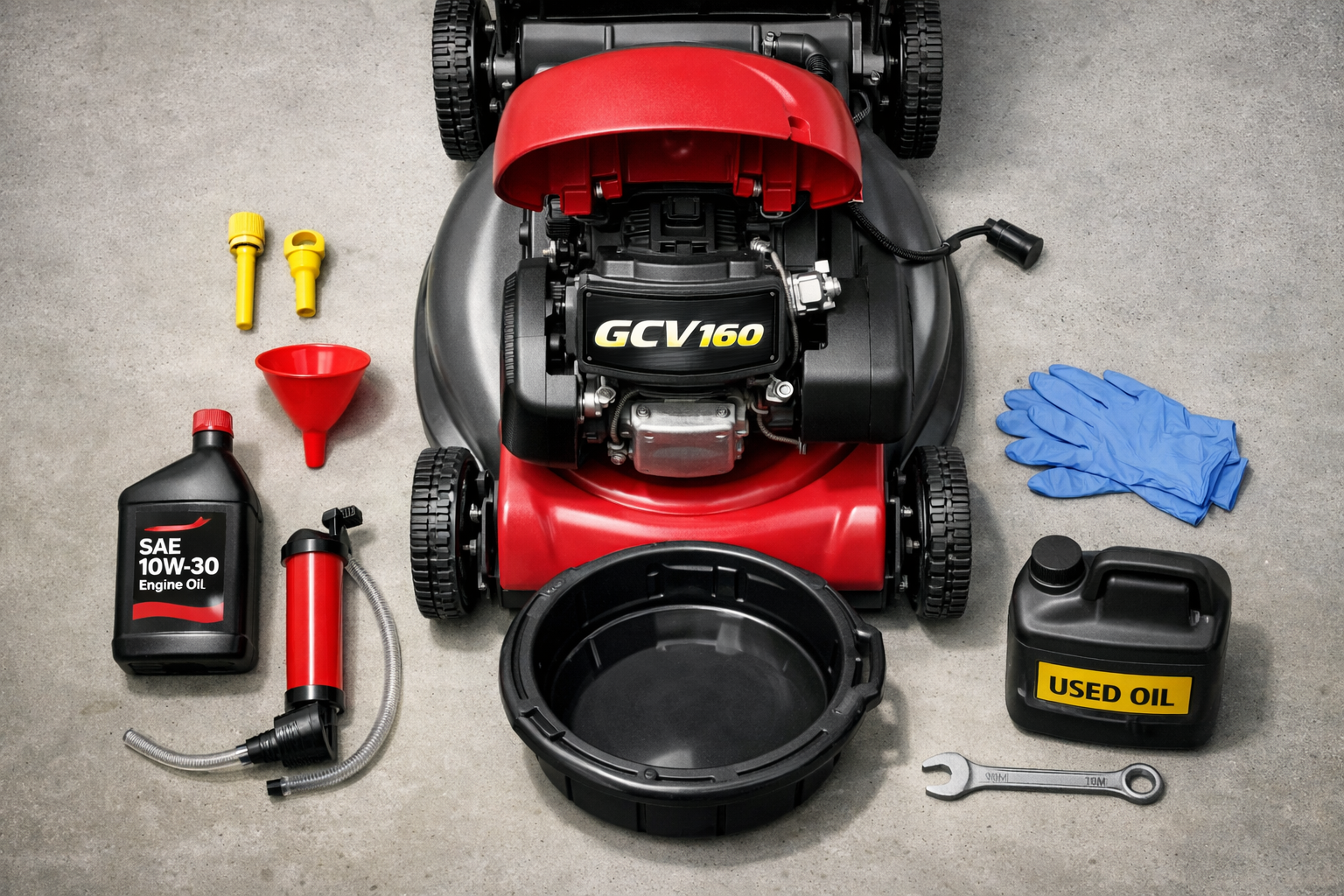
If there’s no visible plug on the bottom of the crankcase, you’re draining through the dipstick tube using a hand pump or by tilting the mower toward the tube opening. If you do spot a plug, it’s usually a 10mm hex-head bolt on the underside of the engine block. Mixing up these two designs is the single biggest reason people give up halfway through an oil change and call it “too hard.”
The 5-Step Oil Change Process
Once you’ve confirmed your engine type, the actual job takes about 20 to 30 minutes, including cooldown and cleanup. Here’s the order that keeps things clean and safe.
Warm the engine for 3 to 5 minutes so the oil flows easily, then shut it off and let it sit for a couple minutes so it’s warm, not scalding.
Disconnect the spark plug wire and set it aside from the plug. This is a non-negotiable safety step that stops the engine from accidentally starting while your hands are near the blade.
Drain the old oil either through the dipstick tube (tilt the mower, air filter side up, into a drain pan) or through the bottom plug if your model has one.
Replace the oil filter if your Honda model uses one (many GCV engines don’t, but some commercial models do) — check your owner’s manual for the exact part.
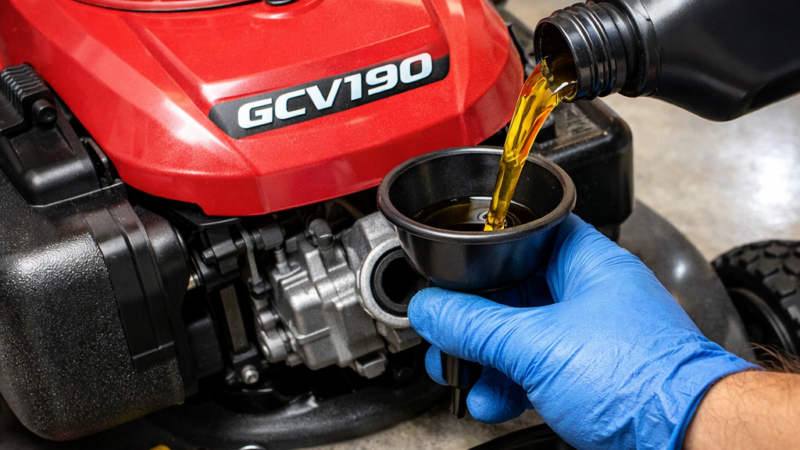
Refill with the correct oil grade to the full mark on the dipstick, then reconnect the spark plug wire and check the level again after a minute of running.
Always disconnect the spark plug wire before doing any maintenance near the blade or crankshaft — this is standard safety guidance repeated across small-engine service manuals.
SAE 30 or 10W-30: Picking the Right Oil Grade
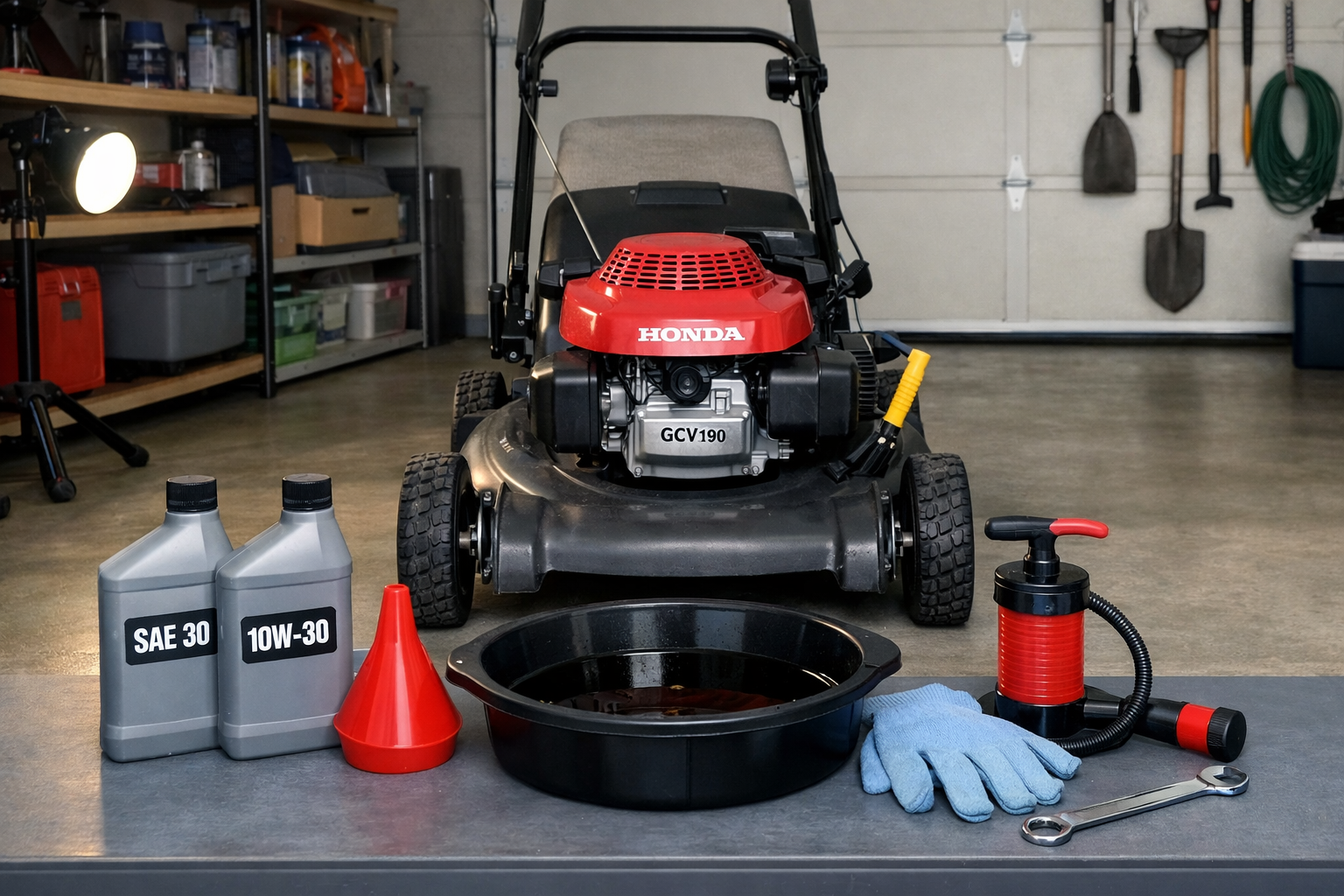
For most residential use, SAE 30 is the right call above 40°F, and 10W-30 works better if you’re mowing in cooler spring or fall temperatures below that. Don’t reach for whatever automotive oil is sitting in your garage — car engines and small air-cooled engines run different tolerances and additive packages.
Honda’s own service literature for GCV-series engines specifies SAE 30 as the standard recommendation for typical mowing seasons, with 10W-30 as an acceptable alternative for wider temperature swings. Using 5W-20 or a heavier diesel-rated oil isn’t going to blow up your engine on day one, but it can cause harder starts in cold weather or slightly reduced protection at high heat. It’s a small mistake with a slow, cumulative cost.
Oil capacity matters just as much as grade. Overfilling past the dipstick’s full line is one of the most common mistakes I see, and it leads to smoking out the muffler or oil getting forced past the seals.
Honda Engine Model
Oil Capacity
Recommended Oil Grade
GCV160
0.58 US quarts (20 oz)
SAE 30
GCV190
0.6 US quarts (20.3 oz)
SAE 30 / 10W-30
GXV160 (vertical shaft)
0.6 US quarts
SAE 30
Draining, Disposal, and When to Do This Again
Change the oil after the first 5 hours on a brand-new mower, then every 25 hours or once per mowing season after that, whichever comes first. If you mow a small suburban lot, once a year in early spring usually covers it.
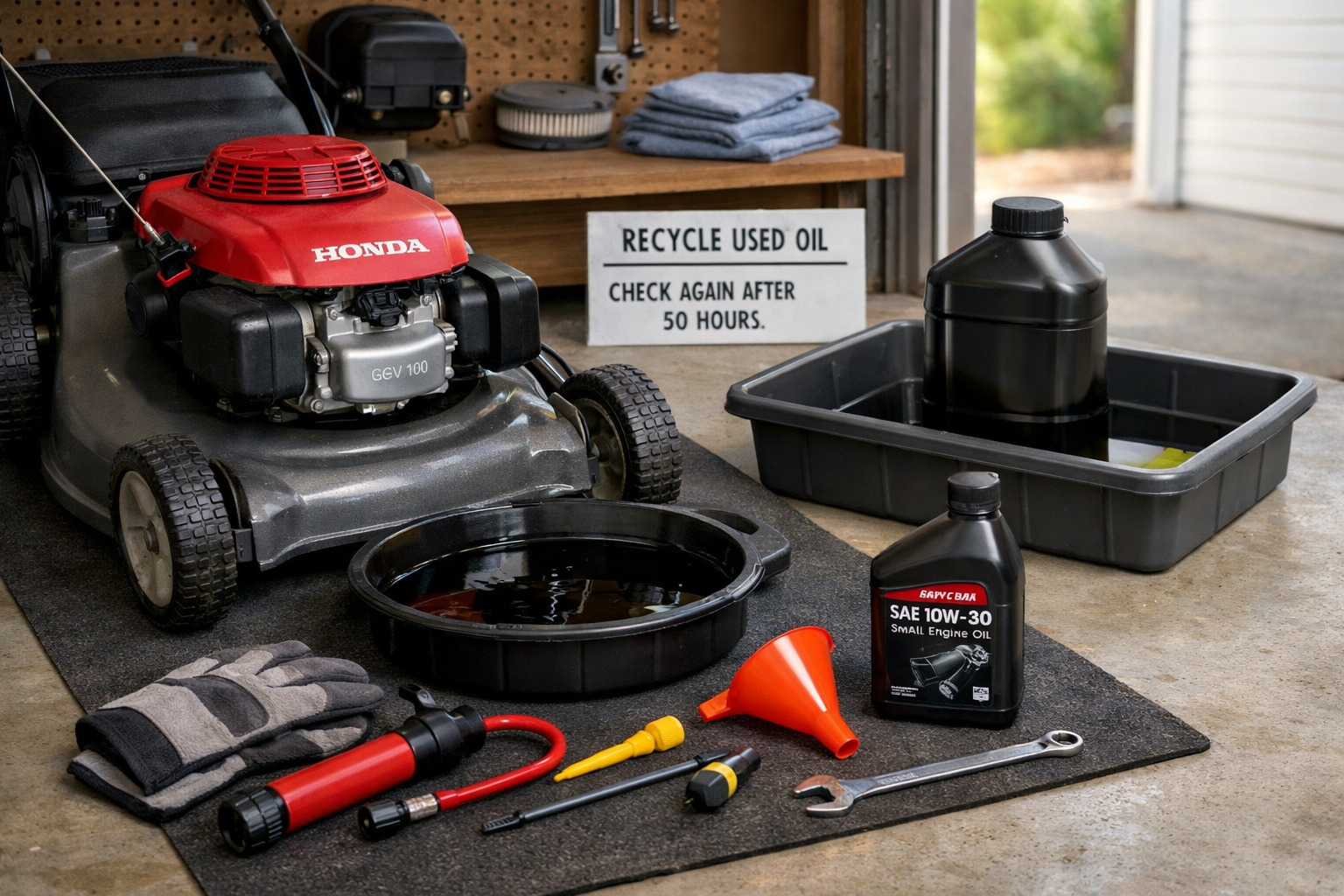
Used oil isn’t trash — pour it into a sealed container (an empty jug works fine) and drop it at an auto parts store like AutoZone or O’Reilly, most of which take used oil for free. Never pour it down a drain or onto the ground; it’s a genuine environmental hazard and most municipalities have rules against it.
If you’re keeping a maintenance log, pairing your oil changes with air filter checks and blade sharpening on the same schedule makes the whole job faster next time. The Mowers Guide keeps a running maintenance schedule breakdown by mower type if you want a broader checklist beyond just the oil.
One more practical note: after refilling, run the mower for about a minute, shut it off, wait 30 seconds, then pull the dipstick and wipe it clean before checking the level. Checking it while oil is still settling gives you a false low reading, and that’s how people end up overfilling on the second try.
Frequently Asked Questions
Can I use car oil in my Honda lawn mower?
Not ideally. Automotive oils are formulated for different temperature and pressure conditions than small air-cooled engines. Stick with SAE 30 or 10W-30 rated for small engines, which is what Honda specifies for GCV-series mowers.
How do I know if my Honda mower has a drain plug or needs dipstick draining?
Check the engine model tag on the shroud. GCV160 and GCV190 engines typically drain through the dipstick tube by tilting the mower, while some commercial Honda engines have a visible 10mm drain plug on the crankcase underside.
What happens if I overfill the oil past the full mark?
Excess oil gets forced into the combustion chamber or air filter, causing white smoke from the muffler and rough running. Drain the excess immediately through the same method you used to fill it, then recheck the level.
Grab a handful of your soil right now and squeeze it. Does it hold a shape but crumble when you poke it? That’s loam, and it’s exactly what grass roots want....
A compact zero turn mower with a 32-inch deck can fit through a standard 36-inch gate opening — but only if the total machine width stays under 35 inches, which not...
10 July 2026
The Mowers Guide is reader-supported. When you buy through links on our site, we may earn an affiliate commission.





Comments are closed.