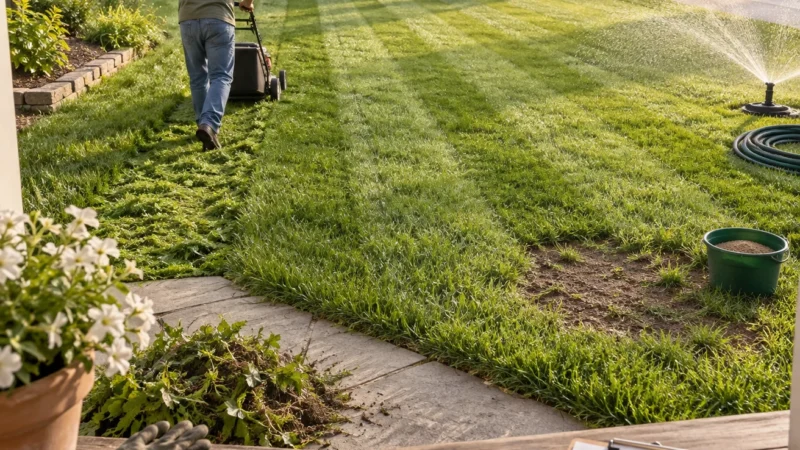
What should you do to your lawn every Sunday? Walk it, mow it, edge and trim it, pull weeds, water only if the soil is dry, then check your mower. That is the whole routine. Never cut off more than one-third of the blade height at once, and fertilize only a few times a year on actively growing grass, not every week.
Most weeks take 30 to 45 minutes. This guide gives you the checklist in order, mowing heights by grass type, a seasonal add-on table, and the weeks when you should skip a task.
The Sunday Reset: What It Is and What It Isn’t
Is Sunday lawn care a brand or a habit? Both exist, and the search results mix them up. Sunday is a company that sells seasonal lawn treatments by subscription, delivered in a box and sprayed from a hose. A Sunday lawn care routine, as we use the term here, is a weekly habit. You pick one day, do a short round of tasks, and keep the lawn from slipping.
You do not need a subscription for the habit. You need a mower, a trimmer, and a half hour of attention.
Why One Fixed Day Works
A fixed day removes the guessing. You do not have to decide whether the lawn “needs” work. You look, you do the short list, and you go inside.
It is also not a replacement for seasonal jobs. Fertilizing, seeding and mower servicing happen in specific weeks, not every Sunday. Think of the weekly slot as a reset that catches small problems early.
Is It OK to Mow on a Sunday?
Yes, in most places. No federal rule bans it. Some towns and homeowners associations (HOAs) set quiet hours, often starting at 8 or 9 a.m. on weekends, so check your local noise ordinance. If neighbors are close, mow after 9 a.m. A dry lawn matters more than the day of the week.
The Weekly Checklist in Order of Work
Do the jobs in this order and you will not redo any of them. Debris comes first, because sticks jam mowers. Trimming and edging come after mowing, so you can sweep the clippings once.
Here is the sequence as a flowing routine. First, walk the whole lawn for five minutes. Look for brown patches, new weeds, mushrooms, dry spots, soggy spots and pet damage. Pick up sticks, toys and loose debris as you go. Push a screwdriver or your finger a few inches into the soil. If it slides in easily and feels damp, skip the water.
Second, check the mower before you start it. Look at the oil level, the blade, the tires and the fuel. Then set the deck height for your grass type and mow when the grass is dry. Wet clippings clump and the cut looks ragged.
Third, trim around fences, trees and beds with a string trimmer. Fourth, edge along the sidewalk and driveway. Fifth, pull or spot-treat weeds while the soil is still soft from the last watering. Sixth, water if the soil check said it was needed. Seventh, clean the mower deck, wipe the tools and put everything away.
Time Budget for a Typical Week
For a quarter-acre lot, the walk-through takes about 5 minutes. Mowing takes 20 to 30 minutes with a push mower, less with a riding mower. Trimming and edging add about 10 minutes. Weeding and cleanup add 5 to 10. That puts most weeks at 30 to 45 minutes, and bigger lots run longer.
How Short to Mow: Heights by Grass Type and the One-Third Rule
How short should you mow your lawn? Higher than you think. For most lawns, aim for 3 to 4 inches on cool-season grasses and 1 to 3 inches on warm-season grasses, depending on the type. Never remove more than one-third of the blade in one cut. Cutting too short dries out the soil and weakens roots.
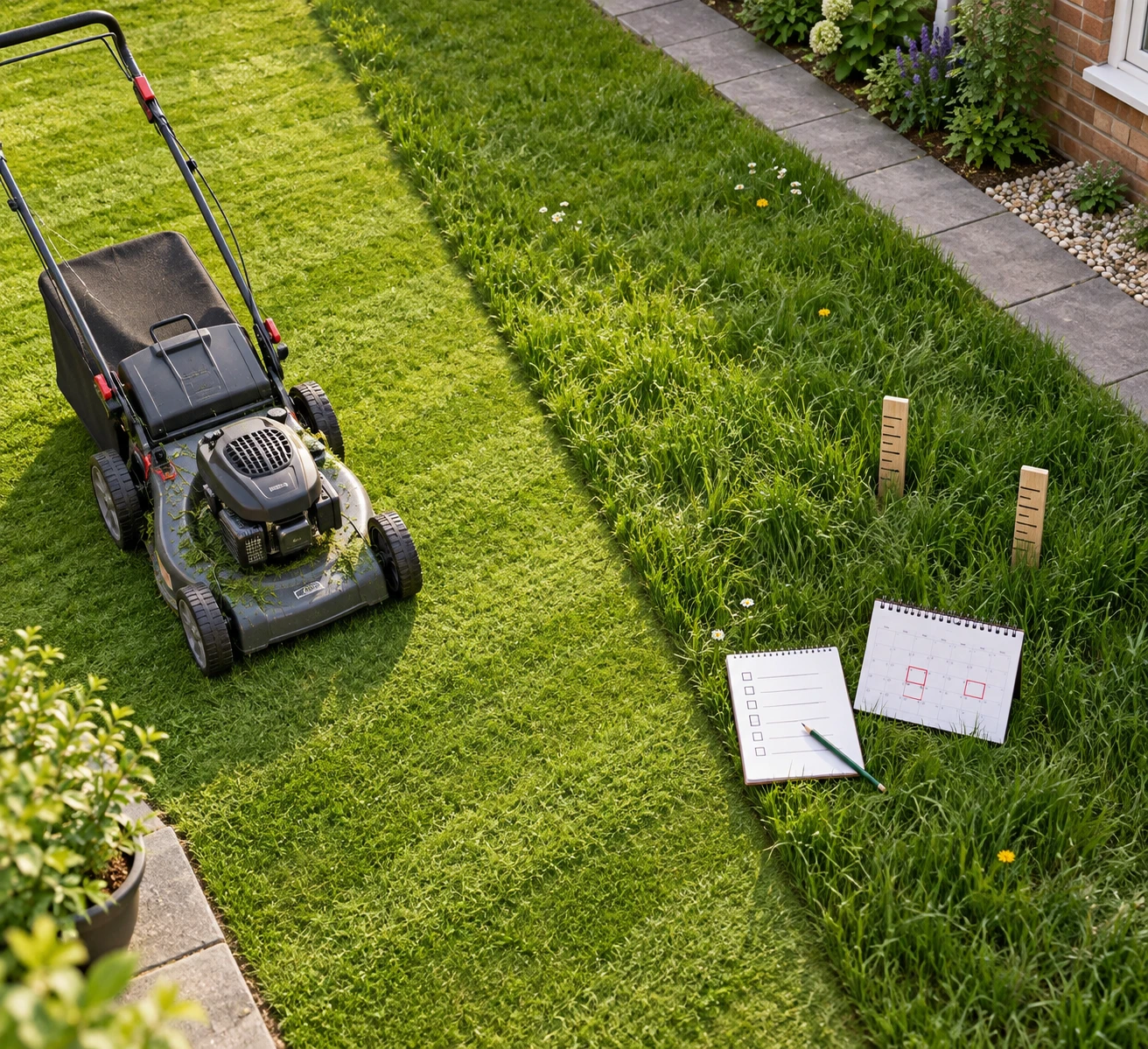
The one-third rule works like this. If you want a 3-inch lawn, mow when the grass reaches 4.5 inches. If it grows to 6 inches while you are away, do not scalp it in one pass. Cut it down to 4 inches, wait two or three days, then cut to 3 inches.
Cool-season grasses grow best in spring and fall. Warm-season grasses grow best in summer heat. If you do not know which you have, ask your local county extension office. It is usually free and quick.
Grass type
Season type
Typical mowing height
Kentucky bluegrass
Cool
2.5 to 3.5 inches
Tall fescue
Cool
3 to 4 inches
Perennial ryegrass
Cool
2 to 3 inches
Bermuda
Warm
1 to 2 inches
Zoysia
Warm
1.5 to 2.5 inches
St. Augustine
Warm
3 to 4 inches
Treat these as typical ranges, not exact rules. In hot summers, mow on the high side of your range. Taller grass shades the soil, keeps it cooler, and cuts down on watering and weeds.
First and Last Mow of the Year
Make the first mow of spring about half an inch shorter than your normal height. This clears dead grass and helps green-up. Cool-season lawns get this first cut once snow melts. Warm-season lawns get it when growth restarts, often by late March.
For the last mow, drop to about 2 inches before the first frost. That protects the crowns, which are the growing points at the base, and lowers the risk of snow mold.
How Often to Mow: Every Week or Every Two Weeks?
Mow when the grass tells you to, not when the calendar does. In peak spring growth, you may need to mow every 3 to 5 days. In midsummer or late fall, every 7 to 10 days is often enough. Every two weeks works only in slow growth, because longer gaps break the one-third rule.
A weekly Sunday mow fits most of the year. In a fast spring, add a mid-week quick cut, or raise the deck a notch and cut twice as often at the same height. Cool-season lawns speed up again in fall, so expect more mowing then.
Weeks to Skip the Mow
Skip mowing in a few cases. Dormant grass is not growing, so there is nothing to cut. Winter is the usual case for both grass types. Skip during a drought or a heat wave too, since mowing stresses a lawn that is already struggling. If the lawn is soggy, wait. Mowing wet soil leaves ruts and clumps.
If you skip a week and the grass gets long, use the two-step cut described above.
Edging, Trimming and Weeds: The Finishing Work
Do you really need to edge every week? No. A neat edge makes a lawn look cared for, but the grass along a sidewalk grows slowly. Trim around fences, posts and trees every week you mow, and edge every second or third week unless you like a sharp line.
Trimming Without Hurting Trees
Keep the string trimmer away from tree trunks. Repeated nicks in the bark can harm young trees. Use a mulch ring or a small trimmer guard instead.
A Quick Weed Pass
The walk-through shows you new weeds early. Pull small ones by hand with a spade or weeding tool while the soil is damp. Do it before they set seed. For large patches, spot-treat with a product labeled for your grass type. Read the label first, because some weed killers harm certain grasses.
Dense, taller grass is your best weed control. Weeds struggle to start in shaded soil. That is one more reason not to mow short.
Watering and Irrigation: Check First, Then Run the System
Should you water every Sunday? Only if the soil is dry. A lawn generally needs about 1 inch of water per week from rain and irrigation combined, though the right amount shifts with soil, heat and grass type. Soak deeply and less often. Frequent light watering grows shallow roots.
Use the screwdriver test. If it slides in easily, wait. If the soil feels dry and firm, water. Place a tuna can on the lawn while the sprinklers run. When it fills to an inch, you have your run time.
Water early in the morning, when the air is cool and less water evaporates. If you have no timer, water in the early evening with a hose.
Weekly Irrigation Check
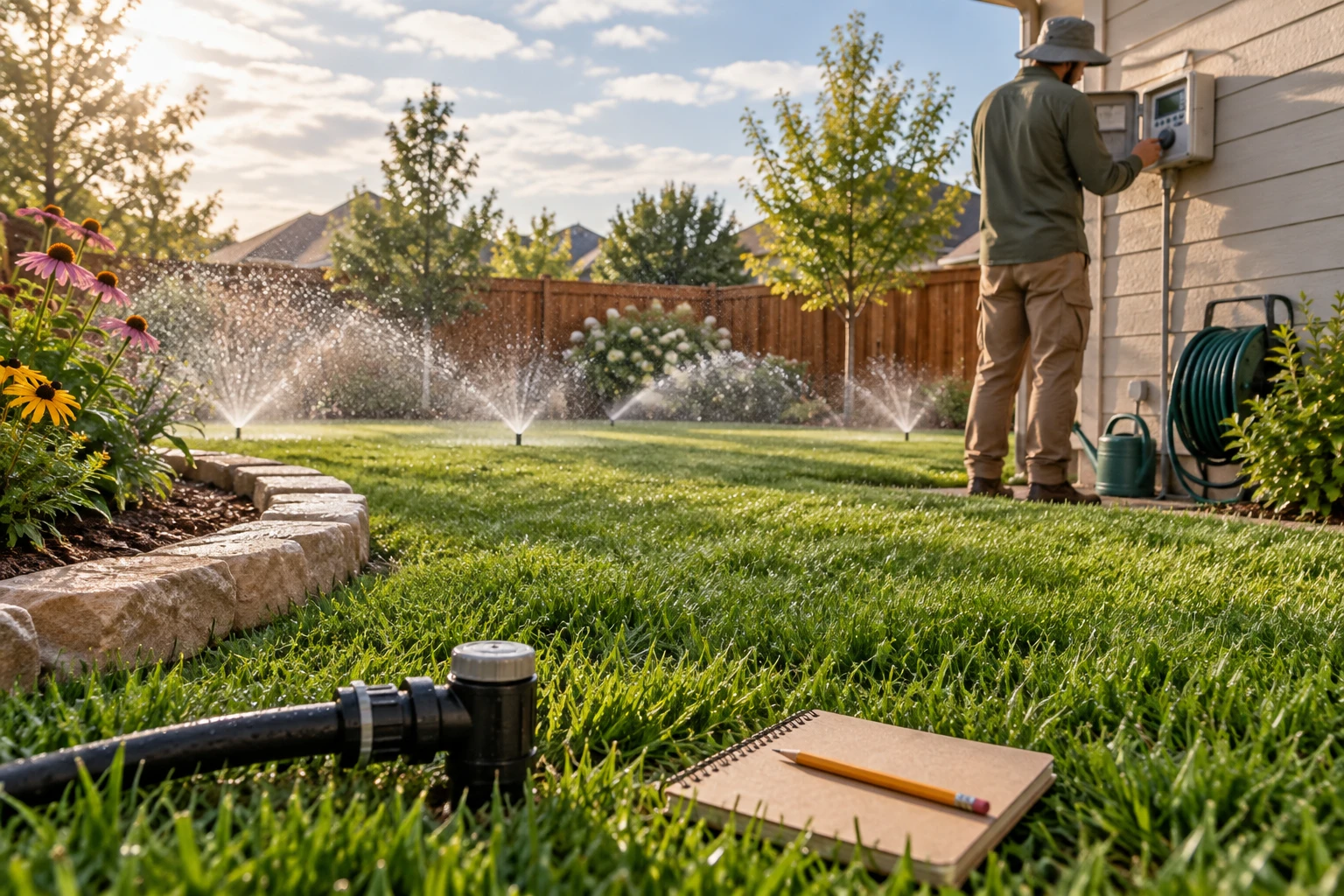
Once a week, run each zone for a minute and watch. Look for clogged heads, broken sprinklers, spray hitting the driveway, and soggy spots. Adjust the timer a little each week. Cut the time in cool weeks, and raise it in heat. Small changes beat big ones.
Seasonal Add-Ons: Fertilizing, Seeding and Mower Service
How often should you fertilize? Not weekly. Most lawns need feeding two to four times a year, and only when the grass is actively growing. Fertilizing dormant grass wastes product, and a heavy rain can wash it into storm drains. A common mistake is putting the same checklist on repeat all year.
Soil temperature guides timing. Cool-season grasses grow when daily averages stay above about 50°F. Warm-season grasses need averages above about 60°F. Some liquid fertilizers are applied every 4 to 6 weeks in that growing window, but always follow the label on whatever you buy.
Mow and water a few hours before applying, and skip the job if heavy rain is expected within a few hours. Keep kids and pets off until the lawn dries.
Season
Cool-season lawn
Warm-season lawn
Early spring
First mow, sharpen blade, change oil
Service mower, wait for green-up
Late spring
Light feeding, weed control
First feeding once fully green, start mowing weekly
Summer
Mow high, water deeply, skip feeding in heat
Peak growth, feed again if label allows
Early fall
Overseed, main feeding, mow often
Last feeding, weed control
Late fall
Leaf cleanup, last mow at about 2 inches
Let grass go dormant, clear leaves
Local weather shifts these weeks, so use them as a guide. A soil test through your county extension office tells you what your lawn actually lacks before you buy anything.
Thatch and Debris
Thatch is the layer of dead stems and roots between the grass and the soil. A thin layer, under half an inch, is fine. If it gets thick, rake or dethatch in the growing season. Clear leaves and heavy debris each fall so they do not smother the grass.
Mower and Tool Check: Sharp Blades and a Clean Deck
A dull blade tears grass instead of cutting it. The tips turn brown and ragged, and the damaged blades invite disease. Sharpen your mower bladeat least once a year, and again after about 20 to 25 hours of mowing if you cut a large lawn or hit sticks and rocks.
Do it at the start of the season. Many homeowners keep a second blade so they can swap and sharpen at leisure. Disconnect the spark plug wire before you touch the blade.
Weekly Quick Look
Before each mow, check the engine oil, the air filter, the tire pressure on a rider, and the underside of the deck. Scrape off caked clippings. Wipe the trimmer head and clear grass wrapped around its shaft.
A dull mower blade tears grass blades rather than slicing them, leaving ragged tips that stress the lawn and can invite disease.
If you want a season-by-season reminder of these jobs, The Mowers Guide has lawn care checklists you can read for free.
Frequently Asked Questions
What should I do for my lawn every Sunday?
Walk the lawn, mow at the right height, trim, edge if needed, pull weeds, and check the soil before watering. Finish by cleaning the mower. Most weeks this takes 30 to 45 minutes, and fertilizing is left for specific seasonal weeks.
How often should I sharpen my mower blade?
Sharpen at least once a year, ideally in early spring. If you mow a large lawn, or the blade hits sticks and stones, sharpen again after roughly 20 to 25 hours of use. Torn, brown grass tips are the warning sign.
Is Sunday lawn care the same as a weekend lawn routine?
The habit is the same as any weekend routine, just on one fixed day. Sunday is also a company that sells seasonal lawn treatments, so results can mix the two. You do not need the product to follow the weekly checklist.
How short should I mow my lawn?
Mow at the height for your grass, and never cut more than one-third of the blade at once. Cool-season lawns usually stay around 2.5 to 4 inches. Warm-season lawns range from about 1 to 4 inches, depending on type.
Stick to the routine, and your lawn, and your weekends, will thank you!
Discover how I use mower attachments to transform my lawn care routine. From mulching to bagging, learn tips for enhancing your mowing experience and achieving a perfect lawn.






Comments are closed.