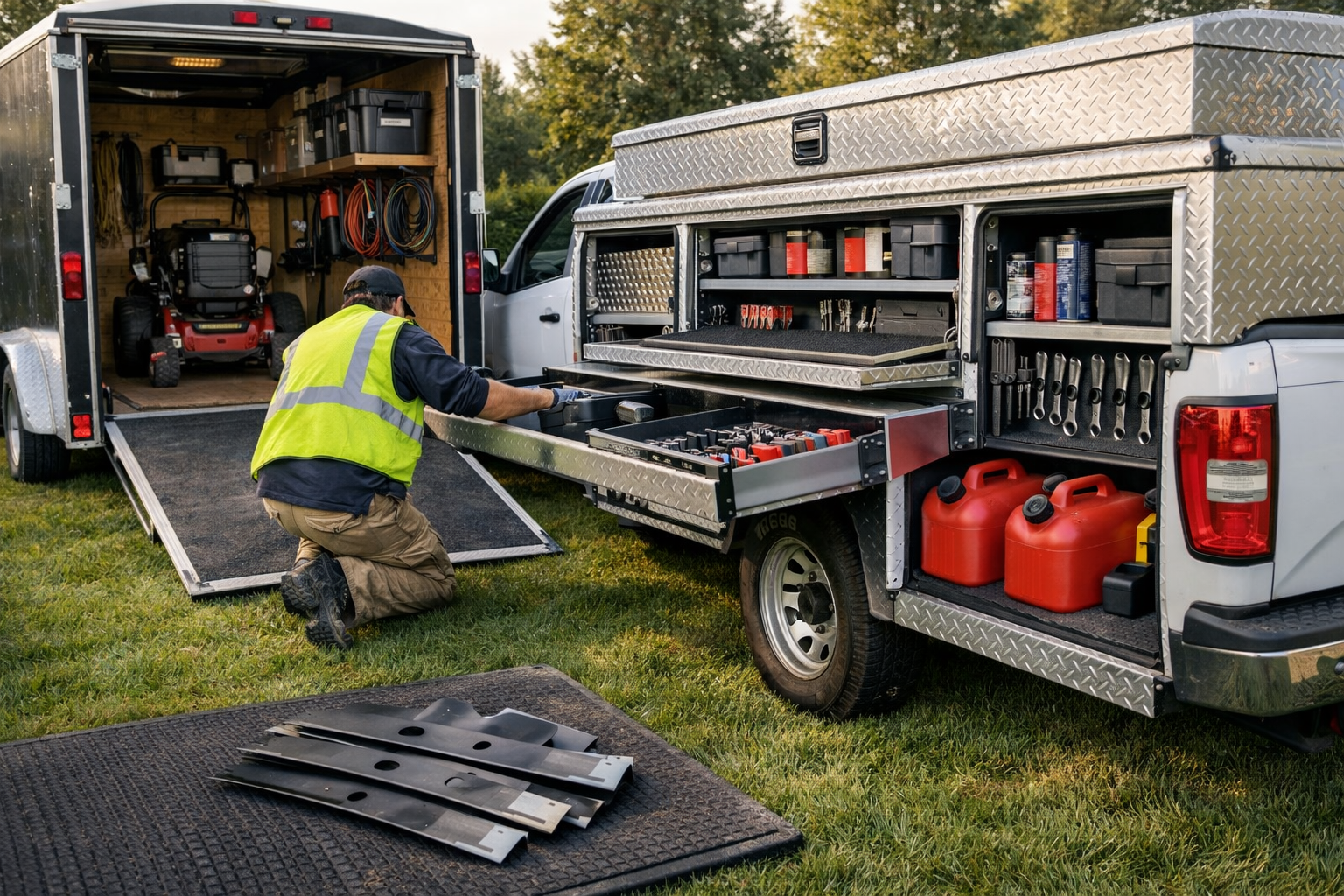
A single snapped mower belt can cost a lawn care crew 90 minutes of billable time, more if the nearest parts store is 20 miles out. A well-stocked toolbox truck closes that gap by turning your pickup into a rolling service unit. The difference between a truck that just hauls equipment and one that actually supports field repairs comes down to what’s in the box and how it’s organized.
What a Toolbox Truck Actually Does for a Lawn Care Operation
A toolbox truck isn’t just storage. It’s the difference between a five-minute roadside fix and a half-day shutdown while you drive back to the shop for a spark plug.
Time is money in the service industry: a single unplanned return trip to the shop can cost a solo operator $50–$100 in lost productivity and fuel before the day is done.
The real function of a properly set-up toolbox truck is minimizing downtime per stop. When your most common mower failure points are already on the truck (belts, blades, spark plugs, fuel filters), you solve problems where they happen. That’s the operational edge a toolbox truck gives you over a crew that relies on the shop.
Crossover, Side-Mount, or Chest: Which Truck Toolbox Type Fits Lawn Care Work
The crossover toolbox is the right default for most lawn care trucks — it mounts across the front of the bed, keeps the rest of the bed open for mowers and trailers, and offers enough volume for a solid parts and tool kit. Your trailer hitch setup and bed length both affect which style actually works.
Toolbox Type
Bed Space Used
Best For
Drawback
Crossover
Front 12–18 in.
Most setups, trailer towing
Reduces usable bed length slightly
Side-Mount
Rail space only
Maximizing center bed access
Lower capacity, less weather-tight
Chest (full-size)
Most of the bed
Shop-truck, no trailer
Blocks trailer loading entirely
Underbody
Frame/underbed
Extra parts overflow
Harder access, needs a step stool
How Toolbox Placement Affects Bed Space and Trailer Clearance
A crossover box on a standard 6.5-foot bed still leaves roughly 5 feet of usable bed, enough for a 21-inch walk-behind and a gas can. If you’re pulling a trailer loaded with zero-turns, that remaining bed length matters for tongue weight distribution. A chest-style box pushed toward the tailgate can shift weight rearward and affect how the trailer tracks on the road.
Lock Quality and Weather Sealing Matter More Than Price
A $90 toolbox with a flimsy paddle latch will let water in after one hard rain and won’t deter a determined thief for more than 30 seconds. Brands like WEATHER GUARD and UWS use compression latches and aluminum construction specifically rated for outdoor exposure. Spend at least $200–$250 for a crossover box if you’re using it daily. The lock and seal quality at that price point is a real step up.
The Tools and Parts That Prevent Costly On-Site Downtime
The goal isn’t to carry everything. It’s to carry the right things. Stock your toolbox truck around the failure points that stop mowers mid-job, not around tools you might need once a season.
Hand Tools Every Mower Tech Reaches for Daily
A 3/8-inch drive ratchet set covers the majority of blade bolts, deck adjustments, and engine covers across most residential mowers. Add a set of combination wrenches from 3/8 to 3/4 inch, a pair of channel-lock pliers, and a flathead plus Phillips screwdriver set. A torque wrench set to the 35–50 ft-lb range common for blade bolts prevents both undertightening and the cracked adapter plates that come from overtightening.
Keep a magnetic parts tray in the box. Small bolts and washers disappear in grass faster than you’d think.
Mower-Specific Spare Parts Worth Carrying on Every Run
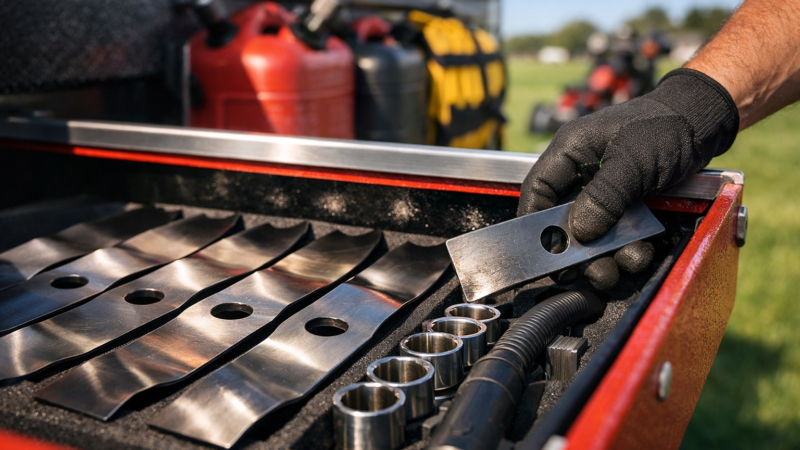
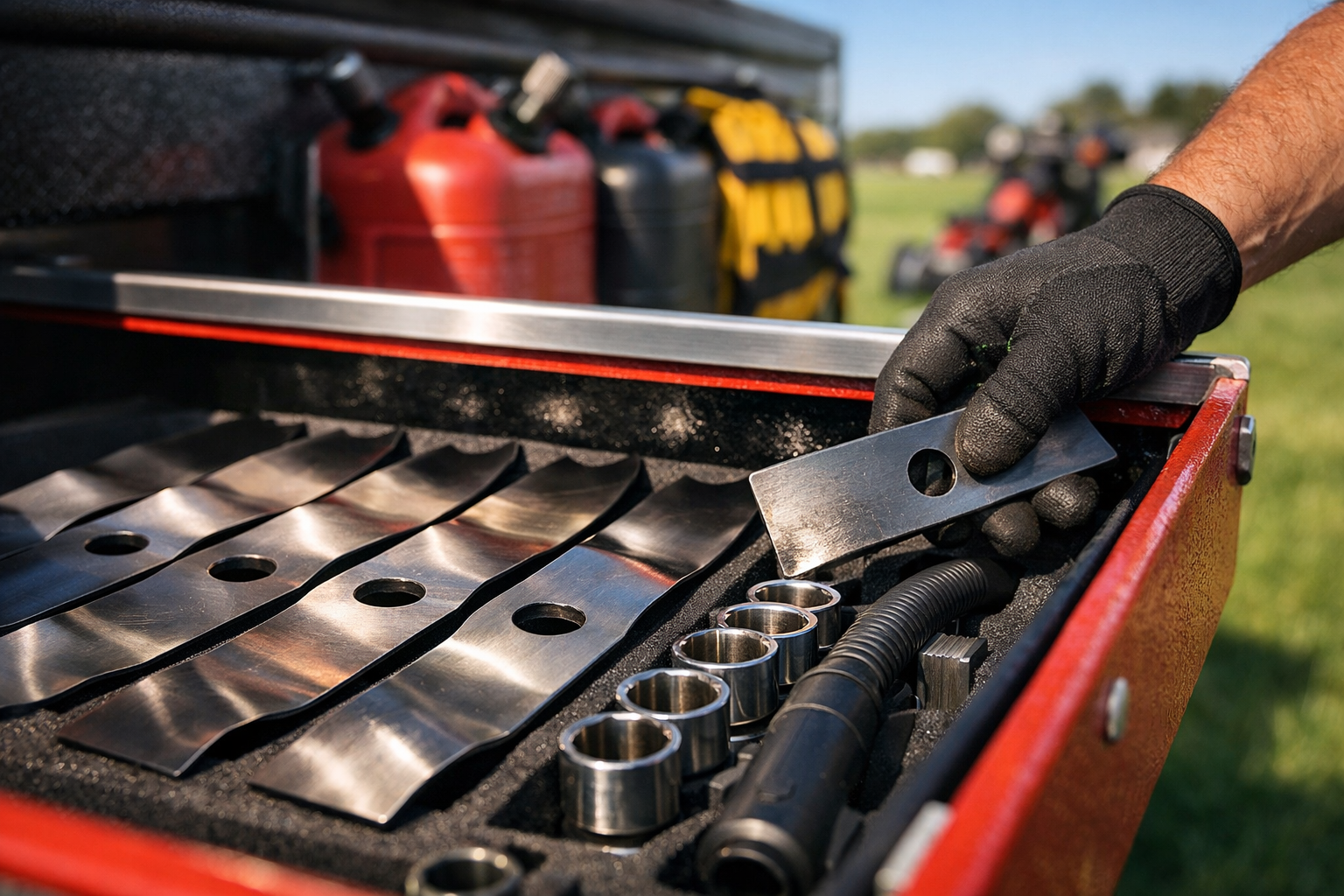
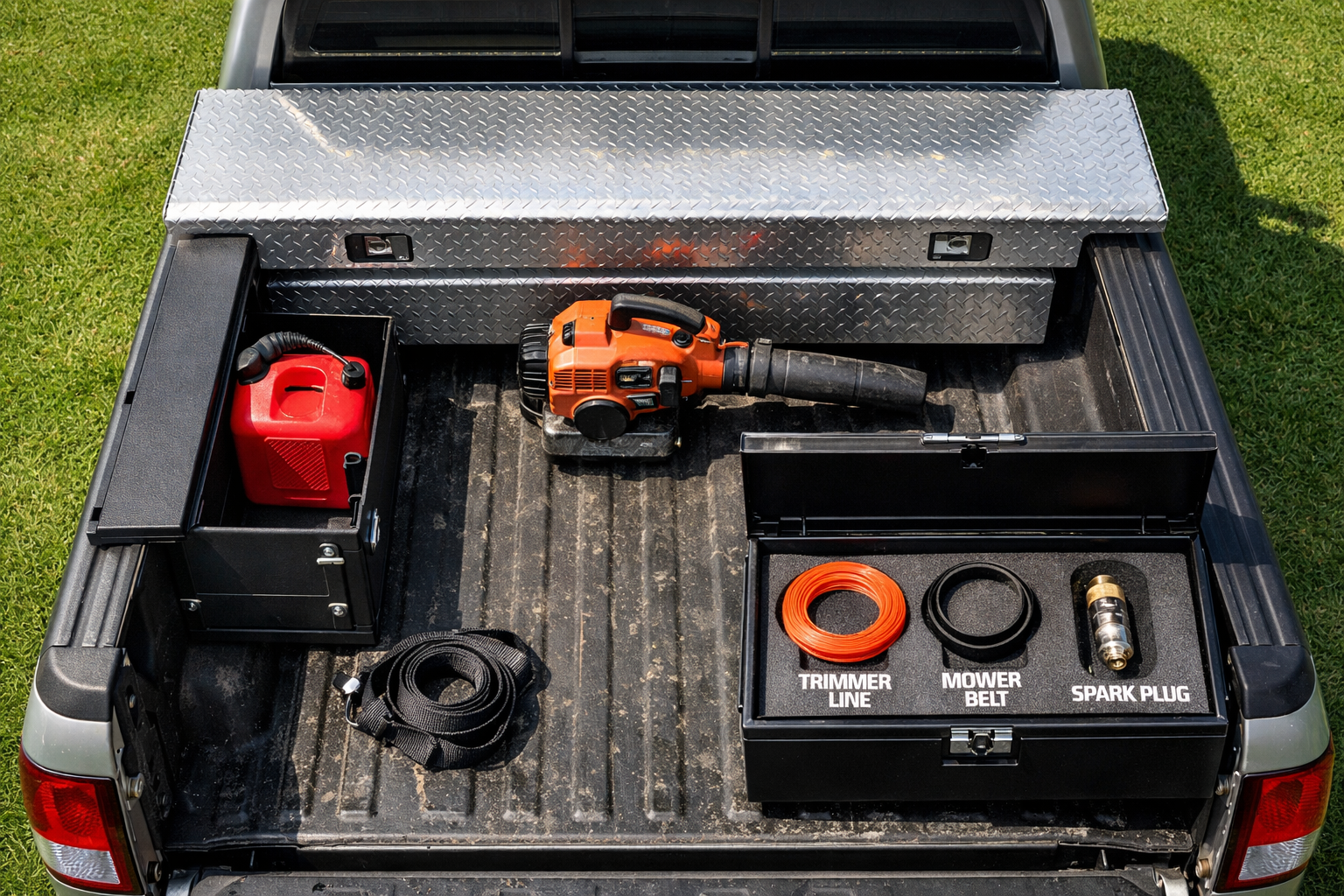
Belts and spark plugs are the two parts that pay for themselves the first time you need them. A deck drive belt for a common residential mower like a Husqvarna YTH series runs $15–$25 at a dealer. Carry one that fits your most-used machine, plus a universal backup. Add two or three spark plugs (NGK or Champion in the sizes your equipment uses), a fuel filter, and a set of spare blades already sharpened and ready to swap.
A blade-change kit (impact wrench, blade holder, and a spare set) turns a 40-minute job into under 10 minutes on-site.
Fluids, Lubricants, and Fuel Storage on a Service Truck
Carry a 1-quart bottle of 10W-30 or SAE 30 engine oil (check your mower’s manual, since most air-cooled engines specify one or the other), a small can of penetrating oil like PB Blaster for seized bolts, and a tube of dielectric grease for electrical connections. A 2.5-gallon fuel jug in a vented, DOT-approved container handles top-offs without a gas station detour.
Do not store fuel in a standard plastic jug in a sealed toolbox. Heat buildup in a truck bed on a 90-degree day creates a real pressure and vapor risk. Use a vented, purpose-built fuel container and keep it in an open section of the bed or a dedicated underbody box.
How to Organize a Toolbox Truck So You Find Things in Under 30 Seconds
The fastest organization system is a zone-based layout where every category of tool has a fixed location and never moves. When you reach for a spark plug at 7 a.m. on a cold jobsite, you shouldn’t be digging. You should be grabbing.
Here’s a practical sequence for setting up your toolbox truck from scratch:
Empty the box completely and group everything by task: hand tools, spare parts, fluids, electrical gear, and safety items.
Assign each group a permanent zone. Front-left for hand tools, front-right for parts, rear tray for fluids, and so on.
Place the highest-frequency items (ratchet, spark plugs, blade bolt) at the top layer or in the shallowest tray.
Put fluids and heavier parts toward the bottom to keep weight low and prevent tipping when the lid opens.
Run a full simulated service call and time yourself grabbing the five tools you use most. If any takes more than 15 seconds, move it.
Drawer and Tray Systems That Work for Lawn Equipment
A foam-lined parts tray like those made by Plano or Akro-Mils keeps small components (spark plugs, fuel filters, blade bolts) sorted without rattling loose. For the main tool section, a two-drawer steel insert that fits inside a crossover box (sold by brands like DECKED or similar aftermarket suppliers) separates hand tools from spare parts cleanly. Expect to spend $80–$150 for a quality drawer insert that fits a full-size crossover box.
Avoid stacking tools loose in the bottom of the box. A ratchet buried under a belt and two spray cans costs you two minutes every single stop.
Labeling and Zone Logic for a Multi-Crew Setup
If more than one person uses the truck, labels aren’t optional. Use a label maker (a Brother P-touch works fine) to mark every tray, drawer, and bin with its contents. Color-coded zones, whether tape or painted dividers, cut retrieval time further when a crew member who didn’t pack the truck needs to find something fast. Assign one person per shift to restock the box at the end of the day, not the beginning.
Blade Sharpening and Electrical Diagnostic Gear for Field Repairs
Carrying a portable blade sharpener and a basic multimeter on your toolbox truck eliminates the two most common reasons a mower gets trailered back to the shop mid-week. Dull blades and dead electrical connections are fixable on-site in under 20 minutes with the right gear.
Portable Blade Sharpening Options That Fit a Truck Setup
The most practical field option is an angle grinder with a flap disc — a 4.5-inch grinder with a 60-grit aluminum oxide flap disc sharpens a standard mower blade in 3–5 minutes. Brands like DeWalt and Makita both make compact 4.5-inch cordless models that run off an 18V battery platform you may already carry. A dedicated blade sharpener attachment (Oregon sells one that mounts to a standard drill) is slower but easier for someone still learning the correct bevel angle, typically 30–35 degrees for most residential blades.
Keep a blade balancer in the tray alongside the grinder. An unbalanced blade causes spindle bearing wear that adds up to a $150–$300 repair if ignored long enough.
Basic Electrical and Diagnostic Tools for Common Mower Faults
A multimeter handles the majority of field electrical diagnosis — testing battery voltage (should read 12.6V fully charged on a standard 12V system), checking for continuity through a safety switch, and confirming whether a solenoid is getting power. A basic digital multimeter from Fluke or Klein runs $40–$80 and fits easily in a shallow tray.
Add a set of spade connectors and a wire crimping tool for quick harness repairs, plus a handful of inline fuse holders in 10A and 20A ratings. Riding mowers blow fuses more often than most owners expect, and a $0.50 fuse is the entire repair when you have one on hand.
Safety Equipment and First Aid Loadout for a Service Truck
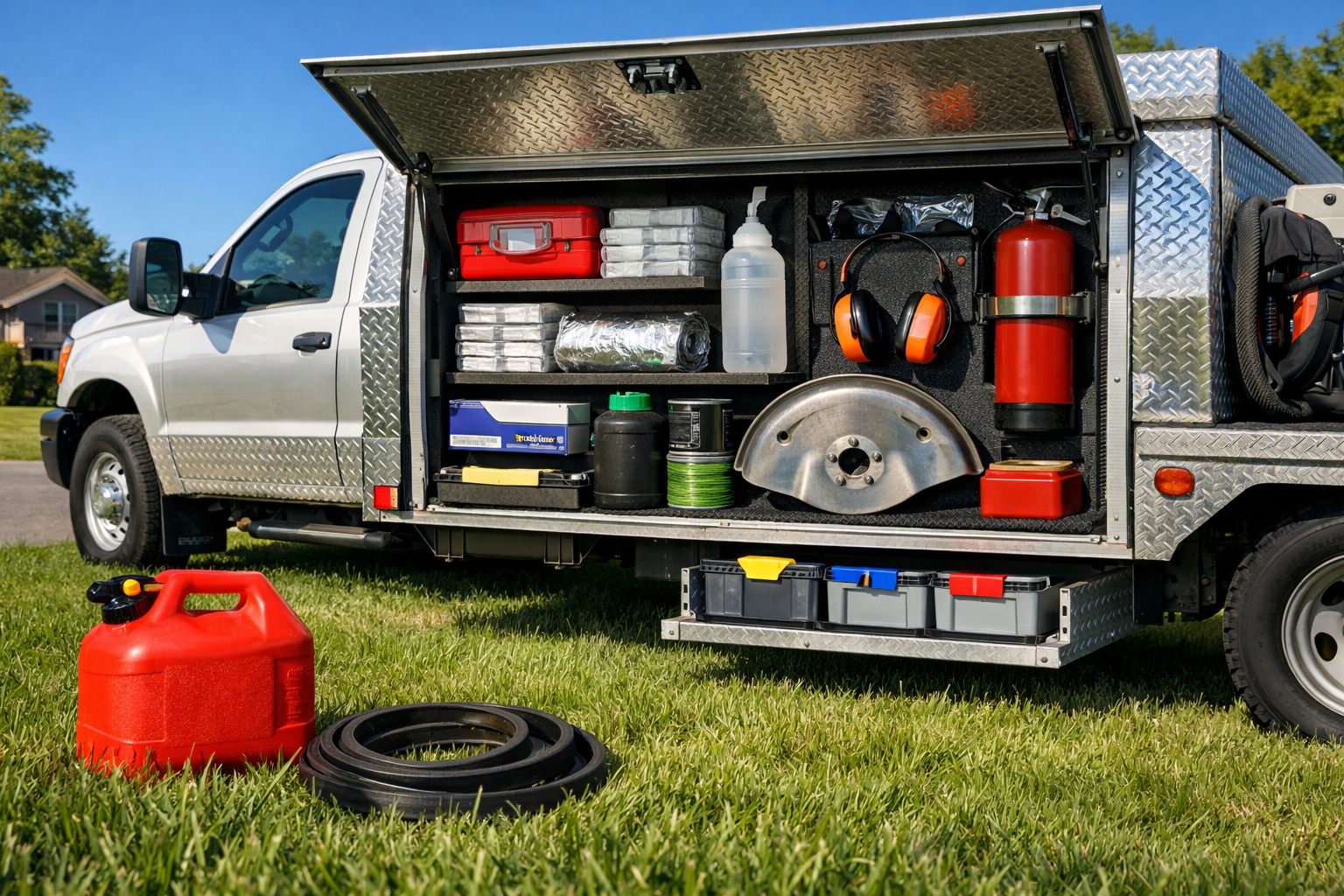
A dedicated first aid kit rated for outdoor work belongs in a fixed spot you can reach without opening the main toolbox. Skip the 10-piece office kit. Look for kits with wound closure strips, nitrile gloves, and burn dressing, since blade handling and hot engine work are the two most common injury sources in lawn care.
Beyond first aid, your service truck should carry a fire extinguisher rated ABC (dry chemical), mounted inside the cab or secured in the bed. A fuel spill near a hot exhaust is a real scenario, not a remote one. A 2.5 lb ABC extinguisher from Kidde costs around $25 and meets most commercial vehicle requirements.
Add high-visibility safety glasses, hearing protection rated at least NRR 25 for equipment operation, and cut-resistant gloves rated ANSI A4 or higher for blade changes. A blade change without cut-resistant gloves is a hand injury waiting to happen. That’s not an exaggeration.
Toolbox Truck vs. Enclosed Trailer: The Right Call for a Small Lawn Business
A toolbox truck wins for solo operators and small crews running 10 or fewer stops per day. An enclosed trailer makes more sense once your equipment list grows past two mowers or you’re hauling a walk-behind, a zero-turn, and a full set of hand tools simultaneously.
Factor
Toolbox Truck
Enclosed Trailer
Upfront cost
$200–$800 (box only)
$3,000–$8,000+
Fuel impact
Minimal
Noticeable (10–15% drop in mpg)
Parking and maneuverability
Easy in tight residential areas
Harder; some HOA streets restrict trailers
Tool security
Lockable aluminum box
Lockable full enclosure
Equipment capacity
Truck bed only
16–20 ft of floor space
Setup time per day
None
5–10 min hitch/unhitch
The toolbox truck setup keeps overhead low and daily setup time near zero. The genuine drawback is capacity: once you’re running a 60-inch zero-turn alongside a 21-inch walk-behind and a trimmer rack, the bed fills fast and tool storage gets squeezed out.
Start with the toolbox truck if you’re in your first two seasons. Upgrade to a trailer when equipment volume forces the decision — not before.
Frequently Asked Questions
What size toolbox fits a standard 6.5-foot truck bed?
A full-size crossover box typically runs 70–71 inches wide to span a 6.5-foot bed’s rail width. Measure your rail width before ordering — beds vary by make and model. Most crossover boxes from brands like Weather Guard or UWS list exact fit dimensions on the product page.
Can I store a fuel jug inside a truck toolbox?
No. Store fuel only in a DOT-approved vented container kept in an open section of the bed, never inside a sealed toolbox. Heat buildup in an enclosed aluminum box on a hot day creates vapor pressure that a standard fuel jug isn’t designed to handle safely.
How much weight can a truck toolbox and tools add to a pickup?
A fully loaded full-size aluminum crossover box with tools and parts can weigh 150–300 lbs depending on contents. Check your truck’s payload rating on the door jamb sticker before loading up. Exceeding payload affects braking, tire wear, and handling — not just the suspension.
Do I need to organize differently if I run a two-person crew?
Yes. With two people using the same truck, every zone needs a label and a designated restocking owner at the end of each shift. Without that accountability, the box drifts into disorder within a week. A Brother P-touch label maker and color-coded tape dividers cost under $30 combined and solve the problem entirely.
Brown patches spreading across your centipede lawn? Before you blame disease, look at your fertilizer bag and your mower deck. Centipede decline is almost always a combination problem, and the two...
Centipede grass earned the nickname “lazy man’s grass” back when it was first promoted for Southern lawns in the mid-1900s, and that reputation still holds up. It needs roughly a third...
26 July 2026
The Mowers Guide is reader-supported. When you buy through links on our site, we may earn an affiliate commission.





Comments are closed.