Grubs can destroy a lawn in as little as two to three weeks once populations cross the damage threshold, and most homeowners don’t notice until the turf is already peeling back like a carpet. Grub lawn care isn’t just about spraying something when you see brown spots. It’s about understanding timing, product differences, and the lawn habits that either invite or discourage egg-laying beetles in the first place. Get those three things right, and you can manage grub pressure without treating reactively every season.
Brown Patches or Grub Damage? How to Tell the Difference Before You Treat
Not every brown patch means grubs. Drought stress, fungal disease, and dog urine all cause discoloration that looks nearly identical from a standing position. Confirming grub presence before you treat saves you money and keeps unnecessary insecticide out of your soil.
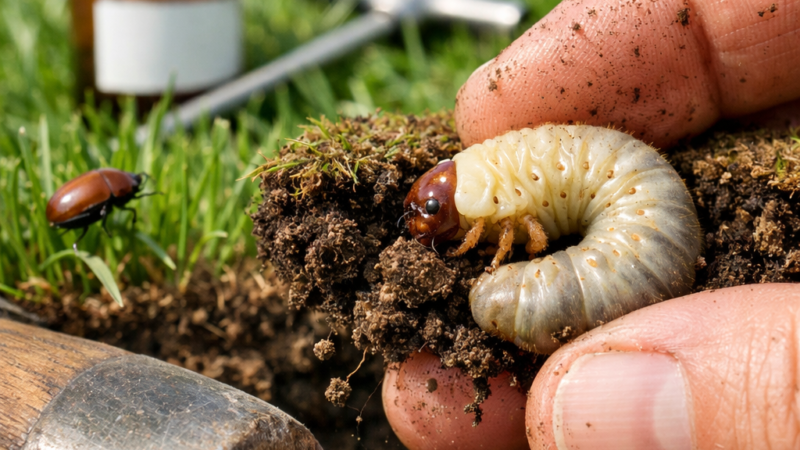
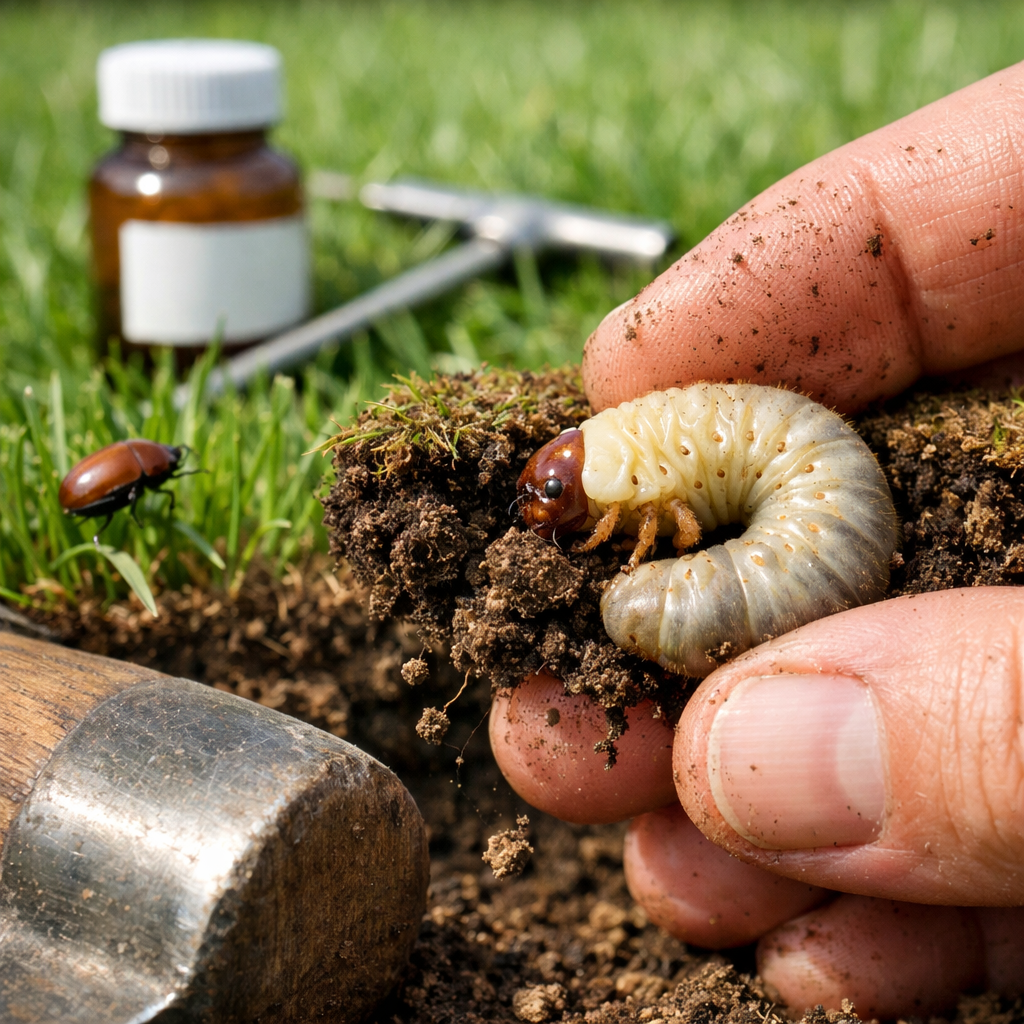
White grub is a general term for the larval stage of several scarab beetles, including the Japanese beetle (Popillia japonica) and masked chafers (Cyclocephala spp.), the two most common culprits in North American lawns.
The Sod Pull Test: Your First Diagnostic Step
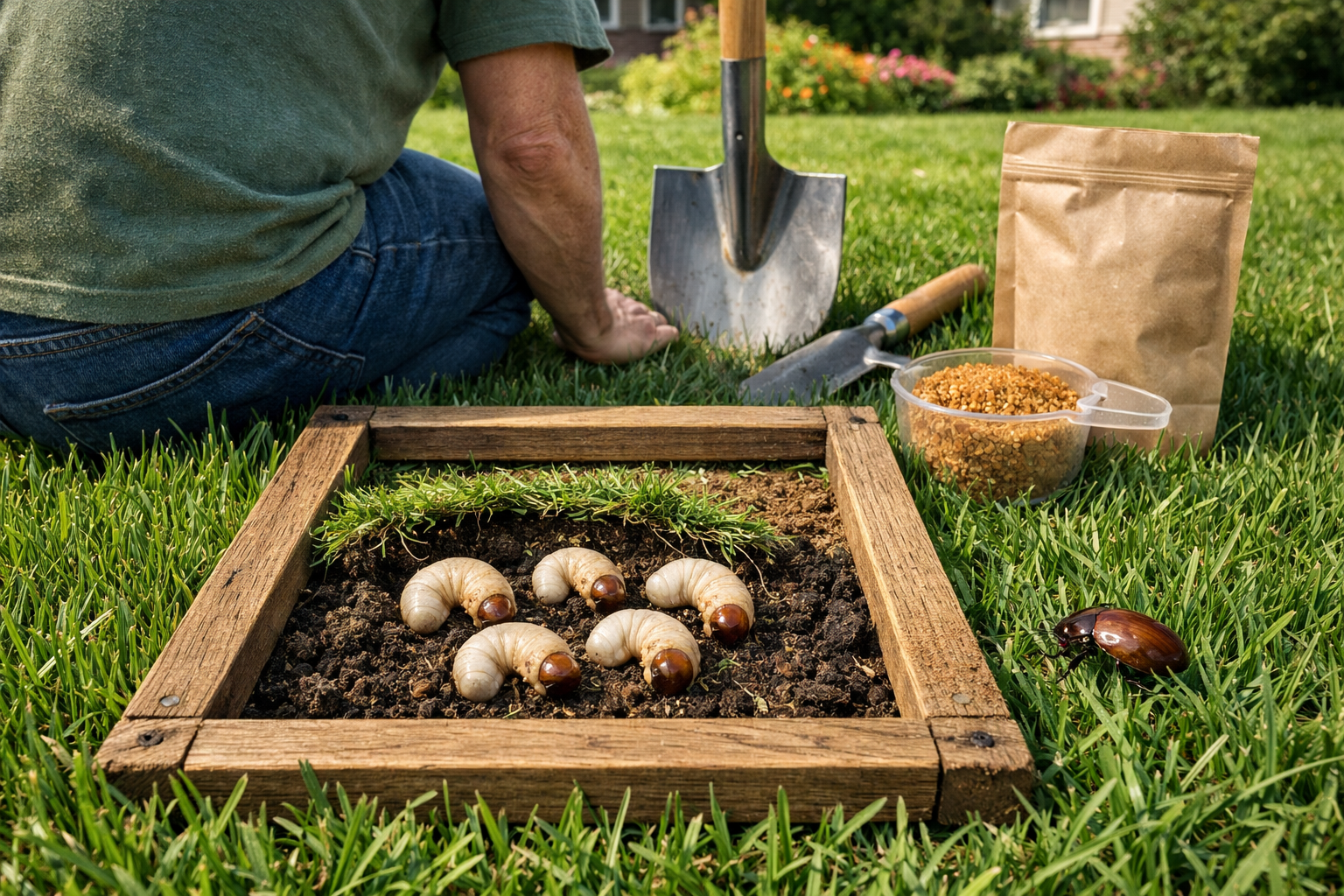
Grab a flat spade and cut a 12-inch square of turf about 3 inches deep in a browning area. Fold it back. If the sod peels away with almost no resistance, like lifting a loose rug, that’s a strong indicator of grub feeding on the root zone. Count any white, C-shaped larvae you find in that square foot.
Other Signs That Point to Grubs (Not Drought or Disease)
Spongy turf that rolls back easily is the clearest field sign. You may also notice raccoons, skunks, or birds digging up small patches overnight. They’re hunting grubs. Drought damage stays firm underfoot; grub-damaged turf does not.
Your Seasonal Grub Prevention Timeline, Month by Month
Timing is the single biggest factor in whether a grub control product works. Apply too early and the active ingredient breaks down before eggs hatch. Apply too late and the grubs are already large enough to shrug off preventive chemistry. Here’s how to structure the season.
April – Early May: Inspect last year’s damage areas. Dig a few test squares to see if overwintering grubs are still active near the surface. This tells you whether you had a real infestation or just drought stress.
Late May – Mid-June: Apply a preventive grub control product. This is the window most homeowners miss. It feels early, but it’s correct.
July: Check treated areas for adult beetle activity. Japanese beetles are visible on ornamental plants; their presence confirms egg-laying is underway in your turf.
August: If you skipped preventive treatment, this is your last realistic window for a curative product before grubs grow too large.
September – October: Pull sod samples again to count grubs and assess whether damage is likely to continue into next spring.
Late Spring: When to Apply Preventive Products and Why Timing Is Everything
Apply preventive products between late May and mid-June in most of the northern United States. That’s the window when adult beetles are laying eggs and young larvae (instars) are small and close to the surface. Products containing chlorantraniliprole (sold under the brand name Acelepryn) can go down even earlier, in April or early May, because the active ingredient is stable in soil for a longer period. Imidacloprid-based products need to go down closer to egg hatch, late May to early June, because they break down faster.
One step most homeowners skip: water in granular products with at least half an inch of irrigation immediately after application. Without that water, the active ingredient stays on the thatch layer and never reaches the soil where eggs are hatching.
Summer Monitoring: What to Watch For After Application
Walk your lawn in July and early August looking for irregular brown patches that weren’t there in June. If you treated correctly in late spring, you should see minimal new damage. Adult Japanese beetles on roses or linden trees nearby are a reliable sign that egg-laying is happening in your lawn right now. Note those areas for a follow-up sod pull in late August.
Fall: Assessing Damage and Deciding Whether to Treat Again
By September, grubs are in their second or third instar, significantly larger and harder to kill with insecticide. A curative treatment in fall is possible but less reliable. If your sod pull reveals more than 5 grubs per square foot, plan for overseeding in early fall and schedule a preventive application for the following late spring rather than chasing large grubs with a curative product now.
Preventive vs. Curative Grub Control Products Compared
Choosing the wrong product category, not just the wrong brand, is the most common grub treatment mistake. Preventive products work on young larvae before they cause visible damage; curative products are designed to knock down existing populations after damage appears. Neither category is universally better. The right choice depends on where you are in the season.
Product Type
Active Ingredient Example
Best Application Window
Effectiveness on Large Grubs
Needs Irrigation After?
Preventive
Chlorantraniliprole (Acelepryn)
April – June
Low
Yes
Preventive
Imidacloprid (Merit)
Late May – June
Low
Yes
Curative
Trichlorfon (Dylox)
July – August
Moderate
Yes
Curative
Carbaryl
July – August
Moderate
Yes
Imidacloprid and Chlorantraniliprole: How They Work Differently
Imidacloprid is a neonicotinoid that disrupts the nervous system of young grubs shortly after they hatch. It works well when applied in the correct window (late May to early June) and watered in promptly, but it has a narrower effective period in soil, roughly 60 to 90 days, so timing precision matters more with this product.
Chlorantraniliprole is a diamide insecticide that works by disrupting muscle function in larvae. Its longer soil residency (up to 6 months under normal conditions) means you can apply it in April and still get effective control when eggs hatch in June or July. Chlorantraniliprole is the better choice if you’re unsure exactly when beetles will lay eggs in your area, though it typically costs more per bag than imidacloprid-based products.
When Curative Products Are Your Only Option (and Their Limits)
If you missed the preventive window entirely and you’re seeing active turf damage in July or August, trichlorfon (commonly sold as Dylox) is the most widely available curative option. It works fastest, often showing results within a week, but it breaks down quickly in soil, so application timing within the season still matters. Expect reduced effectiveness if grubs have already reached their third instar, typically by late August or September. Curative products are a correction, not a substitute for preventive timing next year.
The Prevention Lever Most Homeowners Ignore: Mowing Height and Watering Habits
Most grub prevention guides go straight to the insecticide aisle. That’s the wrong starting point. Mowing height and irrigation habits directly influence whether egg-laying beetles choose your lawn. Adjusting both costs nothing beyond a blade height change and a shift in your watering schedule.
Mowing at 3.5 Inches or Higher Makes Your Lawn Less Attractive to Beetles
Japanese beetles and masked chafers prefer to lay eggs in short, thin turf where the soil surface is easy to reach and stays moist. A lawn mowed at 3.5 inches or higher creates a denser, shadier canopy that makes the soil surface less accessible and less appealing for egg deposition.
Set your mower deck to 3.5 inches for cool-season grasses like tall fescue or Kentucky bluegrass during June and July, the peak egg-laying period. That’s it. No product purchase required. A taller canopy also supports deeper root growth, which means the turf can tolerate minor grub feeding without collapsing the way a shallow-rooted, close-cropped lawn will.
Don’t scalp the lawn in summer to “keep it neat.” That single habit makes your turf significantly more vulnerable.
Deep, Infrequent Watering vs. Daily Light Watering: Which One Invites Grubs
Daily light watering (say, 10 to 15 minutes per zone every morning) keeps the top inch of soil consistently moist, which is exactly the condition egg-laying beetles seek. Female beetles fly low over turf, probe the soil surface, and deposit eggs where moisture is reliable. Short, frequent watering cycles create that condition reliably from June through August.
The fix is deep, infrequent irrigation: water to a depth of 6 inches, then let the top 2 to 3 inches of soil dry out before watering again. In most climates, that means watering once or twice per week rather than daily. A simple screwdriver pushed into the soil tells you how deep moisture has penetrated. If it slides in 6 inches without much resistance, you’ve watered enough.
Letting the surface dry between cycles doesn’t stress healthy turf. It does discourage egg-laying beetles from choosing your lawn over a neighbor’s that’s watered daily.
Natural and Organic Grub Control: What Actually Works
Organic options for grub control are real, but they work differently than synthetic insecticides. They’re slower, more condition-dependent, and better suited as part of a long-term strategy than as an emergency fix.
Milky Spore: Effective but Slow
Milky spore (Bacillus popilliae) is a naturally occurring bacterium that infects and kills Japanese beetle grubs specifically. It won’t affect masked chafers or other species. Applied as a powder to the soil, it can take two to four years to establish a population dense enough to provide meaningful control. Once established, it persists in the soil for 10 years or more without reapplication.
Milky spore is worth applying if Japanese beetles are your confirmed pest and you’re thinking long-term. It’s a poor choice if you need results this season.
Beneficial Nematodes: Application Conditions That Determine Success
Heterorhabditis bacteriophora is the nematode species with the best track record against white grubs. These microscopic roundworms enter grub larvae and release bacteria that kill the host within a few days.
Success depends almost entirely on application conditions. Soil temperature needs to be between 60°F and 85°F, the soil must be moist at application, and you need to water immediately after to drive nematodes into the root zone. Apply in early morning or evening, because UV exposure kills them fast. Nematodes are perishable; use them within the shelf life printed on the package, which is typically two to four weeks from purchase.
How Many Grubs Per Square Foot Is Actually a Problem
The general action threshold is 5 to 8 grubs per square foot for most cool-season turf. Below 5, a healthy lawn with a deep root system can usually tolerate the feeding without visible damage. Above 8, expect brown patches even in well-maintained turf.
The threshold for grub damage varies by turf type and health: Kentucky bluegrass, with its shallower root system, may show damage at 5 grubs per square foot, while tall fescue — which roots more deeply — can often tolerate up to 8 or more before turf loss becomes visible. (University of Kentucky Cooperative Extension, “White Grubs in Turfgrass”)
Turf condition matters as much as the count. A drought-stressed lawn mowed too short may show damage at 4 grubs per square foot. A well-irrigated, deeply rooted tall fescue lawn might handle 10 without losing coverage. When you pull your sod sample, count every grub in that 12-inch square — that number is your square-foot count — and factor in how the rest of your lawn looks before deciding to treat.
Repairing Your Lawn After Grub Damage: Overseeding and Recovery Steps
Once you’ve confirmed grub activity is over — either through a fall treatment or by confirming grub counts have dropped below threshold — recovery is straightforward but requires the right sequence. Skipping steps, especially soil prep, is why overseeded patches fail to fill in.
Pull up and remove dead turf. Dead sod won’t decompose fast enough to help new seed, and it blocks soil contact. Rake it out completely.
Loosen the top 2 to 3 inches of soil with a hard rake or a lawn aerator. Compacted, disturbed soil from grub feeding needs to be broken up before seed can establish root contact.
Apply a starter fertilizer with a high phosphorus ratio — something like a 12-12-12 or 18-24-12 blend — to support root development in new seedlings.
Overseed with a species-matched grass seed. For tall fescue lawns, use a tall fescue blend; for Kentucky bluegrass, match the variety as closely as possible to your existing turf.
Rake seed lightly into the loosened soil so it makes direct contact — seed sitting on top of thatch has poor germination rates.
Water lightly once daily until germination, typically 10 to 14 days. After germination, shift back to deep, infrequent watering to encourage root depth.
Delay mowing the repaired area until new grass reaches 4 inches, then cut no lower than 3.5 inches to protect the still-developing root system.
Fall is the best window for overseeding cool-season grasses — soil is warm, air is cooler, and competition from crabgrass is gone.
Frequently Asked Questions
Can I apply grub control and grass seed at the same time?
No. Most preventive grub control products, particularly those containing imidacloprid or chlorantraniliprole, can inhibit seed germination. Apply grub control in late spring, then wait until fall to overseed any damaged areas after the active season ends.
How long after applying granular grub control should I water it in?
Water within 24 hours of application — ideally the same day. Granular products need at least a half inch of irrigation to move the active ingredient down through the thatch and into the soil where grubs feed. Skipping this step is one of the most common reasons treatments fail.
Do grubs come back every year in the same spots?
Not necessarily the same spots, but egg-laying beetles return to the same lawn conditions year after year: short turf, moist soil surface, thin coverage. If you correct mowing height and watering habits, you reduce repeat pressure without relying entirely on annual insecticide applications.
Will grub damage recover on its own without overseeding?
Occasionally, in mild cases where fewer than 5 grubs per square foot were present and the surrounding turf is dense and healthy. In most cases, bare patches left untreated will fill with weeds — crabgrass moves into open soil fast. Overseeding in September gives desirable grass the head start it needs.
Is a zoysia grass lawn worth the work? It depends on your climate and your mower. Zoysia makes a thick, soft-looking turf that crowds out weeds and handles heat and foot...
Most small engine repair shops report that ethanol-related fuel damage is one of the top reasons mowers won’t start after sitting all winter. That single fact tells you more about picking...
4 August 2026
The Mowers Guide is reader-supported. When you buy through links on our site, we may earn an affiliate commission.









Comments are closed.