Scag mowers carry a commercial-grade price tag that starts around $5,000 for entry-level zero-turns and climbs past $15,000 for top-tier models. That gap matters because paying for a commercial machine on a half-acre residential lot rarely makes financial sense. This guide breaks down exactly which Scag models fit which use cases, what you actually get for the premium, and where the line is between smart investment and overkill.
Scag Power Equipment: What the Brand Actually Builds
Scag Power Equipment, founded in 1983 and headquartered in Mayville, Wisconsin, builds commercial-grade mowing equipment aimed at professional lawn care operators and serious property owners. The company does not make budget machines. Every model in its lineup is designed around high-cycle commercial use, meaning equipment that runs 500 to 1,000+ hours per year without major failure.
Scag Power Equipment defines its manufacturing standard around a simple principle: build the mower a professional can rely on every working day, not just on weekends.
The brand’s core product categories include zero-turn riding mowers, stand-on mowers, and walk-behind units. Scag also produces velocity plus cutting decks, a proprietary deck design engineered for high-volume grass discharge at faster ground speeds. That deck design is one of the most consistently discussed features among commercial operators who run Scag equipment daily.
Scag Model Lines Compared: Deck Sizes, Engines, and Best Use Cases
Scag’s lineup splits into clear tiers, and matching the right model to your property size and usage frequency is the single most important buying decision. Buying too much machine wastes money; buying too little means you’ll be replacing it sooner than expected.
Model
Deck Sizes
Engine Options
Best Use Case
Turf Tiger II
52″, 61″, 72″
Kawasaki/Kohler/Briggs 29–37 hp
Large commercial properties, 3+ acres
Cheetah II
48″, 52″, 61″, 72″
Kawasaki/Kohler 25–37 hp
High-volume commercial, fast ground speed priority
Freedom Z
48″, 52″, 61″
Kawasaki/Kohler 22–26 hp
Large residential, light commercial
Patriot
48″, 52″, 61″
Kawasaki/Kohler 22–25 hp
Residential, 1–3 acres
V-Ride II
36″, 48″, 52″, 61″
Kawasaki/Kohler 19–27 hp
Stand-on, commercial routes, tight properties
Zero-Turn Models: Turf Tiger, Cheetah, and Freedom Z
The Turf Tiger II is Scag’s heaviest-duty zero-turn. It uses a fabricated steel frame and is available with decks up to 72 inches wide, making it the right choice for properties over 3 acres or any commercial operation running the mower daily. Engine options top out at 37 horsepower through Kawasaki’s FX series, which is enough power to push through thick, wet grass without bogging down.
The Cheetah II is built for speed. Its ground speed rating reaches up to 16 mph in transport, and the cutting speed hovers around 12 mph — faster than the Turf Tiger II’s cutting pace. That matters on large, open properties where time is money. Professional operators running multiple accounts in a day will notice the difference.
The Freedom Z sits between full commercial and residential. It shares Scag’s fabricated deck construction but comes with a lighter frame and a lower price — typically in the $7,000 to $9,000 range new. For homeowners with 2 to 4 acres, the Freedom Z hits a practical sweet spot: commercial-quality cutting without the full weight and cost of the Turf Tiger.
Walk-Behind and Homeowner-Tier Options: Patriot and V-Ride
The Patriot is Scag’s residential-leaning zero-turn. It runs a stamped steel deck on some configurations rather than a fully fabricated one, which keeps the price closer to $5,000 to $6,500. It’s a legitimate option for a homeowner with 1 to 3 acres who mows weekly and wants equipment that will outlast a big-box store brand by years.
The V-Ride II is a stand-on mower — a category that experienced operators use on commercial routes because it loads and unloads quickly and handles slopes well. Deck sizes run from 36 to 61 inches, and the 36-inch option fits through standard 36-inch gates. It’s not a homeowner machine; it’s built for operators running multiple properties per day.
What Makes Scag Mowers Built to Last Longer Than Most
Scag mowers hold up longer than most competitors because of specific construction decisions, not marketing claims. The differences show up in the frame, the deck, and the drivetrain — the three areas that fail first on cheaper machines.
Steel Deck Construction and Frame Thickness
Scag fabricates its commercial decks from 7-gauge steel, which is approximately 3/16 of an inch thick. Most residential mower decks use 10-gauge or thinner stamped steel. That difference in material thickness means Scag decks resist warping, cracking, and impact damage at a rate that stamped decks simply can’t match.
The frame on a Turf Tiger II uses 10-gauge and 7-gauge steel tubing welded into a full perimeter design. That construction distributes stress across the entire frame rather than concentrating it at a few weld points — which is exactly where cheaper frames crack after two or three seasons of hard use.
Spindle Design, Belt Routing, and Why Serviceability Matters
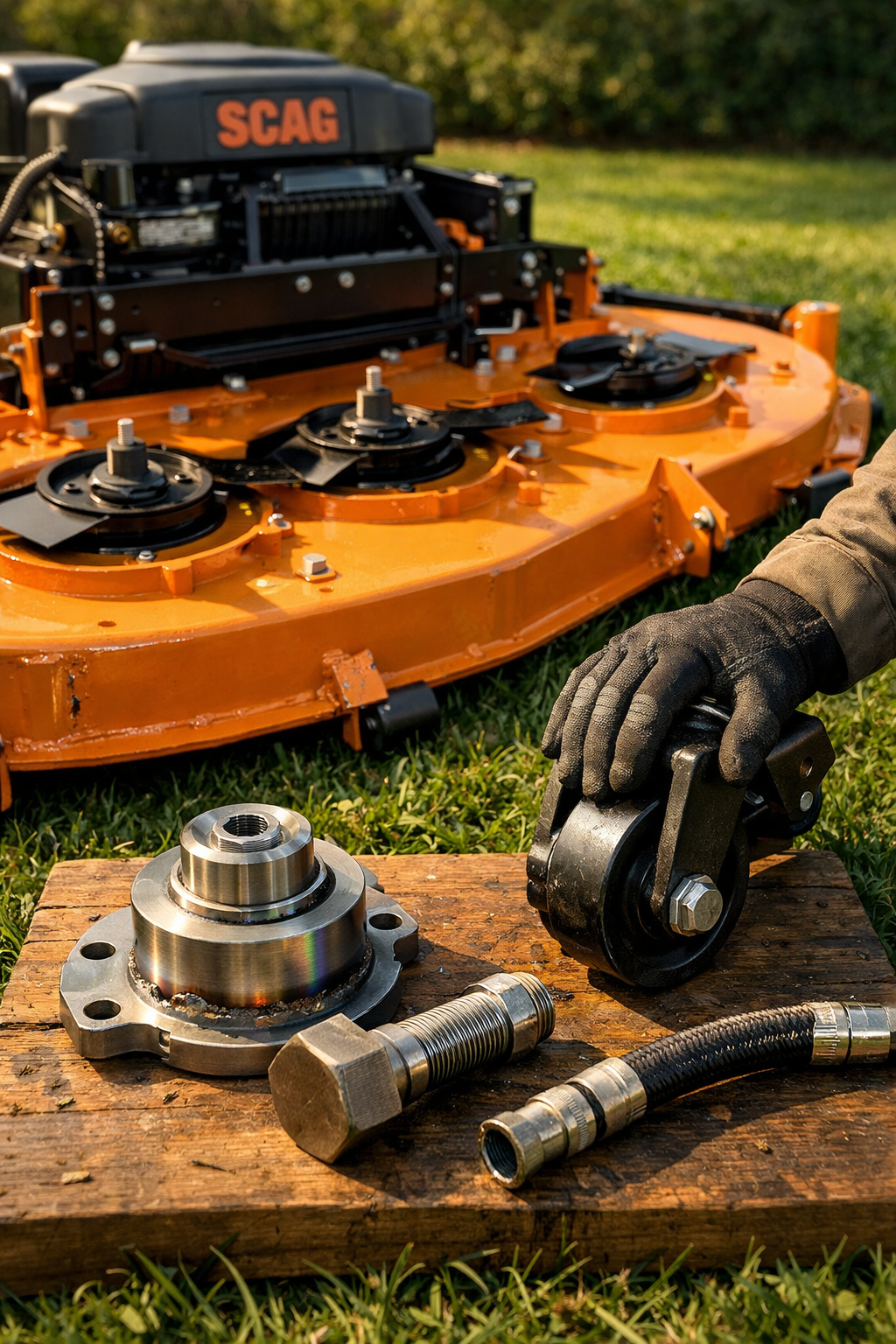
Scag uses greaseable spindle assemblies on its commercial models. That means you can inject fresh grease into the spindle bearings at regular intervals rather than running sealed bearings that fail without warning. A greaseable spindle, serviced every 50 hours, will routinely outlast a sealed bearing spindle by two to three seasons.
Belt routing on Scag decks is designed for fast replacement. On the Turf Tiger II and Cheetah II, the deck belt can be swapped without removing the deck from the machine — a job that takes roughly 20 to 30 minutes with basic hand tools. On some competing brands, the same job requires deck removal and adds an hour or more to the process. For commercial operators, that downtime difference is real money. For homeowners, it means fewer trips to the dealer for service work you can handle yourself.
The Real Cost of Owning a Scag: Upfront Price vs. Long-Term Value
Scag mowers cost more upfront than most competitors, but the total cost over a decade often favors Scag if you’re using the machine hard enough to justify it. The break-even point is roughly 2 acres of weekly mowing or any commercial use. Below that threshold, a mid-range residential zero-turn will serve you fine for less money.
Here’s what drives the real cost comparison:
Purchase price ranges from about $5,500 for a Patriot to over $15,000 for a fully configured Turf Tiger II with a 72-inch deck.
Engine rebuilds on Kawasaki FX-series engines typically run $800 to $1,500, but those engines routinely hit 2,000 hours before needing one, compared to 500 to 800 hours on lighter residential powerplants.
Deck replacement on a competitor’s stamped deck can cost $400 to $700; Scag’s fabricated decks rarely need full replacement, even after years of commercial use.
Resale value on used Scag commercial models holds well. A five-year-old Turf Tiger II in working condition commonly sells for 40 to 55% of its original price in private sales.
Dealer labor rates for Scag service average $85 to $110 per hour depending on region, which is standard for commercial equipment.
Where the Premium Price Pays Off — and Where It Doesn’t
The premium pays off clearly when you’re mowing 2 or more acres weekly, running a lawn care business, or mowing in conditions that stress equipment: thick grass, slopes, or high-hour seasonal use. In those situations, the fabricated deck, greaseable spindles, and commercial drivetrain components reduce repair frequency enough to offset the higher purchase price within four to six years.
It doesn’t pay off on a half-acre suburban lawn mowed every ten days. A homeowner in that situation is paying for durability they’ll never use. A mid-range zero-turn mower from a brand like Husqvarna or Cub Cadet at $3,000 to $4,000 will handle that load without trouble.
Total Cost of Ownership Over 5 to 10 Years
A realistic 10-year cost for a Scag Freedom Z, including purchase, routine maintenance, and typical repairs, runs roughly $12,000 to $14,000. A comparable residential zero-turn purchased at $3,500 may cost $10,000 to $13,000 over the same period once you factor in two replacement machines and higher repair frequency. The gap narrows significantly at higher usage levels, which is exactly why commercial operators view Scag as the cost-efficient choice despite the sticker price.
Maintenance Requirements to Hit Scag’s Advertised Lifespan
Scag’s commercial machines are rated for 2,000+ hours of service life, but that number assumes you’re actually maintaining them. Skipping service intervals is the fastest way to cut that lifespan in half.
Service Task
Interval
Notes
Engine oil change
Every 50 hours
Use manufacturer-specified viscosity; Kawasaki FX engines typically call for 10W-40
Spindle greasing
Every 50 hours
Critical on commercial models with greaseable assemblies
Air filter check
Every 25 hours
Replace, don’t just clean, in dusty conditions
Deck belt inspection
Every 100 hours
Look for glazing, fraying, or tension loss
Blade sharpening
Every 25 hours
Dull blades stress spindle bearings and cut quality drops fast
Hydraulic fluid change
Every 500 hours
Use Scag-specified hydrostatic transmission fluid
Fuel filter replacement
Annually or every 200 hours
More frequent with ethanol-blended fuel
Routine Service Intervals Every Owner Should Know
The 50-hour mark is your most important service checkpoint. Oil changes and spindle greasing both fall there, and missing either shortens engine and bearing life measurably. Keep a simple hour-log in your shop or garage. Most Scag models include an hour meter on the dash, so tracking this takes seconds.
Common Wear Points and Parts That Need Watching
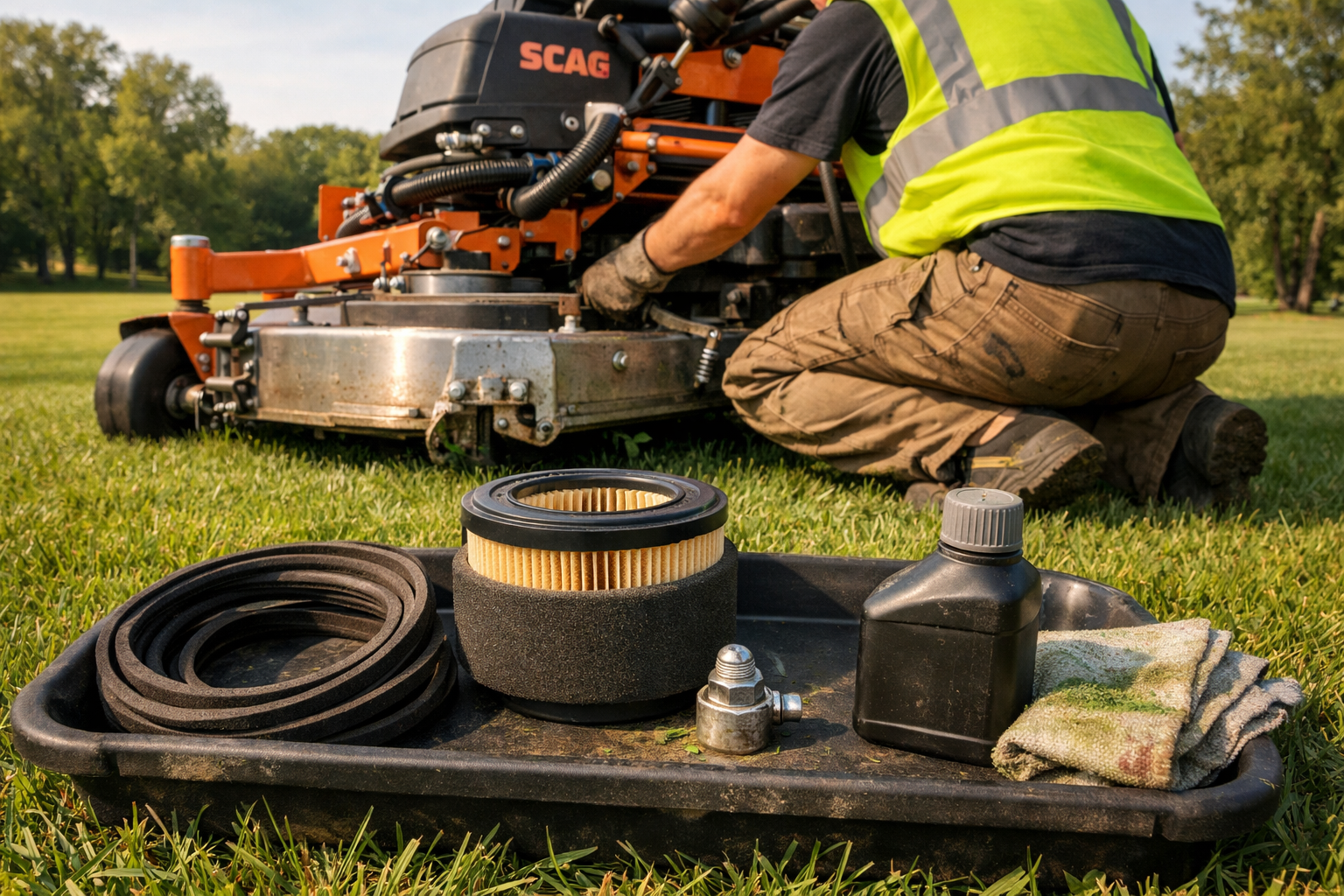
Blades, belts, and spindle bearings are the three parts you’ll replace most often. Blades on a 61-inch deck run about $15 to $25 each; you’ll go through two or three sets per season under heavy use. Idler pulleys are a less obvious wear point. They run constantly under belt tension and typically need replacement every 300 to 500 hours. Budget roughly $20 to $40 per pulley, and keep one spare on hand.
How Scag Stacks Up Against Husqvarna and Exmark
Scag, Husqvarna, and Exmark all build capable commercial mowers, but they target slightly different buyers. Scag’s edge is build quality and parts availability; Husqvarna competes on price and dealer network density; Exmark, which shares ownership with Toro, leans on cutting performance and operator ergonomics.
Exmark describes its Triton and UltraCut deck systems as engineered specifically for professional-grade cut quality across varying grass conditions — a claim Scag counters with its Velocity Plus deck, which prioritizes discharge volume and speed at higher ground rates.
Husqvarna’s commercial zero-turns, like the MZ series, typically come in $1,000 to $2,500 below comparable Scag models at purchase. The trade-off is frame and deck gauge — Husqvarna’s commercial line uses lighter materials in several areas, which shows up in repair frequency after three to four seasons of daily use.
Exmark is the closest competitor to Scag in terms of build quality. Many professional operators who have run both brands report similar longevity, with the choice often coming down to dealer proximity and personal preference on cutting deck feel. If your nearest Scag dealer is 60 miles away and there’s an Exmark dealer in town, that service access matters more than spec-sheet differences. Themowersguide.com covers detailed side-by-side comparisons of both brands if you want to dig into specific model matchups.
Finding a Dealer, Getting Parts, and Warranty Coverage
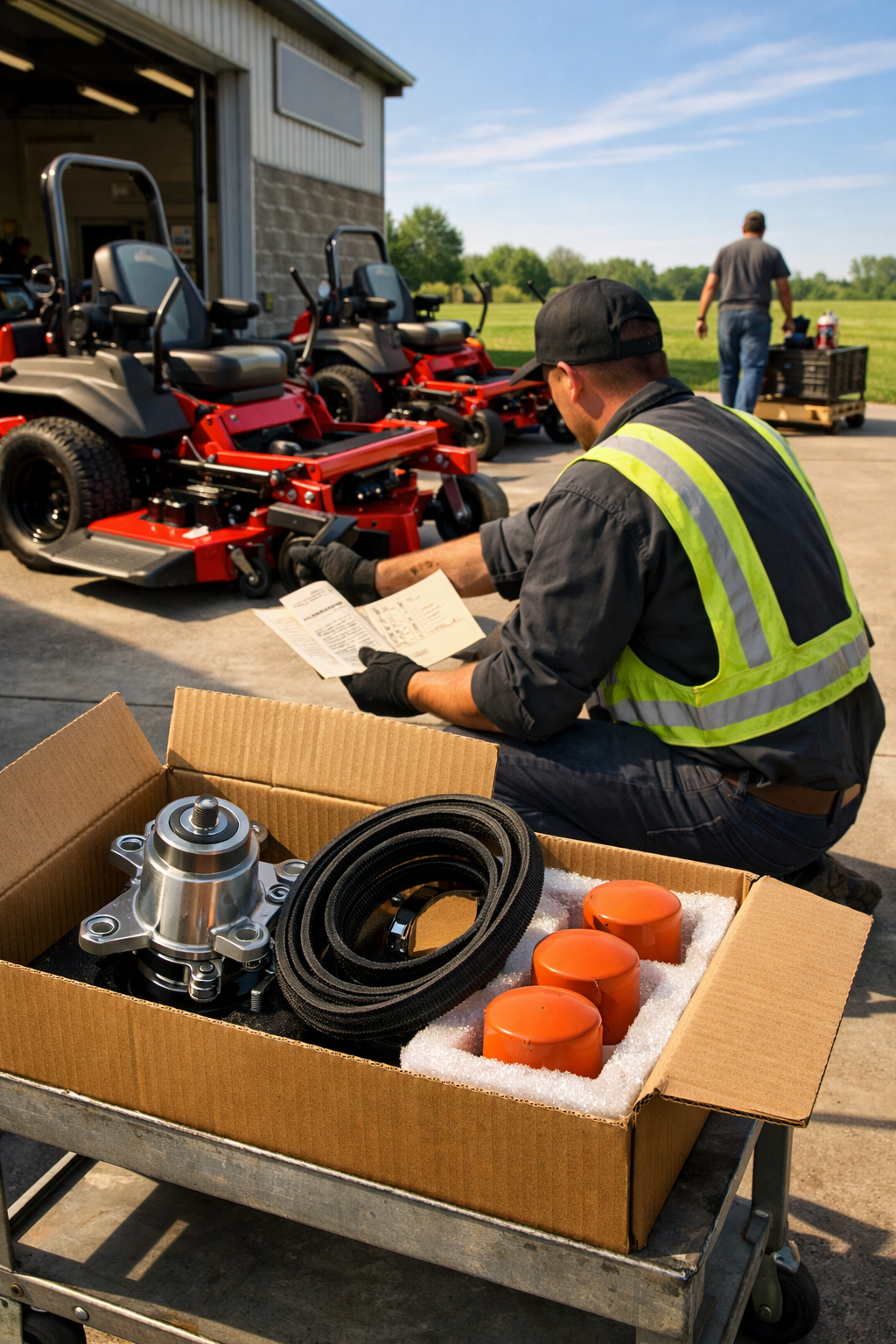
Scag sells exclusively through an authorized dealer network. You won’t find Scag mowers at big-box retailers, and that’s a deliberate choice. Dealers are required to carry parts inventory and provide factory-trained service, which matters when a belt snaps mid-season and you need it same-day.
The dealer locator at scag.com finds authorized locations by zip code. Coverage is solid across most of the South and Midwest, thinner in the Pacific Northwest and parts of New England. If your nearest dealer is more than an hour away, factor that into your purchase decision, because warranty work must go through an authorized location.
Parts availability is a genuine strength. Common wear items like OEM (original equipment manufacturer) blades, belts, and idler pulleys are stocked by most dealers and available through online distributors. Spindle assemblies and hydraulic components typically ship within two to three business days.
Scag’s standard commercial warranty covers two years on the machine and five years on the fabricated steel deck, which is longer deck coverage than most competitors offer at this price tier. Residential models like the Patriot carry a three-year limited warranty. Neither warranty covers normal wear items (blades, belts, filters), so budget for those separately from day one.
Frequently Asked Questions
Are scag mowers worth it for a homeowner?
Yes, if you’re mowing 2 or more acres weekly. Below that, the commercial build quality costs more than it saves. A homeowner with a half-acre lot will find a $3,000 to $4,000 residential zero-turn handles the workload without the premium price.
What engine options do scag mowers use?
Scag equips most commercial models with Kawasaki FX-series or Briggs and Stratton Vanguard engines, ranging from 22 to 37 horsepower depending on the model and deck size. The Freedom Z and Patriot use lighter-duty Kawasaki or Kohler engines suited to lower weekly hours.
How long do scag mowers last?
Commercial models like the Turf Tiger II are rated for 2,000-plus hours with proper maintenance. In practice, well-maintained units running 500 to 600 hours per season can reach eight to ten years of service life before major drivetrain work is needed.
Can I get scag mower parts without going through a dealer?
Yes. Common parts — blades, belts, filters, and pulleys — are available through several online distributors using Scag’s published part numbers. For warranty-covered repairs or hydrostatic transmission components, you’ll need to go through an authorized dealer to keep the warranty intact.
John Deere’s E100 series starts at around $1,700, while a comparable X350 runs closer to $3,200. That $1,500 gap is exactly where most homeowners make the wrong call. Deere tractors span...
Two brands, one driveway, and a decision that’ll cost you real money for the next decade. Cub Cadet vs John Deere isn’t about which name sounds more trustworthy on a tractor...
27 September 2026
The Mowers Guide is reader-supported. When you buy through links on our site, we may earn an affiliate commission.






Comments are closed.