Do you actually need 4 wheel drive lawn mowers, or are you paying for traction you’ll never use? That’s the real question, and it depends entirely on your yard, not on what the salesman at the equipment dealership tells you. A flat quarter-acre lot needs zero extra drivetrain. A half-acre hillside covered in wet clay after every storm is a different story.
Most homeowners buy more mower than their lawn calls for. This guide sorts out where 4WD earns its keep, where it’s dead weight, and what it actually costs you in upkeep.
What Makes 4 Wheel Drive Lawn Mowers Different From 2WD and AWD
A 4WD lawn mower drives power to all four wheels at once through a mechanical or hydraulic system, giving it grip that a 2WD mower (power to just the rear or front wheels) can’t match on loose or sloped ground. That’s the short version. The longer version matters more if you’re comparing specs.
4WD vs 2WD: Where the Power Actually Goes
Two-wheel-drive mowers, which cover the vast majority of residential riding mowers and lawn tractors, send power to the rear axle only. On dry, flat turf that’s plenty. Add a wet slope or loose soil, and the front wheels start to slide instead of steer, which is how mowers end up stuck or, worse, sliding sideways on a grade.
4WD vs AWD: Not the Same System
Here’s where a lot of buyers get tripped up. All-wheel drive systems, common on some newer zero-turn and tractor models, apply power to all four wheels continuously and automatically, often through a hydrostatic transmission that adjusts torque on the fly. True 4WD systems on lawn tractors are usually driver-engaged or mechanically locked, meaning you (or a differential) decide when extra traction kicks in. They solve similar problems but aren’t interchangeable terms, and a spec sheet that blurs the two is worth a second look before you buy.
When 4WD Actually Pays Off: Slopes, Mud, and Rough Ground
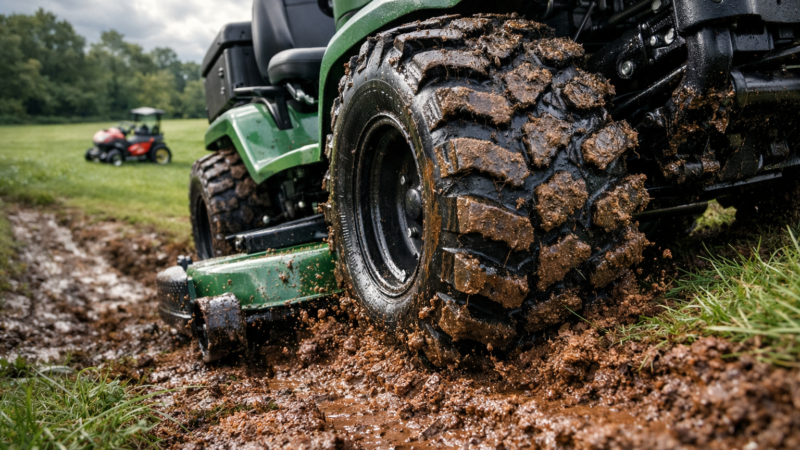
4WD earns its cost on grades over roughly 15 degrees, in consistently wet or clay-heavy soil, or on rough, rutted acreage where a 2WD mower would spin out or bog down. Outside those conditions, you’re carrying extra weight and cost for traction you won’t use.
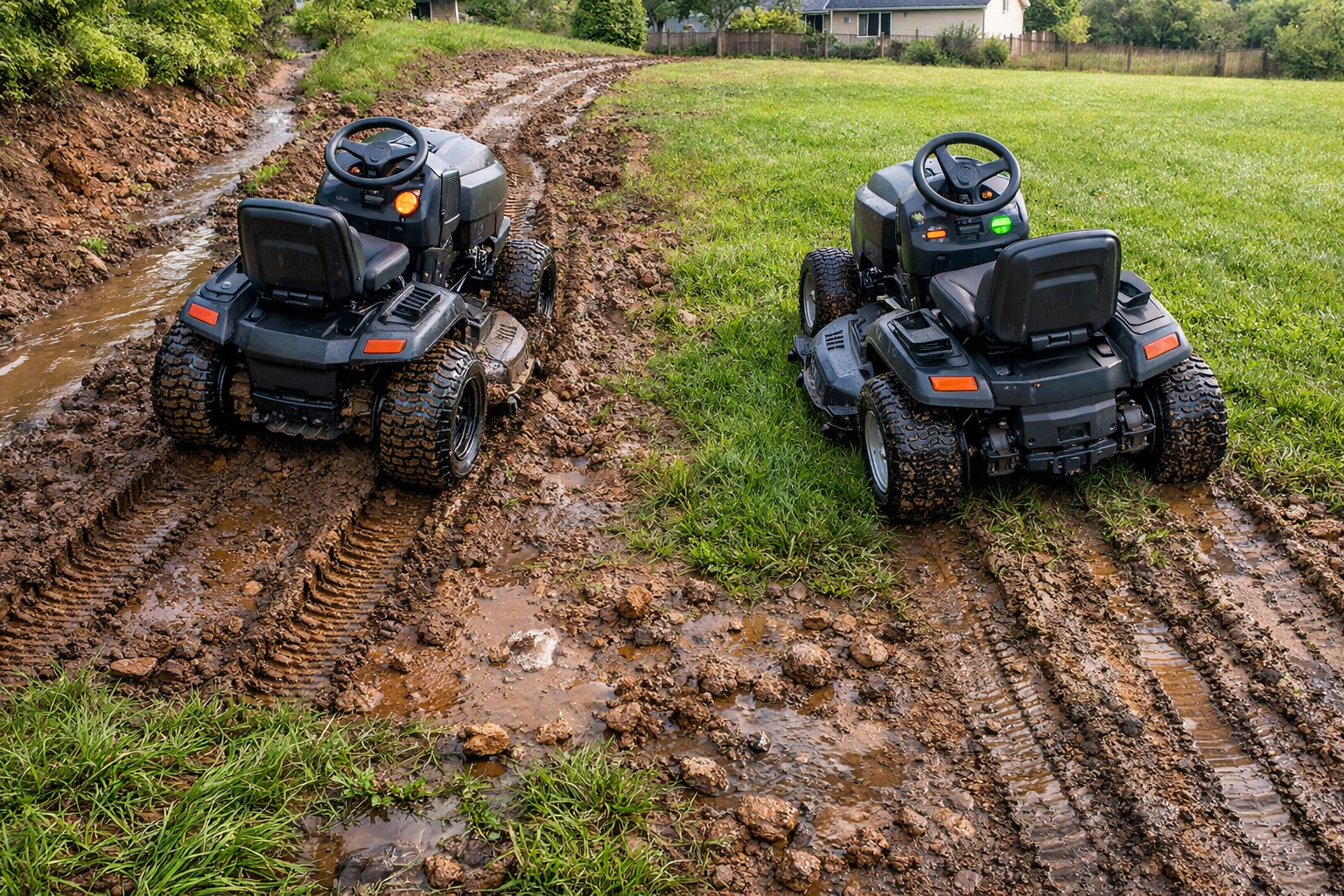
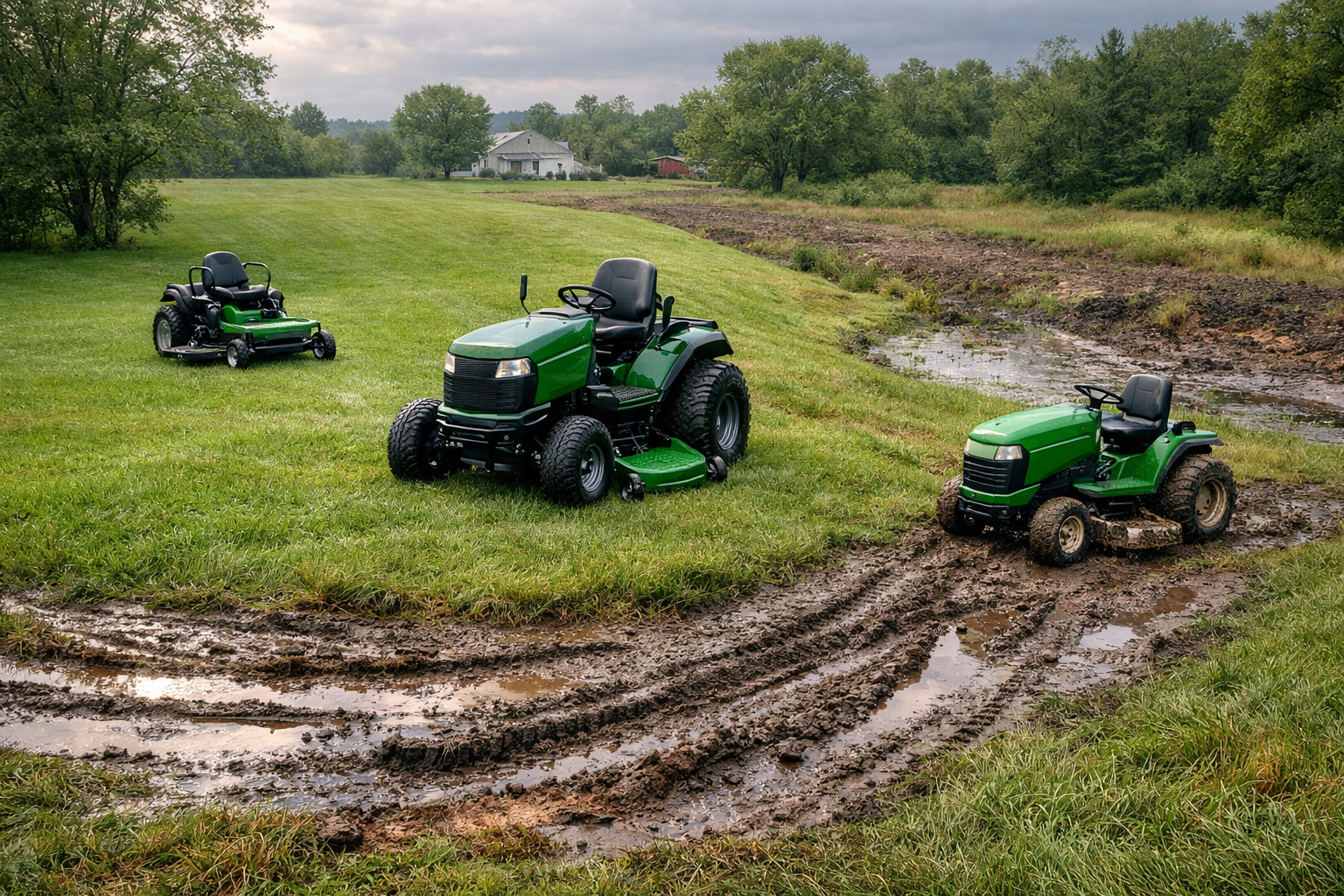
Think about a property with a drainage swale that stays soft through spring, or a back few acres with washed-out ruts from years of runoff. That’s the kind of ground where 4WD lawn tractors and compact utility tractors show a real difference: less wheel spin, less turf tearing, better control climbing back up a grade instead of sliding down it.
Slope safety still comes down to technique, not drivetrain. Even a 4WD lawn tractor can roll on a steep enough grade if you take it sideways or turn uphill too sharply. The Occupational Safety and Health Administration and most mower manufacturers recommend mowing up and down slopes rather than across them on riding equipment, and keeping grades under about 15 degrees for ride-on mowers altogether. Extra traction doesn’t cancel out physics.
A steep slope is one where you’d think twice about walking a wheelbarrow across it. If that describes part of your yard, a push mower or a 4WD zero-turn with rear stability bars is worth considering before a standard riding tractor.
The Honest Downside: Cost, Weight, and Maintenance
4WD mowers cost more to buy, more to fuel, and more to maintain than 2WD equivalents, because you’re running extra axles, a transfer case or hydraulic drive lines, and more moving parts that wear out. For a flat, small lawn, none of that buys you anything.
Expect a 4WD lawn tractor to run several hundred dollars more upfront than a comparable 2WD model, often landing in the $3,500 to $6,000 range for mid-size residential units, versus $2,000 to $3,500 for a solid 2WD tractor of similar cutting width. Fuel use climbs too, since the engine is working the extra drivetrain even on easy ground.
Maintenance is the part people underestimate. Front differentials, drive shafts, and hydraulic traction lines need fluid checks and occasional seal replacement that a 2WD mower simply doesn’t have. That’s real labor and real parts cost every season, not a one-time expense.
Factor
2WD Mower
4WD Mower
Typical price range
$2,000–$3,500
$3,500–$6,000
Best terrain
Flat to mild grade, dry soil
Steep grade, wet or loose soil
Annual maintenance complexity
Low (single drive axle)
Higher (front axle, transfer case, hydraulic lines)
Fuel use
Lower
5–15% higher, depending on load
Weight
Lighter
Heavier, more turf compaction risk
Matching the Mower to the Job: Tractors, Zero-Turns, and Terrain
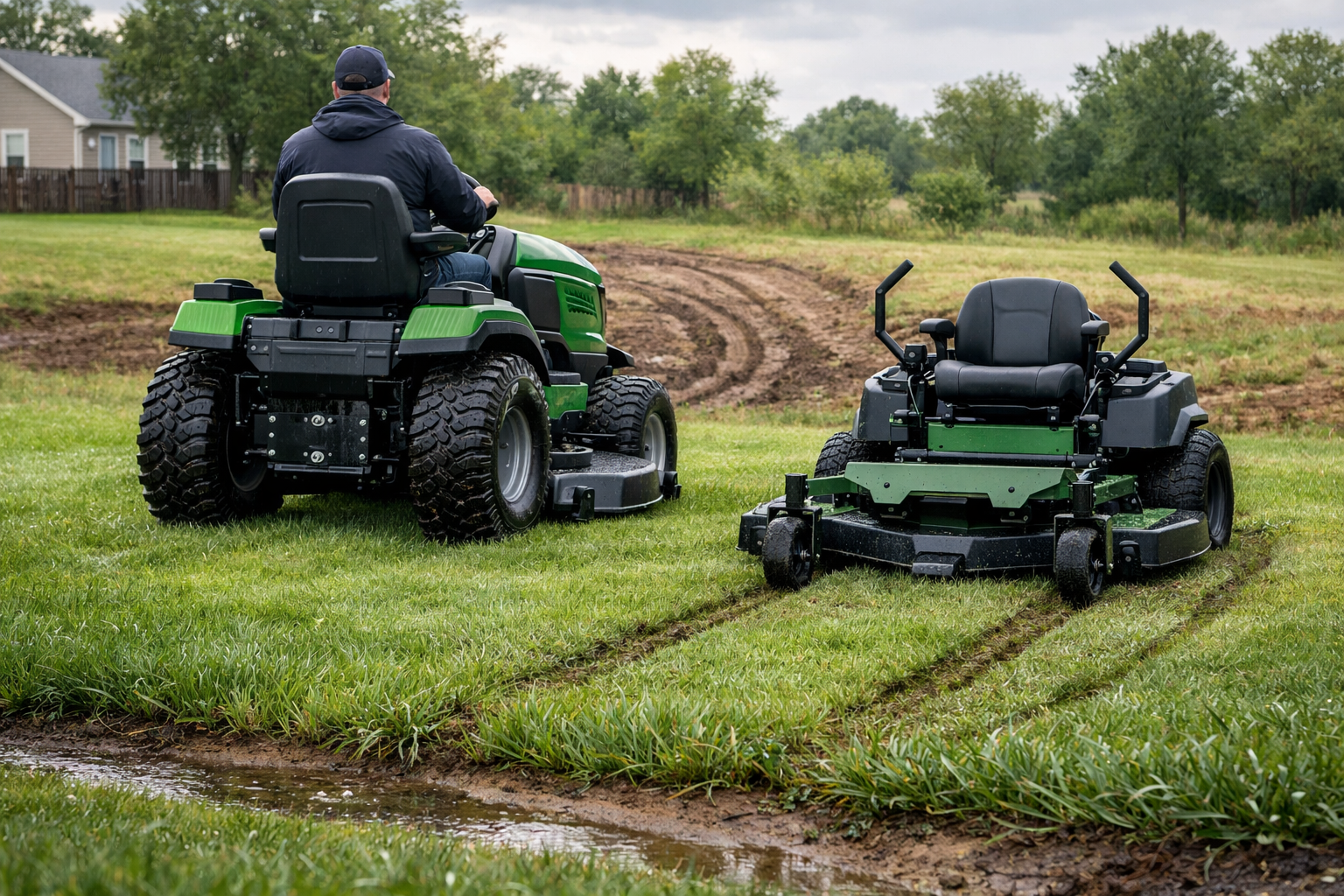
A residential lawn under an acre with mild grades doesn’t need 4WD, full stop. That’s the honest take most retailers won’t lead with, because 4WD models cost more and carry better margins. But a straightforward, flat lawn mowed with a 2WD lawn tractor or a mid-size zero-turn will cut just as clean and last just as long.
Lawn Tractors vs Garden Tractors
Lawn tractors are built for cutting grass on residential lots, typically under 25 horsepower, with a mowing deck as the main attachment. Garden tractors are heavier-duty, often 20 to 25+ horsepower, built to run attachments like tillers, snow blades, and small trailers in addition to mowing. If your property does more than mow (grading, hauling, snow clearing), a garden tractor with 4WD makes far more sense than stretching a lawn tractor beyond its job.
Zero-Turn Compatibility
Most true zero-turn mowers use independent hydrostatic drive to each rear wheel rather than a traditional 4WD system, though some newer AWD zero-turns add front-wheel assist for hillside stability. If your lot has rolling grades but nothing steep, an AWD zero-turn often beats a heavier 4WD tractor for maneuverability around trees and beds.
Here’s a practical way to sort it out before you shop:
Walk your property and note any slope over 15 degrees or consistently soft, wet ground.
Measure your total mowed acreage; under one acre with mild grades rarely justifies 4WD.
Check whether you’ll run attachments beyond a mowing deck (tiller, blade, cart).
Compare fuel and maintenance costs for 4WD versus 2WD models in your target horsepower range.
Test-drive on an actual slope if possible, not just a flat dealer lot.
Confirm whether the model is true 4WD, AWD, or 2WD with a locking differential; the spec sheet doesn’t always spell it out clearly.
For step-by-step maintenance schedules once you’ve settled on a model, riding mower upkeep guides on sites like themowersguide.com walk through fluid checks, belt inspection, and seasonal service intervals specific to tractor and zero-turn drivetrains.
Frequently Asked Questions
Do I need 4 wheel drive for a hilly half-acre lawn?
It depends on the grade, not just the acreage. If slopes stay under 15 degrees and drain well, a 2WD tractor with good tires usually handles it fine; steeper or consistently wet grades are where 4WD earns its cost.
Does 4WD prevent mowers from rolling over on slopes?
No. 4WD improves traction, not stability, and rollovers happen from mowing across a slope or turning too sharply regardless of drivetrain. Always mow up and down steep grades, never sideways, and keep speed low on descents.
Are 4WD mowers harder to repair than 2WD models?
Generally yes, because they have more components: front differentials, transfer cases, or extra hydraulic lines that 2WD mowers don’t carry. Budget for higher annual maintenance costs and expect repairs to take longer at a dealer or independent shop.
What Are Zero-Turn Mowers and Why Choose John Deere John Deere has spent over 185 years earning the trust of landowners, farmers, and lawn care professionals — and their zero-turn mowers...
A slit seeder rental runs about $70 to $100 for a half-day at most equipment centers, while a decent broadcast spreader costs $40 to $60 and lasts a decade. That gap...
23 July 2026
The Mowers Guide is reader-supported. When you buy through links on our site, we may earn an affiliate commission.





Comments are closed.