Introduction to Bad Boy Mowers: Power Meets Precision
Bad Boy Mowers has built a reputation not just on cutting grass, but on cutting it faster, cleaner, and more efficiently than the competition — and lawn enthusiasts across America have taken notice.
For anyone serious about lawn care, the name Bad Boy Mowers carries real weight. Founded in 2002 in Batesville, Arkansas, this American-made brand has grown into one of the most recognized names in the zero-turn and commercial mowing industry. Whether you’re managing a half-acre suburban yard or maintaining sprawling commercial grounds, Bad Boy Mowers offers a lineup designed to tackle virtually every mowing challenge imaginable.
What separates this brand from the crowded field of lawn equipment manufacturers is a commitment to raw power, thoughtful engineering, and machines built to last. These aren’t entry-level mowers dressed up with flashy branding — they’re heavy-duty cutting machines engineered for performance. From homeowners who take pride in a pristine lawn to professional landscapers who need reliable equipment day after day, Bad Boy delivers on its bold promise.
In this guide, we’ll walk through the complete model lineup, explore standout features, compare Bad Boy against competing brands, and help you find the perfect mower for your specific needs and lawn care goals.
A Complete Overview of Bad Boy Mowers Models
When shopping for a Bad Boy mower, you’ll quickly discover the brand offers a broad and well-structured product lineup. Understanding the different categories helps you match the right machine to your specific property and workload.
Model Series
Type
Engine Options
Deck Size Range
Best For
MZ Magnum
Zero-Turn
Kawasaki FR651V, Kohler 7000
42″ – 54″
Residential homeowners
ZT Elite
Zero-Turn
Kawasaki FR730V, Briggs & Stratton
48″ – 60″
Mid-range residential/light commercial
Maverick HD
Zero-Turn
Kawasaki FX Series, Vanguard
54″ – 72″
Heavy residential and light commercial
Outlaw Series
Zero-Turn
Kawasaki FX850V, Vanguard 37
61″ – 72″
Full commercial use
Revolt
Stand-On
Kawasaki FX Series
48″ – 61″
Commercial landscapers
Compact Outlaw
Zero-Turn
Briggs & Stratton, Kawasaki
42″ – 54″
Smaller properties with obstacles
Zero-Turn Mowers
Zero-turn mowers are the cornerstone of the Bad Boy lineup. Models like the Outlaw Series and ZT Elite are built around a lap-bar steering system that allows the operator to make precise, tight turns with virtually zero turning radius. This translates directly into faster mowing times and cleaner results around trees, flower beds, and landscaping features. The Outlaw XP, in particular, stands out as a top-tier commercial performer with its heavy-gauge steel frame and high-horsepower engine options.
Stand-On and Walk-Behind Models
The Revolt stand-on mower is Bad Boy’s answer to the needs of professional landscaping crews. Stand-on mowers offer excellent maneuverability in tight spaces and allow operators to dismount quickly on slopes or around obstacles. Their compact footprint also means more machines can fit on a trailer, improving crew efficiency. While Bad Boy’s walk-behind offerings are more limited compared to their zero-turn range, the stand-on Revolt fills a critical role for commercial operators who need versatility without sacrificing power.
Residential vs. Commercial Grade Options
Bad Boy draws a clear distinction between its residential and commercial-grade machines. Residential models like the MZ Magnum are designed for homeowners with properties up to a few acres, offering excellent value with dependable engine options and user-friendly controls. Commercial-grade machines like the Outlaw and Maverick HD feature heavier frames, larger fuel tanks, more powerful engines, and reinforced cutting decks built to withstand daily, multi-hour use. Choosing the right tier matters — investing in a commercial-grade mower for a small yard is unnecessary, while underspecifying for large acreage will lead to premature wear.
Key Features That Set Bad Boy Mowers Apart
Zero-turn technology, fabricated deck construction, and commercial-grade hydraulics are just a few of the engineering highlights that define the Bad Boy lineup. These aren’t cosmetic features — they directly impact how the mower performs across different terrains and grass conditions.
The best mower isn’t always the most expensive one — it’s the one engineered with the right features for the job at hand, and Bad Boy consistently builds machines that punch above their price point.
Engine Performance and Cutting Deck Technology
Bad Boy mowers are paired with some of the most respected engine brands in the outdoor power equipment industry, including Kawasaki, Kohler, and Briggs & Stratton Vanguard. These powerplants deliver consistent torque and reliable starting across seasons. The fabricated steel cutting decks — as opposed to stamped decks found on budget mowers — are welded for superior rigidity and airflow optimization. This design produces a cleaner, more uniform cut even at higher speeds. Deck thicknesses on commercial models typically range from 7-gauge to 10-gauge steel, offering exceptional resistance to impact damage from rocks and debris.
Durability and Build Quality
Bad Boy’s commitment to American manufacturing shows in every weld and component choice. The brand uses heavy-duty tubular steel frames, reinforced spindle housings, and commercial-rated hydraulic pumps and wheel motors from industry leaders like Parker and Hydro-Gear. These components are the backbone of a mower’s longevity, and sourcing them from trusted suppliers means operators can expect thousands of hours of reliable service with proper maintenance. The overall build philosophy prioritizes long-term durability over short-term cost savings — a distinction that matters deeply to both DIY lawn owners and professional crews alike.
How to Choose the Right Bad Boy Mower for Your Lawn
Selecting the right Bad Boy mower comes down to more than just budget. Your property’s size, terrain, and grass type all play a role in determining which model will deliver the best results. Use the following checklist to guide your decision:
Measure your total lawn acreage accurately before comparing models.
Identify any slopes, ditches, or uneven terrain that could affect stability.
Determine whether your grass type requires a high-lift or mulching blade configuration.
Assess how frequently you mow — weekly residential use differs vastly from daily commercial operation.
Set a realistic budget that accounts for both purchase price and long-term maintenance costs.
Consider storage space, since larger deck sizes require more room in a garage or shed.
Decide whether you need additional attachments like baggers, mulch kits, or striping rollers.
Informed purchasing decisions save money and prevent the frustration of owning a machine that’s either underpowered or unnecessarily oversized for your property.
Matching Mower Size to Lawn Acreage
Deck size is one of the most critical variables when choosing a Bad Boy mower. For lawns under one acre, a 42″ to 48″ deck on a model like the MZ Magnum offers plenty of cutting width without being unwieldy. Properties between one and three acres benefit most from the ZT Elite or Compact Outlaw, with deck sizes in the 54″ to 60″ range that reduce mowing time significantly. For anything beyond three acres — especially commercial properties or large estates — the Outlaw Series with a 61″ to 72″ deck becomes the practical choice. Matching deck size to acreage isn’t just about speed; it also reduces engine strain and fuel consumption over time.
Terrain and Grass Type Considerations
Terrain matters just as much as size. If your yard features steep slopes or uneven ground, a model with a lower center of gravity and wider wheelbase — like the Maverick HD — provides better traction and stability. Flat, open properties allow for wider decks and faster ground speeds without safety concerns. Grass type also influences blade selection: dense fescue and Bermuda grass benefit from high-lift blades that create stronger airflow for a cleaner cut, while fine bluegrass varieties perform well with standard or mulching configurations. Bad Boy’s interchangeable blade systems make it straightforward to adapt your mower to seasonal or regional grass conditions.
Bad Boy Mowers vs. Competing Brands: A Side-by-Side Comparison
When investing in a zero-turn or commercial mower, it’s worth seeing how Bad Boy stacks up against other well-known names in the industry. The comparison below highlights key differences across the most commonly evaluated categories.
Feature
Bad Boy Mowers
John Deere
Husqvarna
Scag Power Equipment
Deck Construction
Fabricated steel (7–10 gauge)
Stamped or fabricated (varies by model)
Stamped (residential), fabricated (commercial)
Fabricated steel (7 gauge)
Engine Partners
Kawasaki, Kohler, Vanguard
Kawasaki, Briggs & Stratton
Kawasaki, Briggs & Stratton
Kawasaki, Briggs & Stratton, Kohler
Hydraulic System
Parker, Hydro-Gear
Hydro-Gear
Hydro-Gear
Parker, Hydro-Gear
Price Range (ZTR)
$3,500 – $15,000+
$4,000 – $18,000+
$2,800 – $14,000+
$7,000 – $17,000+
Made in USA
Yes (Batesville, AR)
Partially
No
Yes
Warranty (residential)
5-year limited
4-year limited
3-year limited
2-year limited
Bad Boy Mowers consistently delivers commercial-grade construction at price points that undercut many competitors — making it one of the strongest value propositions in the zero-turn market today.
What this comparison reveals is that Bad Boy occupies a compelling middle ground: build quality that rivals premium brands like Scag, with pricing that remains more accessible than John Deere’s upper-tier commercial models. For DIY homeowners and professional landscapers alike, that combination of American manufacturing, strong warranty coverage, and trusted hydraulic components makes Bad Boy a genuinely competitive option rather than simply a budget alternative.
Maintenance Tips to Keep Your Bad Boy Mower Running Strong
A Bad Boy mower is a significant investment, and protecting that investment means committing to a consistent maintenance schedule. Neglecting routine upkeep is the fastest way to shorten the life of even the most heavy-duty machine.
Check and change the engine oil every 50 hours of operation or at the start of each season.
Inspect and replace the air filter every 25 hours in dusty or high-debris environments.
Sharpen or replace mower blades at least once per season, or after every 20–25 hours of cutting.
Grease all zerks (grease fittings) on spindles, caster wheels, and deck pivots every 8–10 hours.
Clean the underside of the cutting deck after every use to prevent grass buildup and corrosion.
Inspect hydraulic fluid levels monthly and replace per the manufacturer’s service interval.
Consistent preventive maintenance not only extends the life of your mower but also preserves cut quality and fuel efficiency across the entire operating season.
Routine Blade and Deck Maintenance
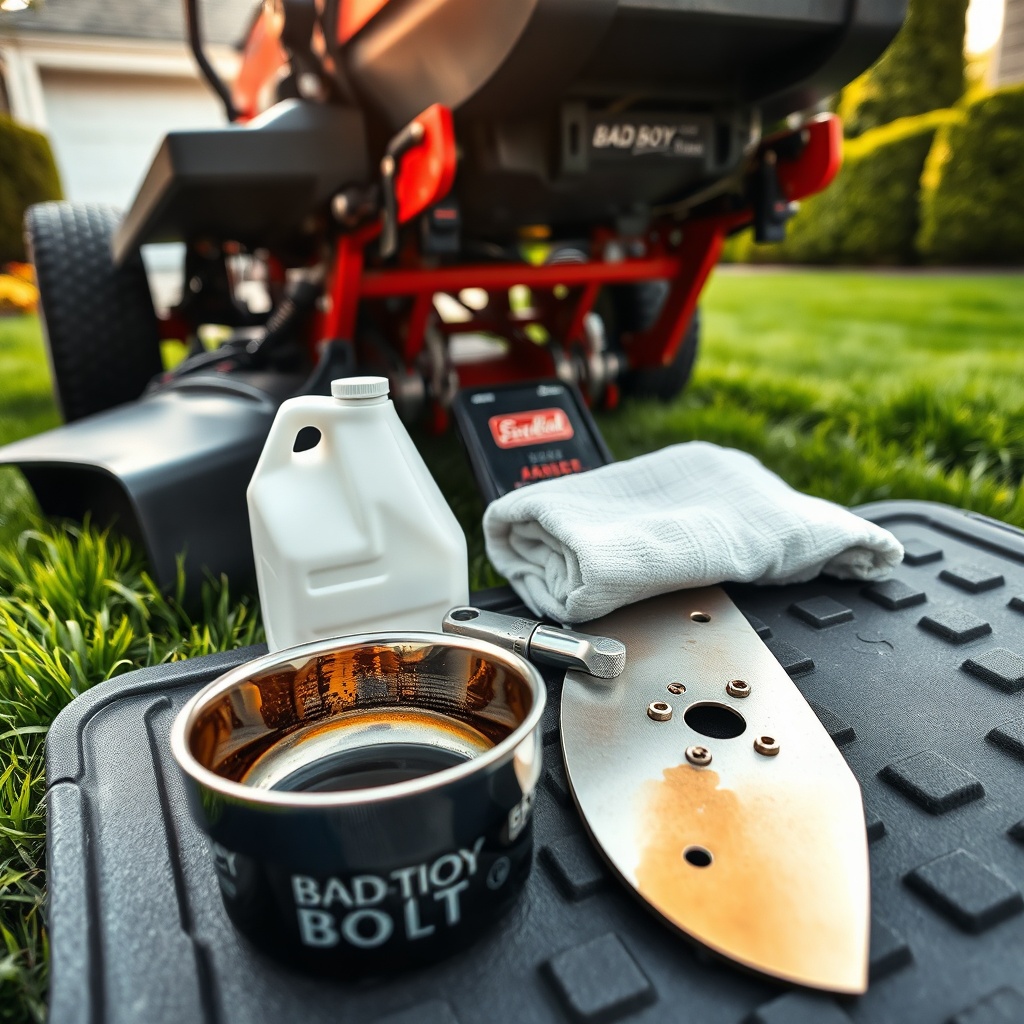
Sharp blades are the single most impactful factor in cut quality. Dull blades tear grass rather than cut it cleanly, leaving ragged tips that turn brown and invite disease. Bad Boy’s fabricated steel decks are designed for easy blade access, but operators should still inspect the deck underside for rust, cracks, or debris accumulation after heavy use. Applying a thin coat of deck spray or silicone lubricant to the underside reduces clumping and makes cleanup faster. Spindle bearings should also be checked regularly — a wobbling blade or unusual vibration is often an early warning sign of bearing failure.
Engine Care and Seasonal Storage
Before storing your Bad Boy mower at the end of the mowing season, a few critical steps protect the engine from cold-weather damage. Run the fuel system dry or add a quality fuel stabilizer to prevent carburetor gumming over winter. Change the oil before storage rather than after, since used oil contains acids that can corrode internal engine components during extended downtime. Remove and inspect the spark plugs, clean the cooling fins, and store the mower in a dry, covered location. Reconnecting a fully charged battery in spring and completing a fresh pre-season inspection will have your Bad Boy ready to perform from the very first cut.
Where to Buy Bad Boy Mowers and What to Expect on Price
Finding a Bad Boy Mower through the right channel makes a meaningful difference — not just in price, but in the level of support and service you receive after the sale. The most reliable starting point is the official Bad Boy Mowers dealer locator at badboysmowers.com, which connects buyers with authorized dealerships across the United States. Purchasing through an authorized dealer ensures your warranty remains valid and that factory-trained technicians are available for service and parts.
Beyond the manufacturer’s website, Bad Boy mowers are sold through regional outdoor power equipment dealers, farm supply stores, and select big-box retailers. Tractor Supply Co. carries select residential models in many locations, making it a convenient option for buyers who want to see a machine in person before committing. For commercial-grade models like the Outlaw or Maverick HD, a dedicated dealership is typically the better route since staff can walk you through configuration options and financing.
Pricing varies considerably depending on the model tier and engine configuration:
Residential zero-turns like the MZ Magnum start around $3,500 to $5,500
Mid-tier models such as the ZT Elite and Compact Outlaw typically range from $6,000 to $9,500
Commercial-grade Outlaw Series and Renegade models can reach $10,000 to $15,000 or more
Many authorized dealers offer seasonal financing promotions, particularly in spring and fall, which can include zero-interest periods for qualified buyers. It’s worth asking about end-of-season clearance pricing as well, since dealers often discount current-year inventory to make room for new models.
Used Bad Boy mowers are also available through platforms like Facebook Marketplace, Craigslist, and dealer trade-in programs. If purchasing used, always request maintenance records, inspect the deck and spindles for wear, and verify the hours on the engine meter. A well-maintained used unit can offer exceptional value, but skipping the inspection step is a risk not worth taking.
Frequently Asked Questions
How long do Bad Boy Mowers typically last?
With proper maintenance, a Bad Boy mower can last 15 to 20 years or more. Commercial-grade models built with heavy-gauge fabricated steel decks and premium engines like Kawasaki or Vanguard are particularly durable. Consistent oil changes, blade sharpening, and proper seasonal storage are the most important factors in maximizing the lifespan of any Bad Boy unit.
Are Bad Boy Mowers good for hilly or sloped terrain?
Yes, several Bad Boy models are well-suited for slopes. The Maverick HD and Renegade series feature wider wheelbases and lower centers of gravity that improve traction and stability on uneven ground. That said, zero-turn mowers should generally not be operated on slopes exceeding 15 degrees without specific safety features. Always consult the operator’s manual for slope ratings before mowing on challenging terrain.
Where are Bad Boy Mowers manufactured?
Bad Boy Mowers are proudly made in the United States, with manufacturing operations based in Batesville, Arkansas. This domestic production is a key selling point for buyers who prioritize American craftsmanship and want to support U.S.-based manufacturing jobs.
What engines do Bad Boy Mowers use?
Bad Boy partners with several of the most trusted engine manufacturers in the industry, including Kawasaki, Kohler, Briggs & Stratton Vanguard, and EFI (Electronic Fuel Injection) variants depending on the model. Engine choice affects power output, fuel efficiency, and long-term reliability, so it’s worth comparing options when selecting a specific model tier.
Do Bad Boy Mowers come with a warranty?
Yes. Bad Boy offers a 5-year limited warranty on residential models, which is one of the most competitive warranties in the zero-turn mower segment. Commercial models carry separate warranty terms. Coverage typically includes the frame, deck, and major mechanical components, though it’s advisable to review the full warranty documentation through an authorized dealer before purchase.
Ten days. That’s roughly how fast perennial rye grass pokes through soil under good conditions, compared to 14-30 days for Kentucky bluegrass. That speed is the whole reason lawn owners reach...
How do you calculate acreage? Measure the area in square feet and divide by 43,560. That’s the whole trick, and it works for a half-acre backyard or a 5-acre lot. The...
13 October 2026
The Mowers Guide is reader-supported. When you buy through links on our site, we may earn an affiliate commission.





Comments are closed.