Soil temperature, not the calendar, decides whether planting lawn seed in summer works. Warm-season grasses like Bermuda and zoysia germinate best between 70°F and 95°F soil temperature, which is exactly what July delivers across most of the country. Cool-season grasses like Kentucky bluegrass and tall fescue face the opposite problem: heat stresses seedlings faster than they can establish roots, and germination rates drop off once soil temps climb past 85°F.
That single distinction is the difference between a lawn that fills in by August and one that burns out by the second week. Before you buy a bag of seed, figure out which category your grass falls into.
Warm-Season vs. Cool-Season: The Rule That Decides Everything
If you don’t know which category your grass belongs to, nothing else in this article matters yet. Warm-season grasses thrive in summer heat and go dormant in winter. Cool-season grasses do the opposite: they grow best in spring and fall, and they suffer when soil temperatures climb into the 80s and 90s.
Warm-Season Grasses: Summer Is Their Growing Season
Bermudagrass, zoysia, centipede, St. Augustine, and bahiagrass are warm-season types common across the South, Southwest, and parts of the transition zone. These grasses germinate fastest when soil temperature sits between 70°F and 90°F, which lines up with peak summer conditions in most of their range. Seeding in June, July, or early August is not just acceptable for these species — it’s often the recommended window.
Cool-Season Grasses: Summer Works Against Them
Kentucky bluegrass, perennial ryegrass, tall fescue, and fine fescue are cool-season grasses common across the North, Midwest, and Pacific Northwest. They germinate best in soil temperatures between 50°F and 65°F. Push seed into ground that’s baking at 85°F soil temperature, and you’ll get spotty, weak germination at best. Many seedlings that do sprout won’t survive the following heat wave.
Here’s the plain rule, stated without hedging: if you have cool-season grass, don’t seed in summer. Wait for fall. If you have warm-season grass, summer is a legitimate and often ideal time to seed. There’s no middle ground here worth pretending exists — the two grass families respond to heat in opposite ways, and no amount of careful watering changes that basic biology.
Figuring out which type you have isn’t hard. Look at your existing lawn or your neighbors’ lawns during winter. If it goes brown and dormant, it’s warm-season. If it stays green through winter but struggles in peak summer heat, it’s cool-season. Regional norms help too — a lawn in Georgia or Texas is almost certainly warm-season, while one in Minnesota or Oregon is almost certainly cool-season. The transition zone (a band running roughly through Tennessee, Kentucky, and parts of Virginia and Missouri) grows both types, so check your specific species before deciding.
Why Soil Temperature Matters More Than the Calendar
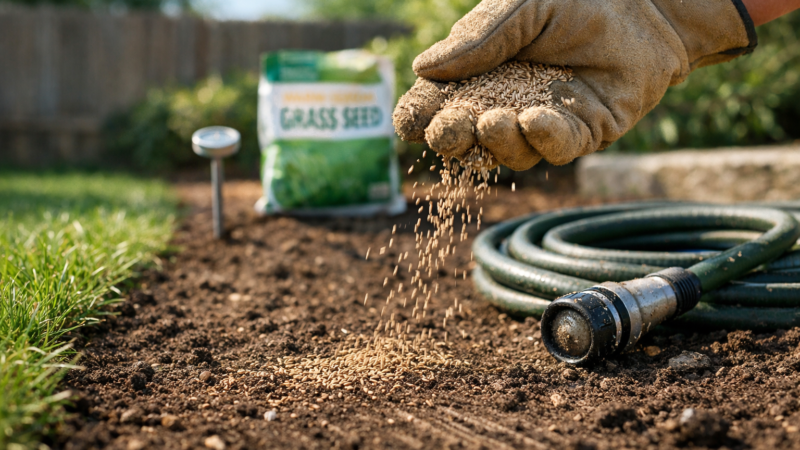
Grass seed doesn’t germinate based on the date. It germinates based on soil temperature at seed depth, typically measured 1 to 2 inches down. This is the single most misunderstood part of seeding, and it’s why so many DIY attempts fail even when the timing “feels” right.
Air temperature and soil temperature are not the same number, and the gap between them can be significant. A 90°F afternoon might sit over soil that’s only 75°F if there’s shade or recent rain cooling it down, or soil could be pushing 95°F in full sun on compacted clay. Checking the thermometer on your porch tells you nothing useful about what’s happening at the seed’s actual depth.
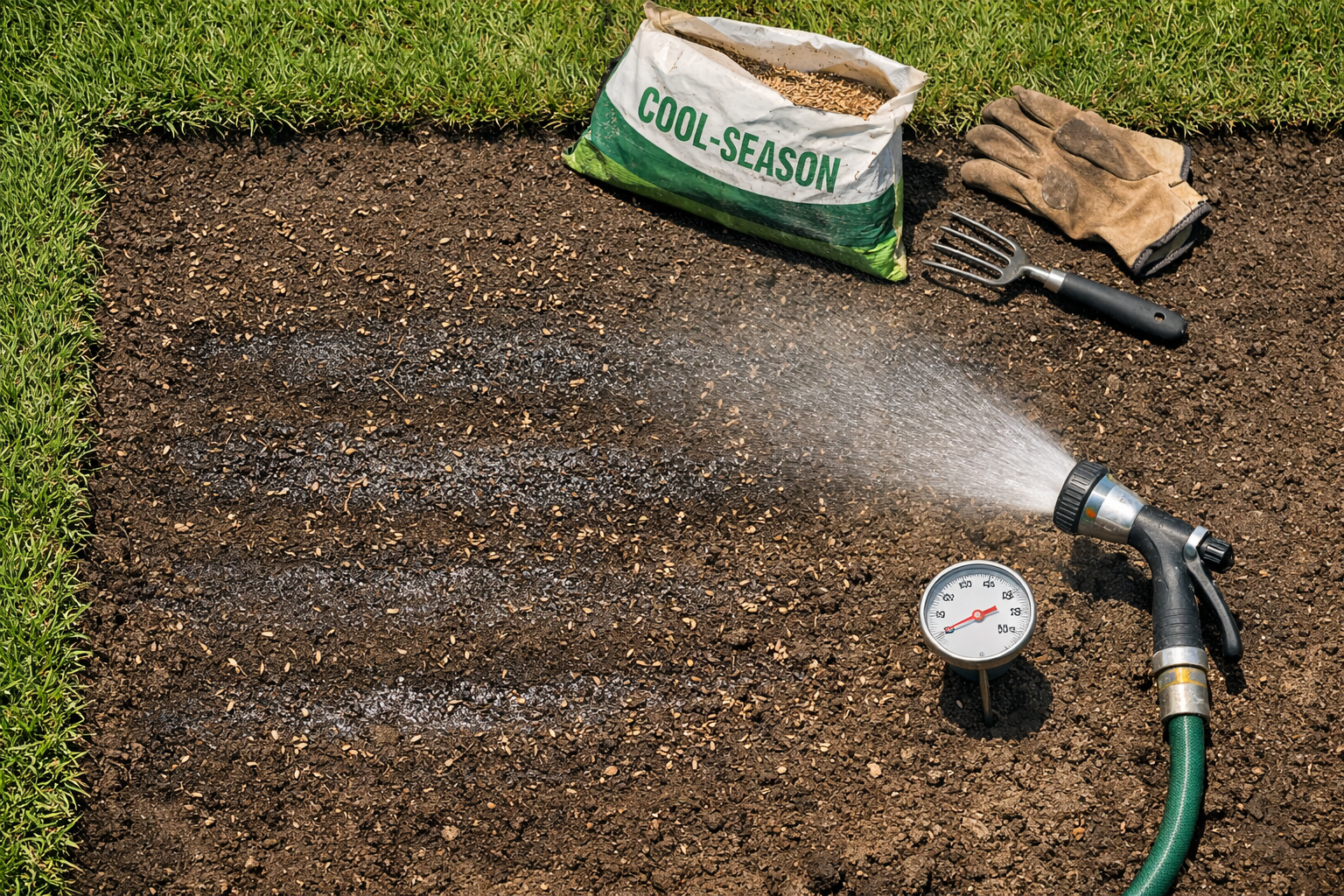
A basic soil thermometer, the kind sold for around $10 to $15 at most garden centers, solves this problem in about 30 seconds. Push it into the top 2 inches of soil in the area you plan to seed, check it in early morning and again in late afternoon, and average the two readings. Do this over three or four consecutive days rather than relying on a single reading, since one hot afternoon isn’t representative of your actual planting window.
Warm-season grass seed germinates fastest in soil temperatures of 70°F to 95°F, while most cool-season grass seed germinates best between 50°F and 65°F soil temperature — a gap wide enough that timing by species, not by calendar month, is the only reliable approach.
This is also why the same seeding advice can be right for one yard and wrong for the yard two streets over. A shaded, well-irrigated lot might run 8 to 10 degrees cooler at soil level than an exposed, south-facing yard with compacted soil. If you’re on the edge of a temperature range, that microclimate difference can be the deciding factor between decent germination and a wasted bag of seed.
Ignoring soil temperature and going by “it’s July, so it must be warm enough” is one of the most common seeding mistakes homeowners make. It leads people to seed cool-season lawns during heat spikes when soil temps have already blown past the safe germination window, and it leads warm-season lawn owners to seed too early in spring before soil has actually warmed enough, wasting seed on a cold snap.
Watering New Seed in Summer Heat: Frequency Beats Volume
New grass seed in summer needs light, frequent watering, not one deep soaking per day. The top quarter-inch of soil where seed sits dries out fast in July heat, sometimes within a couple of hours in full sun, so a single daily watering leaves seed dry for most of the day.
The standard mistake is treating new seed like an established lawn. Established turf wants deep, infrequent watering to encourage deep roots. New seed wants the opposite: shallow, frequent moisture that keeps the seed coat from drying out during germination. Confusing these two watering philosophies is one of the most common reasons summer seeding fails, even when soil temperature and grass type are both right.
The Watering Schedule That Actually Works
For the first 7 to 10 days after seeding, plan on watering 2 to 3 times per day, for roughly 5 to 10 minutes per session, enough to keep the top half-inch of soil consistently damp without pooling water or washing seed away. Morning (around 6 to 8 a.m.), midday (around noon to 1 p.m.), and early evening (around 5 to 6 p.m.) is a workable pattern for most climates. Once you see germination — usually 5 to 21 days depending on species, with ryegrass on the fast end and fescue and bluegrass slower — you can start stretching the interval between waterings.
Cutting Back as Roots Establish
By week three, most seedlings have enough root depth to shift toward once-daily watering, and by week five or six you can move toward the deep, infrequent schedule that mature turf prefers, typically about 1 inch of water per week split across two sessions. Rushing this transition is a common error; pull back too early and shallow summer heat can dry out young roots before they’ve gone deep enough to find moisture on their own.
Automated irrigation with a timer makes this dramatically easier to manage than hand-watering, especially with a midday session that most people forget when they’re at work. If you’re hand-watering, a simple kitchen timer or phone alarm for each session keeps things consistent, because missing even one midday watering on a 95°F day can set germination back noticeably.
Heat Stress on Seedlings: What Kills New Grass in July
Heat stress kills young seedlings by drying out their root zone faster than the plant can absorb replacement moisture, and by pushing leaf temperatures high enough to damage cell structure. Seedlings have no established root system yet, so they have almost no buffer against a hot, dry afternoon.
Symptoms show up fast: seedlings that were green in the morning can look wilted, gray-green, or crispy by late afternoon on a genuinely hot day. This is different from drought stress in mature grass, which usually takes days to show. A seedling can go from fine to damaged in a single afternoon if watering lapses during a heat spike.
Warm-season grass handles this better because it evolved for exactly these conditions, but even Bermuda and zoysia seedlings benefit from extra watering attention during the first two weeks, before roots are established enough to pull moisture from deeper soil. Cool-season seedlings have almost no tolerance for this kind of stress, which circles back to the core recommendation: don’t put cool-season seed through a Southern-summer-style heat cycle if you can avoid it by waiting for fall.
One overlooked factor is reflected heat from nearby surfaces. Seed planted next to a driveway, sidewalk, or south-facing wall experiences higher soil temperatures than seed planted in open lawn, sometimes by 5 to 8 degrees, because concrete and asphalt radiate stored heat back into the adjacent soil well into the evening. If you’re patching bare spots near hardscaping in summer, expect that section to need more frequent watering and closer monitoring than seed planted in open turf.
Best Time of Day to Seed and How to Protect It Afterward
Seed in the early morning or early evening, never at midday. Morning seeding (roughly 6 to 9 a.m.) lets you get seed and starter fertilizer down before the day’s heat builds, and it lines up naturally with the first watering session of the day. Evening seeding works too, giving seed a cooler overnight period before the next day’s heat arrives.
Midday seeding isn’t dangerous to the seed itself sitting in the bag, but working in full sun during peak heat is harder on you, and delays in getting water down after spreading seed matter more when the ground is already hot. Practically speaking, timing your seeding session to the start of a watering cycle is more important than the exact clock time.
Mulch and Straw Cover Cut Moisture Loss Significantly
A light layer of straw mulch, spread thin enough that you can still see about half the soil through it, reduces surface evaporation and moderates soil temperature swings. This matters more in summer than in fall or spring, because bare soil exposed to direct July sun can lose surface moisture within an hour or two of watering. Weed-free straw, sold in bales for roughly $6 to $10 at most garden centers, covers about 1,000 square feet per bale at a proper light rate. Avoid piling it thick — a heavy mat blocks light seedlings need once they emerge.
Starter Fertilizer Timing
Apply a starter fertilizer with higher phosphorus content (something like a 10-20-10 or similar ratio labeled for new lawns) at seeding time, following the bag’s rate for new seeding, not the maintenance rate. Phosphorus supports root development, which matters even more in summer heat when root establishment is racing against moisture loss. Skip a second fertilizer application until you’ve mowed the new grass two or three times, since pushing too much nitrogen on young seedlings in heat can stress them rather than help.
Overseeding an Existing Lawn vs. Starting Fresh in Summer
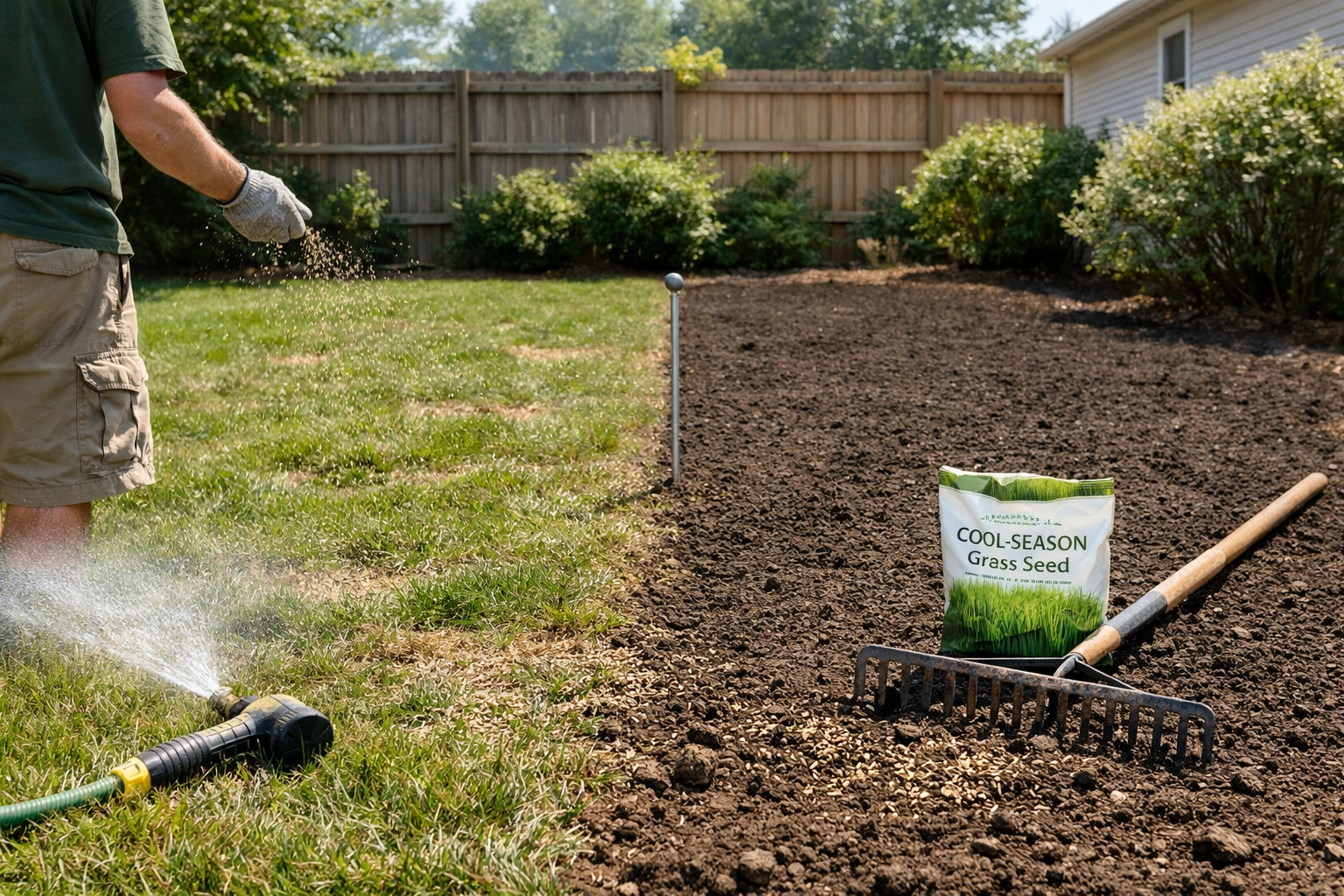
Overseeding thin or bare patches in an established warm-season lawn is generally lower-risk than seeding an entirely bare lot, because existing turf holds moisture better and shades new seedlings during the vulnerable first week or two. A full bare-soil renovation in summer heat is a bigger commitment, with more exposed soil, more evaporation, and less margin for error if watering lapses even one day.
If you’re patching bare spots in a Bermuda or zoysia lawn, light overseeding in summer is a reasonable project for a weekend, and existing grass around the patch provides some natural windbreak and shade. If you’re starting an entire yard from bare dirt in July, you’re taking on a harder version of the same problem, with more square footage exposed to heat and no established grass nearby to buffer conditions. It’s doable, but expect more intensive watering and more seedling loss at the margins than you’d see with a smaller patch job.
The table below compares the two approaches for warm-season grass specifically, since cool-season lawns shouldn’t be doing either project in summer.
Factor
Overseeding Existing Turf
Full Bare-Soil Renovation
Risk level in summer heat
Lower — surrounding grass buffers heat and holds moisture
Higher — soil fully exposed to sun and wind
Typical watering frequency
2x daily for 7–10 days
3x daily for 10–14 days
Straw mulch needed
Optional, helpful in hot spots
Strongly recommended across the full area
Weekend workload
A few hours for a small patch
Full weekend or more for prep and seeding
Time to visible fill-in
2–3 weeks for warm-season species
3–5 weeks depending on coverage
Mowing New Grass and Adjusting Your Mower Settings
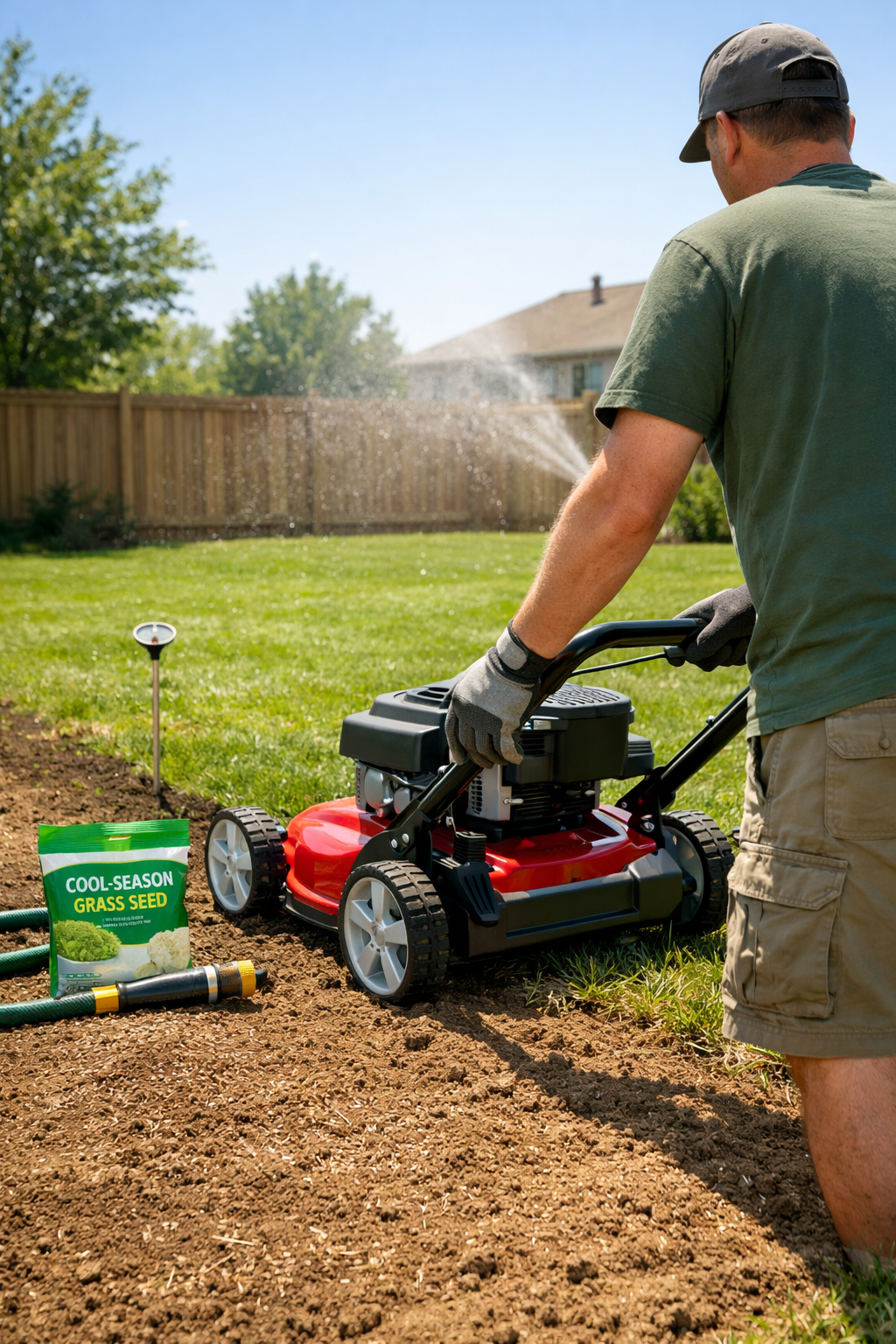
Don’t mow new seedlings until they’ve reached about 3 to 4 inches tall, and then only take off the top third with a sharp blade set high. Cutting too early damages shallow root systems that haven’t anchored yet, and a dull blade tears rather than cuts, leaving young grass more vulnerable to disease and moisture loss in summer heat.
For the first several mowings, raise your deck to the highest setting appropriate for the grass species — around 3 to 3.5 inches for most warm-season lawns being overseeded, a bit higher for St. Augustine. A rotary mower with a freshly sharpened blade is the right tool here; a dull blade on new seedlings does more damage than the same dull blade on mature turf, since young grass blades are softer and tear more easily. If you’re unsure whether your mower’s cutting height is set correctly for new seed, checking a deck-height reference guide like the ones on themowersguide.com before your first pass is a reasonable way to avoid guessing.
Shade’s Effect on Both Seeding and Mowing
Shaded areas need less frequent mowing early on since growth is slower, but they also hold soil moisture longer, which changes your watering math. A shaded patch might need watering once a day instead of twice, while the sunny two-thirds of the same yard still needs the standard schedule. Treat shaded and sun-exposed sections as two separate watering zones rather than applying one blanket schedule across a yard with mixed light conditions.
Why Fall Beats Summer for Cool-Season Seeding
Fall seeding wins for cool-season grass because soil temperatures in September and early October typically sit in the 50°F to 65°F range that Kentucky bluegrass, fescue, and ryegrass actually prefer, and cooler air temperatures reduce evaporation and heat stress on seedlings. There’s also less weed competition in fall, since many summer annual weeds are finishing their life cycle rather than germinating alongside your new grass.
The comparison isn’t close. Summer seeding of cool-season grass fights soil temperatures that are 20 to 30 degrees above the ideal range, fights heat stress on shallow-rooted seedlings, and fights faster water evaporation that demands more attentive watering than most homeowners realize going in. Fall seeding removes nearly all of those obstacles at once.
Wait for soil temperatures to drop into the 50s and 60s, typically late August through October depending on your region.
Seed 6 to 8 weeks before your area’s first expected frost, giving seedlings time to establish before winter dormancy.
Reduce watering frequency compared to summer since cooler air and soil hold moisture longer between waterings.
Skip the heavy mulch layer in most fall conditions, since evaporation risk is much lower than in July.
Apply starter fertilizer at seeding, same as you would in summer, to support root development before winter.
If your lawn is cool-season and thin patches are bothering you right now in July, the honest answer is to manage what you have through summer — mow correctly, water established turf deeply but infrequently, and hold off on seed — and put the actual seeding project on the calendar for September. That patience is the difference between a lawn that fills in reliably and one where you’ve burned money and effort on seed that never had a real chance.
Frequently Asked Questions
Can I plant grass seed in the middle of summer?
Yes, if you have warm-season grass like Bermuda or zoysia — summer is actually one of the best windows since soil temperatures of 70°F to 95°F match their ideal germination range. If you have cool-season grass, wait for fall instead.
What happens if I seed cool-season grass in July?
Expect poor, patchy germination and high seedling mortality, since soil temperatures often exceed the 50°F to 65°F range cool-season grass needs. Seedlings that do sprout are prone to dying off during the next heat wave.
How often should I water grass seed in hot weather?
Water 2 to 3 times daily for the first 7 to 10 days, about 5 to 10 minutes per session, to keep the top half-inch of soil consistently damp. Once germination starts, gradually reduce to once daily over the following two to three weeks.
Is it better to overseed or start a completely new lawn in summer?
Overseeding an existing warm-season lawn carries less risk than a full bare-soil renovation, since surrounding grass buffers heat and retains moisture. A full renovation in summer heat demands more frequent watering and closer daily attention to avoid seedling loss.
Did you know some commercial reel mowers have up to 55 blades? These machines are just one of the many amazing lawn care innovations. Choosing between a manual and a powered...
Already got a DeWalt drill sitting in your garage? Then a dewalt weed trimmer might be the cheapest upgrade to your lawn setup you’ll ever make. Instead of buying a whole...
4 September 2026
The Mowers Guide is reader-supported. When you buy through links on our site, we may earn an affiliate commission.






Comments are closed.