
Battery Powered Lawn Mower Self-Propelled: Buyer’s Guide

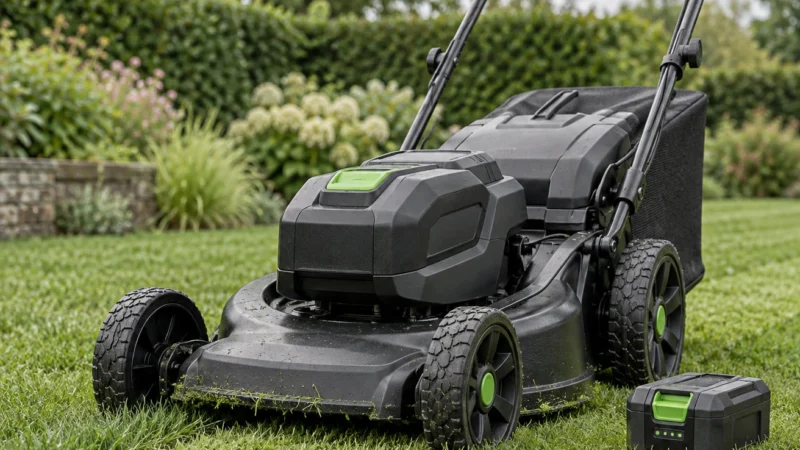
A good battery-powered self-propelled lawn mower handles a lawn of a quarter-acre to a half-acre on one or two charges, and the best models now cut as well as gas. The catch is that the runtime on the box rarely matches your yard. Thick grass, hills and the drive motor all drain the battery faster.
So the right buy depends less on brand and more on fit. You need enough battery energy for your square footage, a drive that suits your slopes, and a kit that actually includes the batteries and charger you need. Here’s how to match each one to your lawn.
How much lawn can one charge really cut?
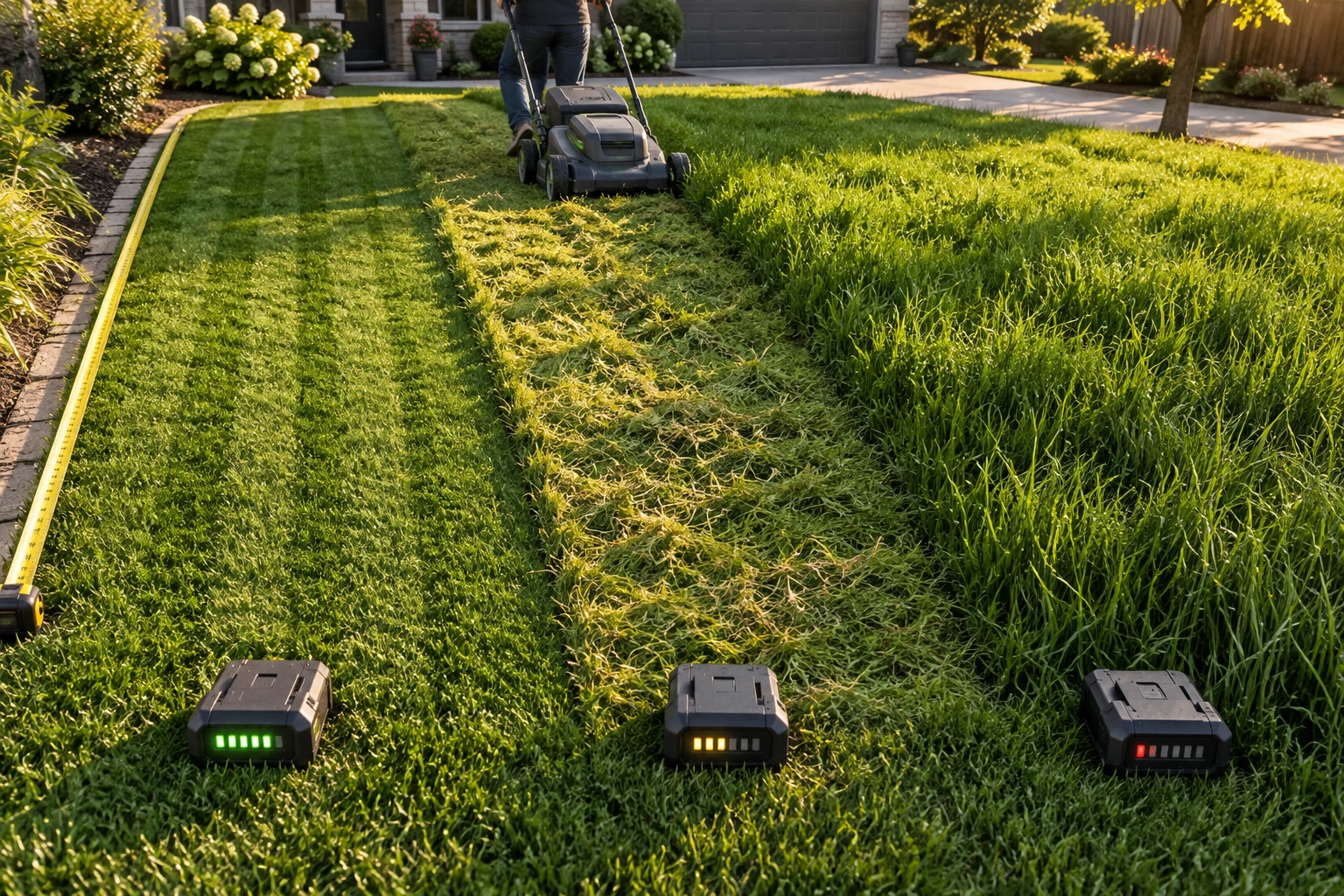
Expect about 45 to 50 minutes of mowing from a typical battery mower. That’s the average run time Consumer Reports measured across the battery mowers in its tests. Several self-propelled models run 70 minutes or more, often by using two battery slots that switch over when the first pack is empty.
In area, that usually means a quarter-acre to a half-acre per charge for a well-equipped mower in good conditions. A smaller single-pack setup covers less.
“Battery run times have increased to the point where some mowers are able to cut half an acre on one charge,” says David Trezza, who leads Consumer Reports’ lawn mower tests.
Why the box number is optimistic
Makers rate runtime in easy conditions: dry grass, flat ground, a high cut and often no drive. Your Saturday mow is rarely like that. A battery mower doesn’t draw steady power. It pulls more current every time the blade meets dense or wet grass, and that cuts the runtime sharply.
Four habits drain the pack faster. Cutting tall or thick grass makes the motor work harder. Mulching uses more energy than bagging or side discharge, because the blade chops clippings several times. Running the self-propelled drive adds a second motor to the load. Heat and an aging battery also reduce the energy you can draw.
A worked example
Picture a 5,000 sq ft lawn (about 1/8 acre) of dense St. Augustine and Bermuda grass in Louisiana. The owner runs a 60V mower with a small 3.0Ah battery.
On the first cut of spring, the grass was tall and a little wet, the deck was set low and the drive was on. The battery lasted about 22 minutes and died before the lawn was finished. On a normal weekly mow, with dry grass, a medium-high deck and the mower pushed by hand, the same battery ran about 38 minutes. It finished the lawn with roughly 10 to 15% charge left.
Same mower, same battery, almost double the runtime. Size your battery for the hard mows, not the easy ones.
What that means for your yard
Take your lawn size, then add a buffer of about 30 to 50% for thick spring growth, slopes and drive use. If your lawn is close to the edge of what one battery covers, plan on a second battery. A half-mowed lawn and a 60-minute wait for a recharge are the most common frustration with these mowers.
Watt-hours, not volts, tell you the battery size
Compare batteries by watt-hours (Wh), not by the voltage printed on the mower. Voltage tells you about power. Watt-hours tell you how much energy is in the tank.
Watt-hours = volts × amp-hours. It’s the total energy a battery stores, and the fairest way to compare packs from different brands.
Here’s why it matters. A 40V battery rated at 6.0Ah holds 40 × 6 = 240 Wh. An 80V battery at 3.0Ah holds 80 × 3 = 240 Wh. Those are the same amount of energy, even though one sounds twice as strong. A 56V pack at 5.0Ah holds 56 × 5 = 280 Wh, which is more than both.
Voltage still matters for cutting force. Systems at 36V/40V max or higher are where true gas-replacement mowers live. 18V/20V tools usually struggle with a full lawn unless the mower combines two batteries to run at a higher voltage. A higher-voltage system also tends to use energy faster for the same amp-hours. A 3.0Ah pack can run up to about 40 minutes on a 40V mower but closer to 20 to 25 minutes on an 80V one, because the 80V motor delivers more cutting power.
The table below is a starting point for matching battery energy and deck width to your lawn. Treat the battery figures as typical guidance for average grass, then move up a step if your yard is hilly or the grass is thick.
| Lawn size | Approx. sq ft | Suggested deck width | Suggested battery energy | Mower type |
|---|---|---|---|---|
| Under 1/4 acre | Under 10,900 | 19-21 inches | 200-300 Wh | Push or self-propelled |
| 1/4 to 1/2 acre | 10,900-21,800 | 21-22 inches | 300-500 Wh, or two packs | Self-propelled |
| 1/2 to 3/4 acre | 21,800-32,700 | 22-30 inches | 500 Wh or more, dual slots | Self-propelled, wide deck |
| Over 3/4 acre | Over 32,700 | Not a walk-behind job | — | Riding or zero-turn |
The quarter-acre and half-acre break points follow Consumer Reports’ advice. Under a quarter-acre, a battery push mower usually does the job and costs less. Between a quarter-acre and a half-acre, self-propelled is the better choice because it handles slopes with less effort.
Kit or bare tool: what’s actually in the box
Buy a kit unless you already own batteries on the same platform. A bare tool is the mower only: no battery and no charger. It looks cheaper online, but once you add a battery and charger it often costs more than the kit.
Always check the listing for three things: how many batteries are included, the amp-hour rating of each one, and which charger comes with it. Two kits with the same model name can ship with different batteries.
Chargers and recharge time
A standard charger can take two hours or more to fill a large pack. A fast charger fills a 3.0Ah battery in about 60 to 90 minutes. Bigger packs take longer. If your lawn needs more than one battery, a fast charger lets you rotate packs over a single afternoon.
Charge your batteries indoors at room temperature. Most lithium-ion packs won’t accept a charge when they’re very hot straight off the mower. Let them cool for 15 to 30 minutes first.
Battery platform compatibility
Each brand builds its batteries for its own platform, meaning its own range of tools that share one battery design. An EGO 56V battery fits EGO tools. A Ryobi 40V battery fits Ryobi 40V tools. Batteries don’t cross brands, and they don’t always cross voltages within one brand.
This is the hidden value in a kit. If you plan to buy a battery string trimmer, leaf blower or hedge trimmer later, pick a mower on the platform you want for all of them. The mower’s large batteries then power your other tools, and you buy bare tools after that.
When a bare tool makes sense
Go bare-tool only if you already own two or more large batteries on the same platform and a charger that works with them. Check that the mower’s manual lists your battery size as compatible. Some mowers need a minimum amp-hour rating to run the drive and blade together.
Self-propelled drive, slopes and handling
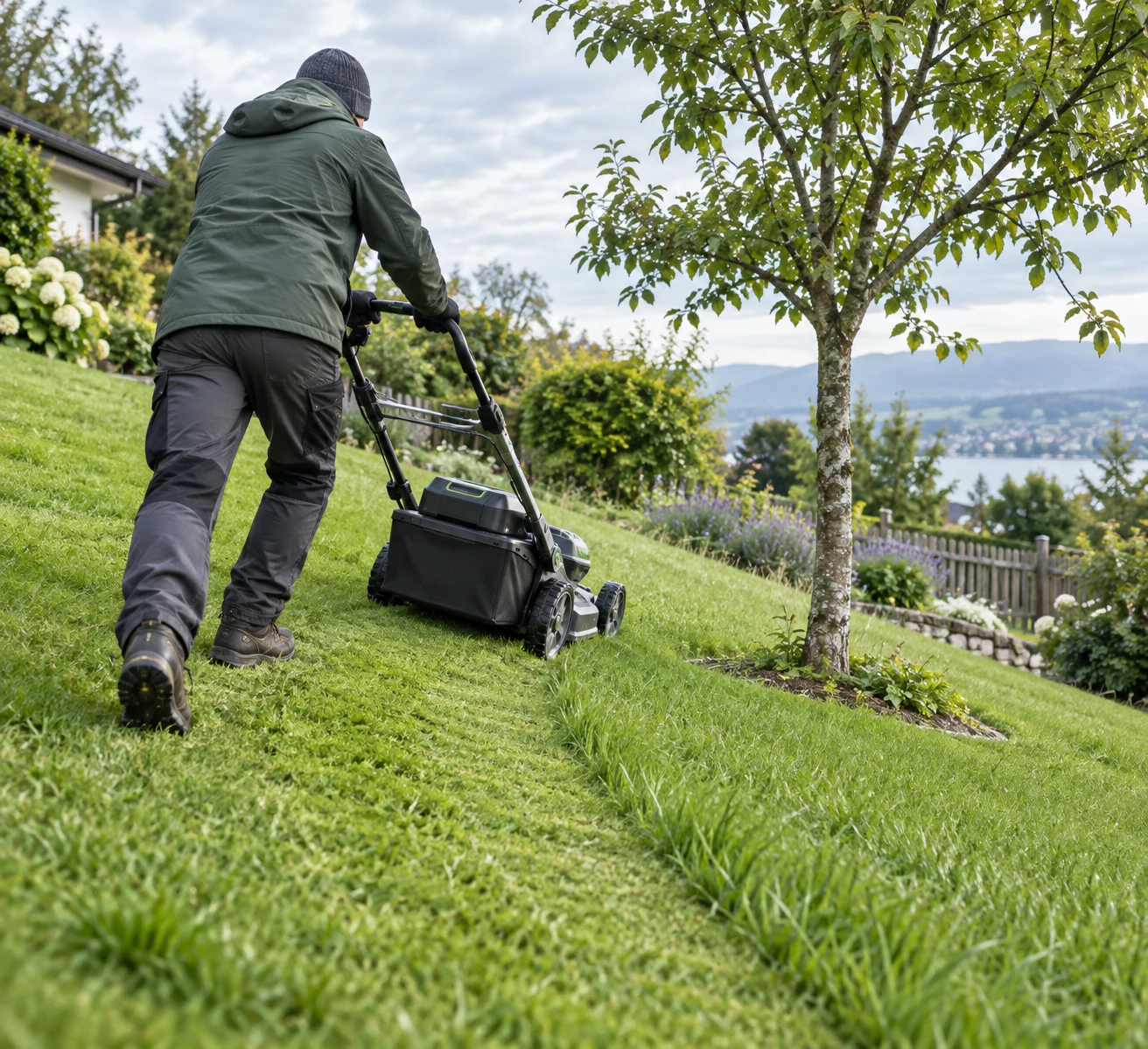
A self-propelled mower drives its wheels with a small electric motor, so you steer instead of shove. That’s what makes a third or half acre feel easy. But the drive design changes how the mower behaves on your ground.
Variable speed and wheel drive
Look for variable-speed drive, which lets you match the mower’s pace to yours. Good systems use a thumb dial, a trigger bar or a pressure-sensitive bail. You push the handle forward a little and the mower speeds up. Try the control in a store if you can, because a jerky drive gets tiring fast.
Rear-wheel drive grips better going uphill and when the bag is full, since weight shifts onto the back wheels. Front-wheel drive is easier to turn, because you tip the front wheels up at the end of a row. For most yards with any slope, rear-wheel drive is the safer pick. Some higher-end mowers use all-wheel drive for steep or uneven lawns.
Slopes and safety
Self-propelled drive cuts the effort on hills. It doesn’t raise the safe limit. Mow slopes across the face, never up and down, and follow the slope limit in your mower’s manual. That limit varies by model. Wet grass on a slope is a common cause of slips under the deck.
Remember the runtime cost too. Climbing a hill with the drive working hard can drain a battery faster than the same area on flat ground. If half your lawn is a bank, count that half twice when you size the battery.
Weight, maneuvering and storage
Battery self-propelled mowers typically weigh somewhere between 50 and 90 pounds with batteries fitted. Two-battery and wide-deck models sit at the heavy end. That weight helps traction but makes lifting the mower into a truck or up steps harder.
Storage is where batteries shine. Many models fold the handle flat, and some stand upright on their back end against a garage wall, because there’s no fuel or oil to leak. If floor space is tight, check that the model you want stores vertically before you buy.
Deck width, cutting height and clipping options
Deck width sets how many passes you make. A 21-inch deck is the standard for a quarter-acre to half-acre lawn. Wider decks of 22 to 30 inches cut mowing time on open lawns but are heavier and harder to steer around beds and trees.
Cutting-height range
Look for a range of roughly 1.25 to 4 inches, with a single lever that sets all four wheels at once. Cool-season grasses like tall fescue and Kentucky bluegrass do best at 3 to 4 inches. Warm-season grasses such as Bermuda often sit much lower. Follow the one-third rule: never remove more than a third of the blade height in a single mow. That keeps your grass healthy and protects your battery from overload.
Mulch, bag or side discharge
Most good models offer all three, often called 3-in-1. Mulching returns finely chopped clippings to the lawn as free fertilizer, but it uses the most energy. Bagging gives the cleanest finish and helps in spring and fall when leaves pile up. Side discharge is the best choice for tall, overgrown grass because it throws clippings out instead of clogging the deck.
Here’s a practical routine. Side-discharge or bag for the first long cut of spring, then mulch for weekly mowing once the grass is under control. Check that the kit includes the bag, the mulch plug and the side-discharge chute. Some listings sell the side chute separately.
Cut quality in thick grass
Battery mowers now cut thick grass well, but the voltage and the blade design matter. Some mowers have a boost mode or load-sensing, which raises blade speed when the grass gets dense and slows it on easy patches to save battery. Others use stacked or multi-blade designs to chop clippings finer for mulching. If your lawn is thick St. Augustine or Zoysia, choose a 56V or higher system with a boost setting.
Which brands and models to shortlist
There’s no single best maker for every lawn. EGO, Ryobi, Greenworks, Stihl, Toro, Makita and Skil all build strong battery self-propelled mowers. Consumer Reports had more than 80 battery mowers in its ratings in 2026 and recommended over half of them. Its testing also found that more than a dozen battery walk-behind mowers outscored the top-rated gas model.
Start with the platform you’ll use for your other yard tools, then compare these models. The table lists only what each one is known for.
| Model | Voltage | Deck | Best fit |
|---|---|---|---|
| Stihl RMA 510 V | 36V | 21 inches | Stihl battery tool owners; buy through a servicing dealer |
| Ryobi 40V HP Brushless Self-Propelled Multi-Blade (RY40HPLM02) | 40V | 21 inches | Ryobi 40V owners who mulch often |
| Skil PWRCore 40 Self-Propelled (SM4910-10) | 40V | 20 inches | Smaller lawns on a budget-minded platform |
| Greenworks 60V Self-Propelled | 60V | 21 inches | Greenworks 60V owners with medium lawns |
| EGO Power+ 1300 Series Self-Propelled (LM3004SP-2) | 56V | 30 inches | Large, open lawns near the half-acre mark and above |
EGO added the 30-inch LM3004SP-2 to its lineup for 2026, which shows where the market is heading: wider decks and bigger batteries for lawns that used to need a gas mower.
At the top end, commercial-grade battery walk-behinds now exist for lawn crews. One leading model sold as a kit at about $2,999 with two 7.2Ah batteries (November 2026 prices) and claimed up to 0.80 acre on its battery set. Most homeowners don’t need that. But it’s a useful benchmark: a true pro-level setup costs several times a typical homeowner kit.
Read reviews for the model number, not just the model name. Brands often reuse a name across kits with different batteries. Before you click a buy link, it’s worth knowing how review sites earn money. Our own disclosure page explains that some links earn a commission at no extra cost to you.
Long-term costs: batteries, warranty and repairs
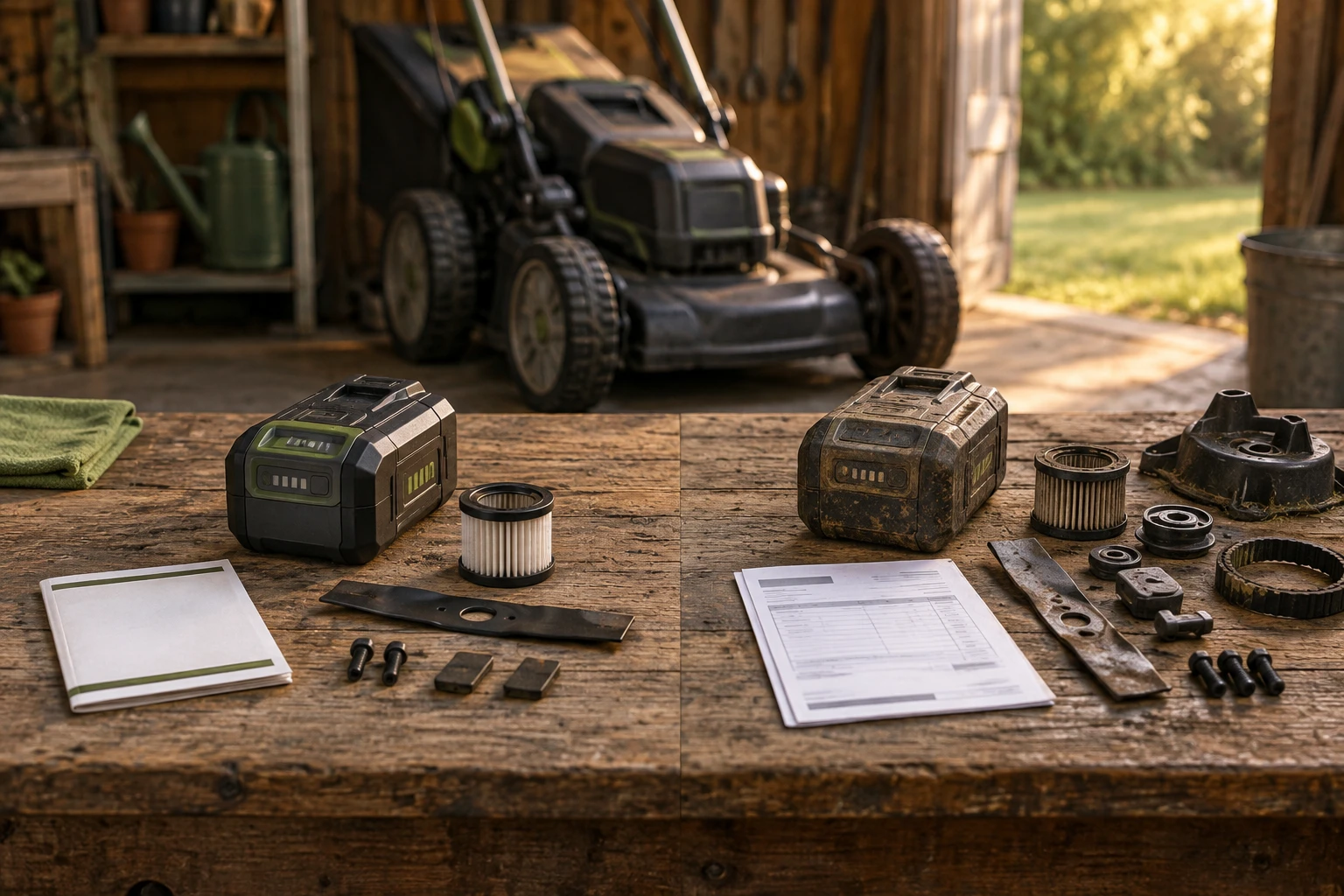
The battery is the part that wears out, so plan for its replacement from day one. A quality lithium-ion pack typically lasts 4 to 10 years, or roughly 500 to 1,000 full charge cycles. Deep drains and summer heat shorten that. Avoid mowing until the battery dies every time, and store packs indoors at around 40 to 60% charge over winter.
Replacement battery cost
A large replacement lithium-ion pack costs about $300 in today’s market. Spread over its life, that adds up fast. A $300 pack that lasts eight years works out to about $37.50 per year. If you mow a big lawn twice a week in a hot Southern summer, expect the shorter end of that lifespan.
This is where platform choice pays off again. A popular platform means more battery sizes, more sellers and a better chance the pack is still on sale in ten years.
Warranty coverage
Mower and battery warranties are often different lengths. A brand might cover the mower body for five years but the battery for only three. Quality lithium-ion packs typically carry three to five years of coverage. Read both terms before you buy, and register the mower right away. Many brands require registration to honor a claim.
The warranty also signals what to expect. A good residential battery mower should give you at least three to five years of reliable use. A short warranty on an expensive mower is a warning sign.
Parts and repair support
Battery mowers need far less care than gas: no oil, no spark plugs, no carburetor. You still sharpen or replace the blade once a season, clean under the deck and check the wheels and drive belt or gears. Before you buy, check that the brand sells replacement blades, wheels, bags and switches online. Brands with dealer networks, such as Stihl and Toro, are easier to get serviced in person. Big-box brands rely more on mail-in warranty repair, which can leave you without a mower for weeks in peak season.
Frequently Asked Questions
What is the biggest disadvantage of a battery-powered lawn mower?
Limited runtime is the biggest drawback. Most battery mowers run about 45 to 50 minutes per charge, and thick grass, hills and the drive shorten that. A spare battery fixes it but adds cost.
Which battery lawn mowers does Consumer Reports recommend?
Consumer Reports recommended more than half of the 80-plus battery mowers in its 2026 ratings. Its full model scores are for members only, and it rates brands such as EGO, Ryobi, Toro, Stihl, Makita and Hart.
Should I buy a mower kit or a bare tool?
Buy a kit unless you already own large batteries on the same brand platform. The bare tool has no battery or charger, and buying those separately often costs more than the kit.
Who makes the best battery self-propelled mower?
No single brand wins for every yard. EGO, Ryobi, Greenworks, Stihl and Toro all make top performers. Pick the brand whose battery platform you’ll use for your other yard tools, then choose battery size by lawn area.
References
- Best Battery-Powered Lawn Mowers 2026
- 10 Best Battery Lawn Mowers of 2026, Expert-Tested and Reviewed
- Push vs Self-Propelled Lawn Mower: Which Should You Buy?
[4]
[5] The 9 Best Electric Lawn Mowers Cut Well, Run Long, and Are Easy to Use .
[6] Lawn Care 101: Choosing the Best Lawn Mower for Your Needs
[7] What Should I Look For In A Cordless Lawn Mower? – Buyers Guide
[8] How Long Does a 3.0Ah Battery Last on an Electric Lawnmower
[9] How Long Do Lawn Mower Batteries Last: Fully Guide 2026 – Mammotion
[10] Introducing the New EGO 2026 Tool Lineup: Innovation Meets Power


Comments are closed.