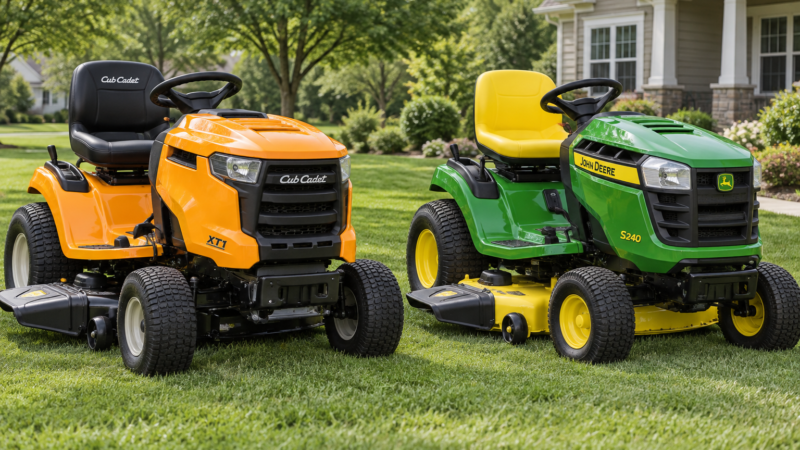
Two brands, one driveway, and a decision that’ll cost you real money for the next decade. Cub Cadet vs John Deere isn’t about which name sounds more trustworthy on a tractor — it’s about which one actually saves you cash after year three. Both build solid mowers, but they’re not solving the same problem for the same buyer.
If you’re standing in a dealer lot right now trying to pick between a green machine and an orange one, the answer depends less on brand loyalty and more on your lawn size, your budget for repairs, and how far you’re willing to drive for parts.
Price and What You Actually Get for It
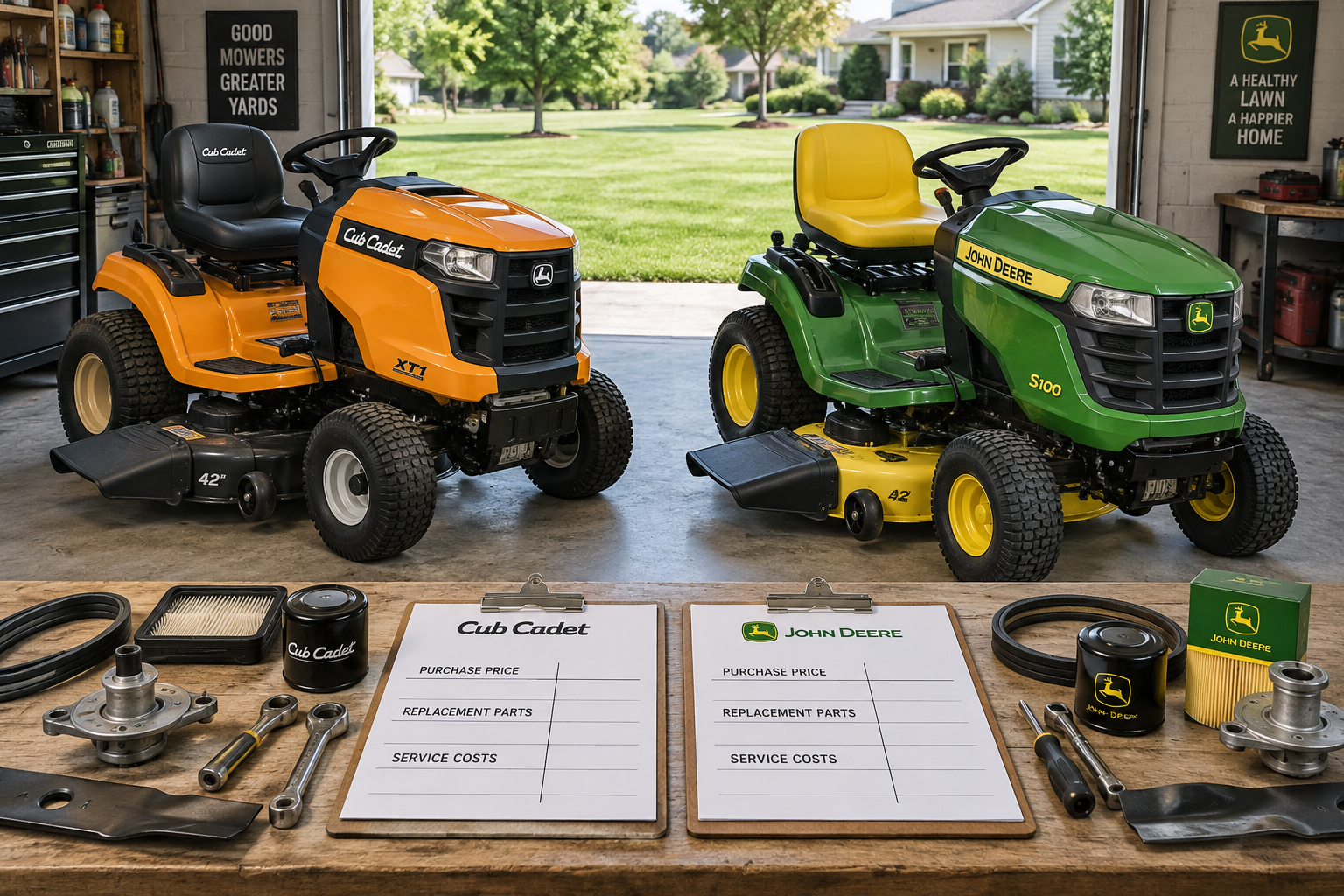
Cub Cadet generally undercuts John Deere by $500 to $1,500 on comparable riding mowers, and that gap matters more than most buyers admit.
A Cub Cadet XT1 series lawn tractor starts around $1,800 to $2,600, while a similar John Deere E100 series runs $2,000 to $3,000. Step up to zero-turn mowers and the spread widens: a Cub Cadet Ultima ZT1 lands near $3,500 to $5,500, while a John Deere Z300 series starts closer to $4,000 and climbs past $8,000 for the Z500 line.
Here’s the mistake people make constantly: comparing a base Cub Cadet to a premium John Deere, or vice versa. That’s not a brand comparison — that’s comparing a Honda Civic to a Cadillac and calling it a fair fight. Match trim levels, deck size, and engine class before you look at the price tag.
Category
Cub Cadet
John Deere
Entry lawn tractor
$1,800–$2,600
$2,000–$3,000
Mid-range zero-turn
$3,500–$5,500
$4,000–$6,500
Premium zero-turn
$6,000–$8,500
$7,000–$10,000+
Typical deck size
42″–60″
42″–60″
Engines and Transmissions: Who Actually Builds Yours?
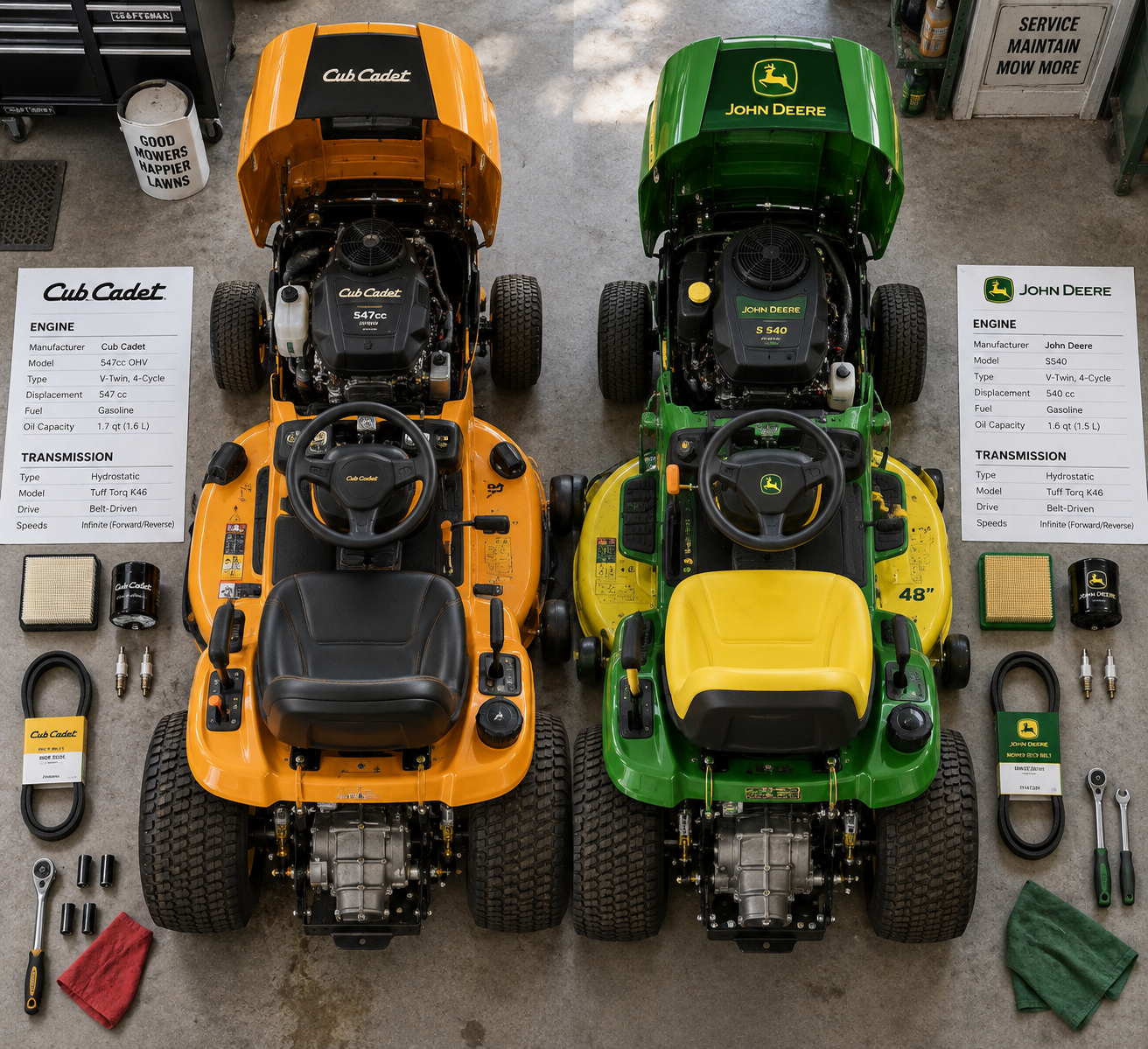
Neither brand makes its own small engines, and that fact changes how you should think about repair costs down the road.
Engine Sourcing
Cub Cadet mowers commonly run Kohler or Cub Cadet’s own house-branded engines on entry models, with Kawasaki FX and FR series engines on higher-end zero-turns. John Deere uses a mix of its own branded engines (often built by Briggs & Stratton or Kawasaki under license) plus true Kawasaki units on commercial-grade Z900 series machines.
Why This Matters for Repairs
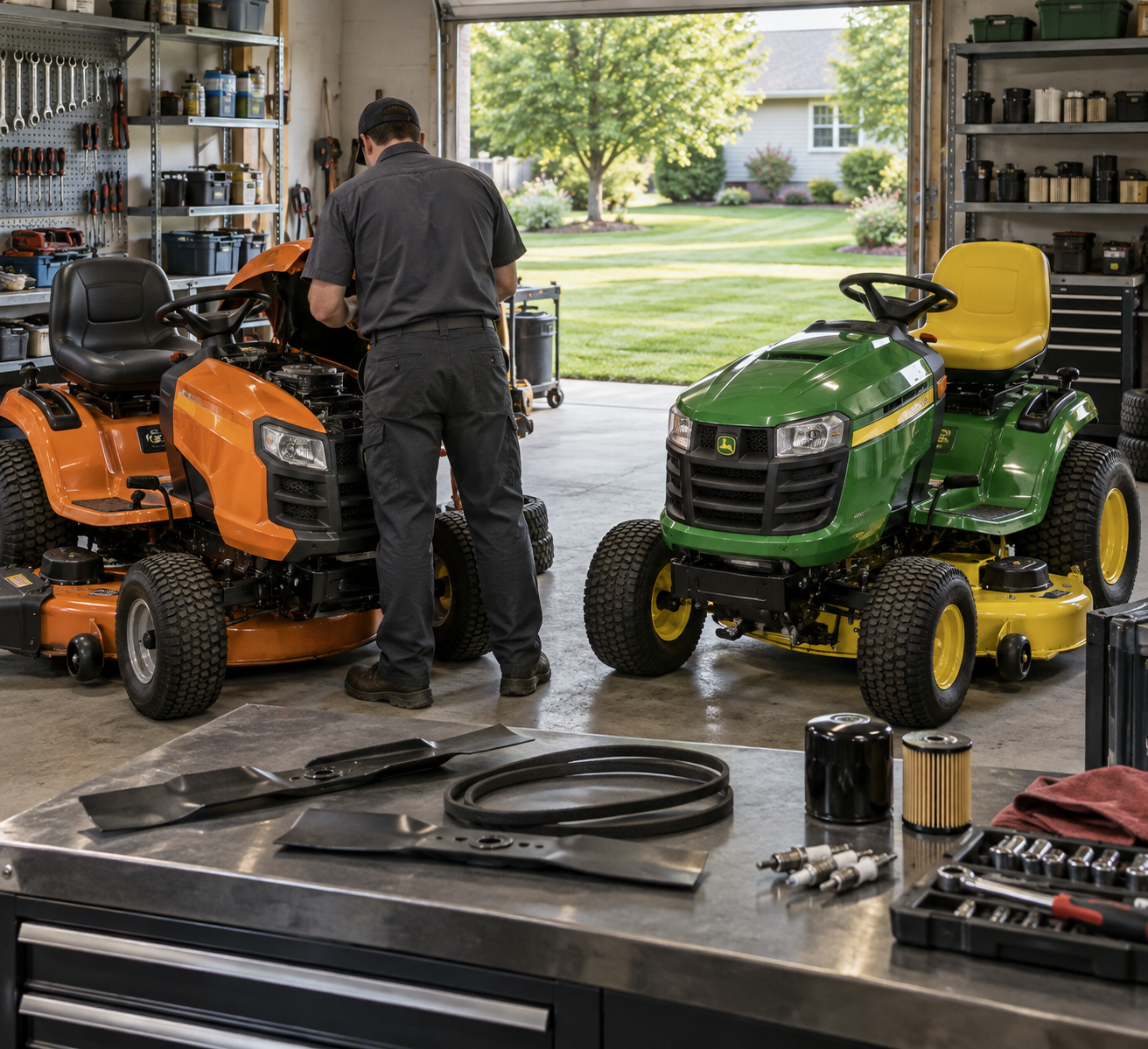
Engine sourcing determines who stocks your parts. A Kawasaki engine has parts available at any small-engine shop nationwide, not just a brand dealer. A proprietary John Deere-branded engine sometimes means dealer-only parts, and that pushes labor costs up because you’re locked into their shop rate — often $100 to $140 an hour versus $70 to $95 at an independent mechanic.
Hydrostatic Transmissions
Both brands use hydrostatic transmissions (a pump-and-motor system that lets you vary speed without shifting gears) on nearly all riding models above entry level. Failure rates are similar between the two; the real difference is repair cost, since Deere-specific hydro units run pricier when they need replacing.
Build Quality and the Total Cost of Ownership Nobody Talks About
Most comparisons stop at sticker price and warranty length. That’s a mistake, because the real cost gap shows up in years three through ten, not on day one.
John Deere consistently commands higher resale value — often 10% to 20% more than a comparable Cub Cadet after five years — because dealers trust the frame and deck construction, and buyers know it. Deere decks tend to use heavier-gauge steel on mid-to-upper models, which resists rust and impact damage longer under regular mowing.
Cub Cadet has closed the durability gap significantly over the last decade, and its cast-iron front axles on tractor models hold up well. But parts markup at Deere dealers is the real sting: a deck spindle that costs $35 at an independent supplier can run $60 to $90 through a Deere parts counter.
“Warranty length tells you what the manufacturer expects to fail — not what will actually break in year seven.” That’s the practical lens worth applying here, since both brands offer 3-year to 4-year limited warranties on residential mowers, but neither warranty covers the decade of ownership that actually determines your total cost.
Dealer Network and Repairability: The Factor Everyone Skips
Buying a mower is buying a relationship with a dealer, whether you like it or not. Skip this step and you’ll regret it by year two.
Count your local dealers — John Deere has a denser dealer network in most rural and suburban U.S. markets, meaning shorter drives for warranty work.
Ask about loaner mowers — some Deere dealers loan a unit while yours is in the shop during peak season; fewer Cub Cadet dealers offer this.
Check parts lead time — Cub Cadet parts often ship faster online through big-box retail partners like Home Depot and Lowe’s.
Compare labor rates directly — call both dealers and ask their hourly shop rate before you buy, not after.
Look at independent shop compatibility — Kawasaki-engine models are easier for any local small-engine mechanic to service.
Factor in your terrain — hilly or uneven lawns wear belts and spindles faster regardless of brand, so repair frequency matters more than brand choice.
For anyone comparing maintenance schedules side by side across brands, a dedicated mower maintenance guide can save a lot of guesswork before service season starts.
Frequently Asked Questions
Which brand holds up better on hills and rough terrain?
John Deere’s heavier deck gauge and frame construction handle uneven terrain slightly better on mid-to-premium models. But terrain wear is more about tire type, ground speed, and mowing habits than brand — a Cub Cadet mowed carefully on hills will outlast a Deere mowed carelessly.
Is Cub Cadet as reliable as John Deere long-term?
Yes, on comparable trim levels. Cub Cadet’s reliability has closed the gap over the past ten years, especially on Kawasaki-engine zero-turns. The bigger difference shows up in resale value and dealer parts pricing, not mechanical failure rates.
Does lawn size actually decide which brand I should buy?
Yes — more than brand loyalty does. Under half an acre, either brand’s entry tractor works fine; over 1.5 acres with hills, a zero-turn from either brand with a 50-inch-plus deck saves hours weekly regardless of nameplate.
Did you know some commercial reel mowers have up to 55 blades? These machines are just one of the many amazing lawn care innovations. Choosing between a manual and a powered...
Forget the spec sheets for a second. What actually matters is whether the mower you buy matches the lawn you own. A quarter-acre flat yard and a hilly half-acre lot need...
22 August 2026
The Mowers Guide is reader-supported. When you buy through links on our site, we may earn an affiliate commission.






Comments are closed.