Wrong bagger, wrong bolt pattern, wasted money. That’s what happens when you order a grass catcher for Craftsman riding mower by guessing deck size alone. Craftsman changed hands, rebadged parts, and discontinued whole lines over the years, so the fit game isn’t as simple as it used to be.
If you’re here, you probably already own the mower and just need the bagger to match. Good news: once you know where to look, matching one takes about five minutes.
Start With the Model Number, Not the Deck Size
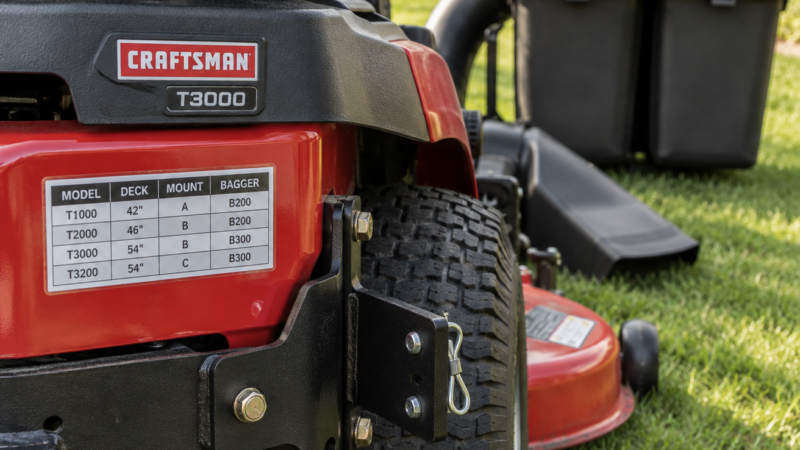
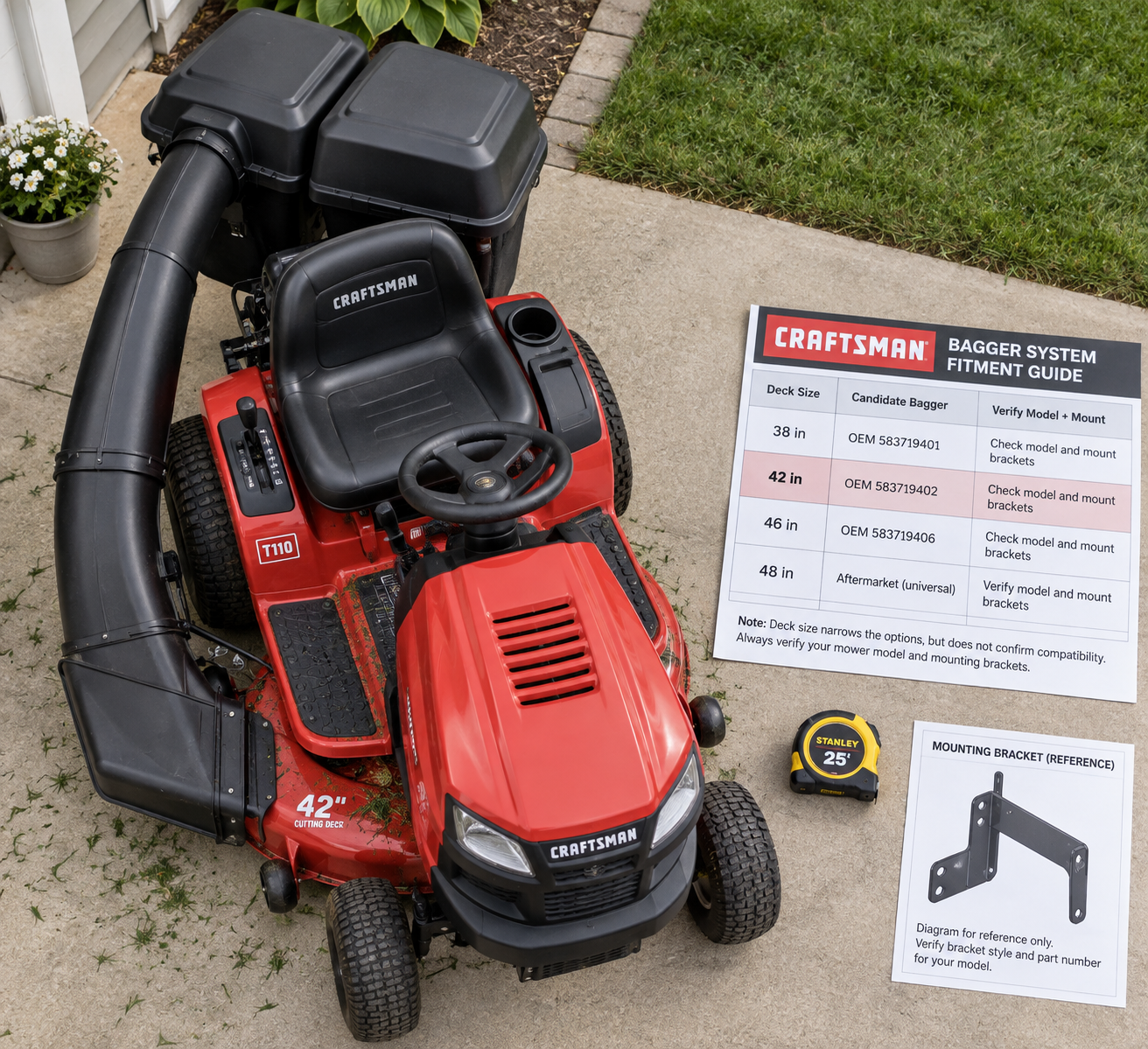
Deck size tells you almost nothing about bagger compatibility on its own. Two 42-inch Craftsman decks built four years apart can use completely different hopper mounts, chute shapes, and hitch brackets.
Where to Find It
The model number is usually on a metal or vinyl decal under the seat, on the frame near the rear axle, or inside the fender well by the fuel tank. It’s typically a string like “CMXGRAM1130038” or an older-style “917.xxxxxx” for pre-2017 units. Write down the full number before you shop — not just the first few digits.
Why the Full Number Matters
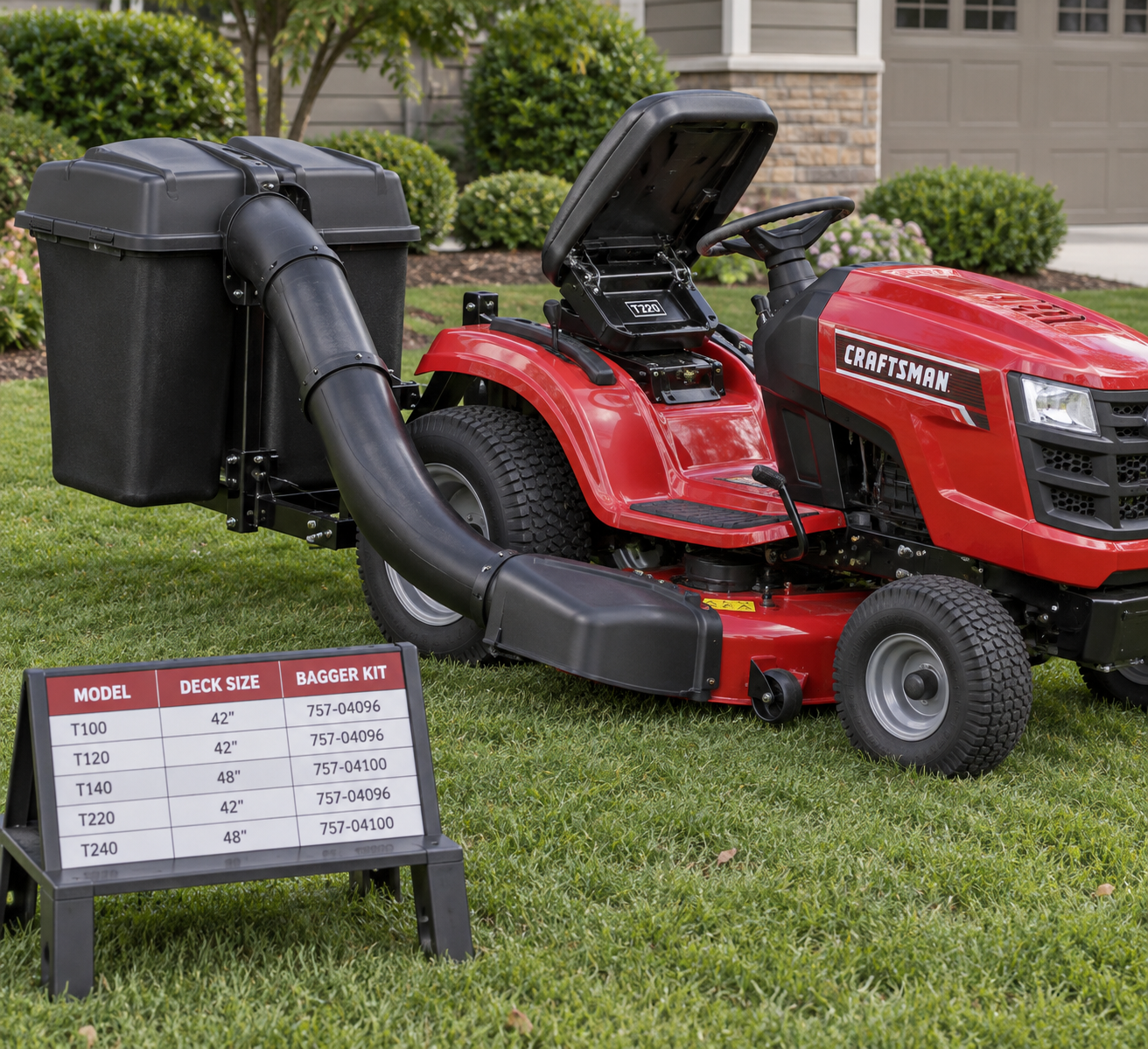
Craftsman used the same deck width across dozens of trim levels, and each one can call for a different bagger kit number. A T110 and a T130 with the same 42-inch deck might not share a hitch bracket. Cross-check the model number against the bagger’s listed compatibility chart before buying, not after it shows up on your porch.
Deck Size Still Narrows the Field
Once you have the model number, deck size becomes useful for a quick sanity check.
Deck Size
Typical Bagger Type
Common Capacity
42-inch
Twin bagger
6.5 cu ft
46-inch
Twin bagger
9.0 cu ft
54-inch
Triple bagger
9.6–12 cu ft
These numbers are typical, not universal — always confirm against your specific kit number. A 54-inch deck almost always pairs with a triple bagger (three hoppers instead of two) because the wider deck throws more clippings per pass. Buying a twin bagger for a 54-inch deck usually means overflow and clogging within a few passes.
Twin Bagger vs. Triple Bagger: What Actually Changes
The core difference isn’t just bag count — it’s airflow and dump frequency. Twin baggers work fine on smaller lawns under half an acre. Triple baggers exist because wider decks move more volume and need a third hopper to avoid stopping every ten minutes to dump.
Twin baggers mount with a two-point hitch and single chute adapter.
Triple baggers need a wider chute assembly and often a different hitch kit entirely.
Weight capacity matters: most twin bagger frames hold up to 200 pounds of clippings before the hitch strains.
Triple baggers run heavier when full, so check your mower’s rear-lift rating before hauling a full load uphill.
Fabric bags are lighter and cheaper; hard-shell hoppers last longer but cost more upfront.
Mixing components — a twin bagger frame with a triple bagger chute — doesn’t work. The mounting geometry is different, and forcing it strains the hitch bracket.
The Husqvarna Connection Most Buyers Miss
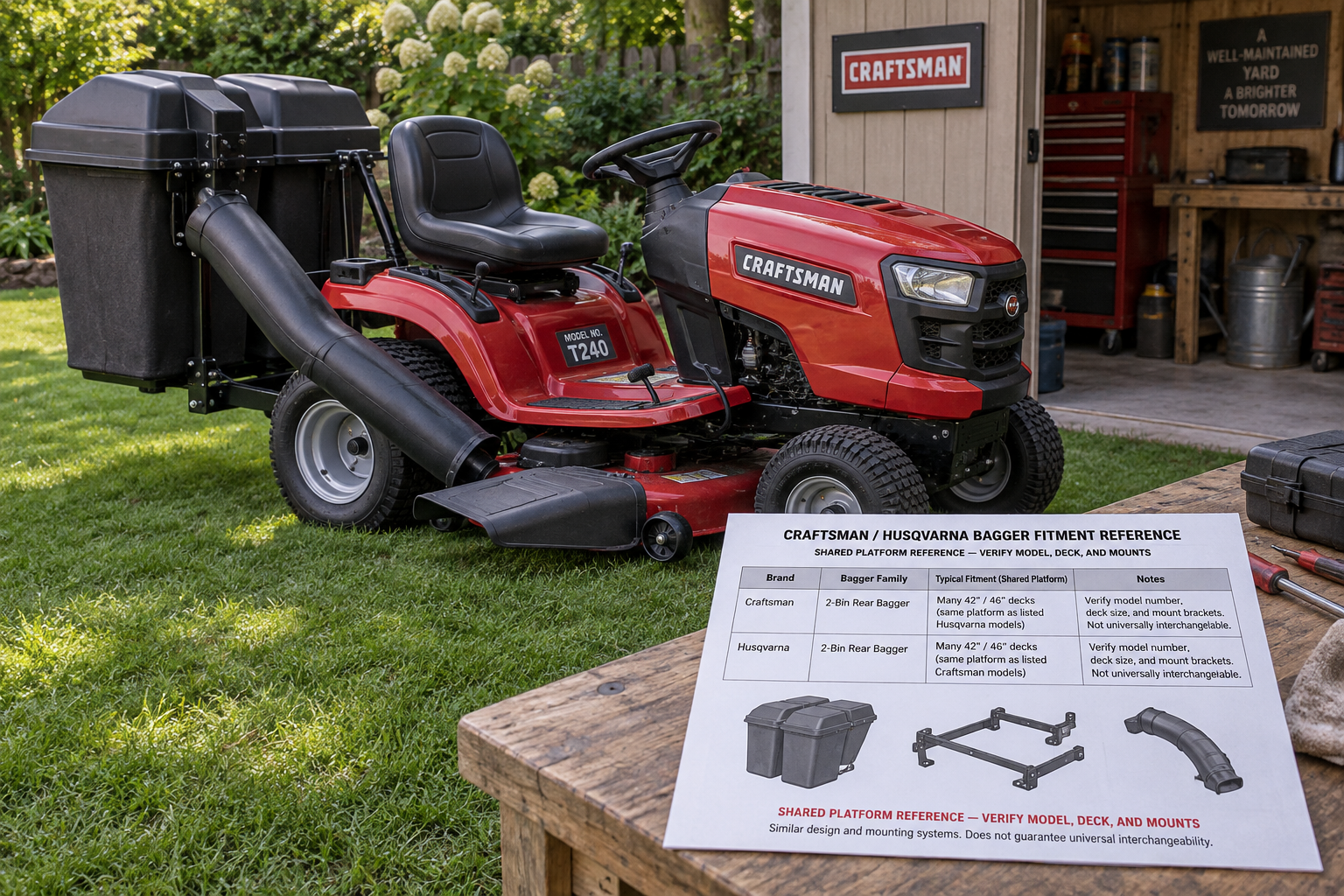
Here’s the part that saves real money: Craftsman riding mowers have been built by Husqvarna since Sears sold the Craftsman brand in 2017, and many “Craftsman” baggers are rebadged Husqvarna parts with a different sticker.
Husqvarna Group has manufactured Craftsman-branded outdoor power equipment under license since acquiring the brand’s tooling and production agreements from Sears Holdings in 2017.
This means a Husqvarna twin bagger kit with a matching part number can fit your Craftsman mower identically to the Craftsman-labeled version, often for less. Search both the Craftsman part number and its Husqvarna cross-reference before settling on a price. Parts counters at dealers like Ace Hardware’s outdoor power section or independent Husqvarna dealers can usually run that cross-reference for you in a few minutes if you bring your model number.
This isn’t true for every accessory — some Craftsman-specific brackets never had a Husqvarna twin — but for bagger hoppers and mounting hardware built after 2017, the overlap is common enough to always check.
Don’t Forget the Chute Cover and Hitch Kit
Buying just the bagger bags is the most common mistake owners make. The bagger kit rarely includes everything needed for installation.
What’s Usually Sold Separately
Most OEM bagger kits ship with the hoppers, support frame, and canvas or poly bags. What they often don’t include is the chute cover (the plate that blocks the discharge opening when you switch from mulching to bagging) and sometimes the hitch bracket if your mower didn’t come pre-drilled for one.
OEM vs. Aftermarket
OEM Craftsman or Husqvarna kits guarantee a bolt-pattern match but cost more, often $180–$350 depending on capacity. Aftermarket brands run cheaper, sometimes $120–$200, but fit tolerances vary more. Check return policies before buying aftermarket — a bagger that’s off by half an inch on the chute opening won’t seal properly and lets clippings scatter across the lawn.
If your mower runs a mulching kit now, note that swapping to a bagger usually means removing the mulching plug and installing the open chute plus the bagger’s discharge tube. Keep the mulching plug — you’ll likely swap back and forth by season.
Frequently Asked Questions
Can I use a Husqvarna grass catcher on my Craftsman mower?
Often yes, if the part numbers cross-reference and the mower was built after 2017 under Husqvarna’s manufacturing agreement. Confirm the exact model and part number match before buying — hitch brackets and chute widths still vary by trim level.
How do I know if my Craftsman mower needs a twin or triple bagger?
Check your deck width first: 42-inch and 46-inch decks typically use twin baggers, while 54-inch decks need triple baggers for adequate airflow. The mower’s owner’s manual or model number decal will confirm the exact kit number required.
What if my Craftsman mower model is discontinued?
Discontinued models still usually have a Husqvarna cross-reference part, since production shifted rather than disappeared. Search the model number on a Husqvarna parts lookup tool or call a local dealer with the full decal number for a match.
Brown patches after mowing? Weeds creeping into thin spots? Before you blame fertilizer or bugs, check your lawnmower blade height. Most lawn problems that homeowners chase for weeks trace back to...
That generic diagram you found on Google? It’s probably wrong for your mower. There isn’t one universal craftsman riding mower drive belt diagram — routing depends on your deck size and...
14 September 2026
The Mowers Guide is reader-supported. When you buy through links on our site, we may earn an affiliate commission.






Comments are closed.