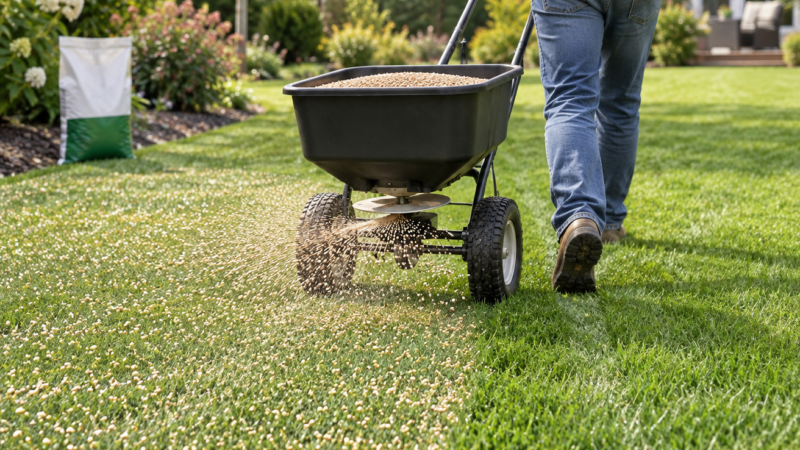
Check the bag for your spreader setting, fill the closed hopper on a driveway, and mow first. Run a perimeter pass, then walk straight, overlapping rows at a steady pace. A fertilizer broadcast spreader should only be open while you’re moving. Sweep spills off hard surfaces, and water lightly if the label says so. Here’s how to do it without stripes or burn marks.
Prep and Application: Step by Step
This is the part that matters most. Skip a step and the lawn shows it within a week.
Mow first, a day or so before. Shorter, dry grass lets granules reach the soil.
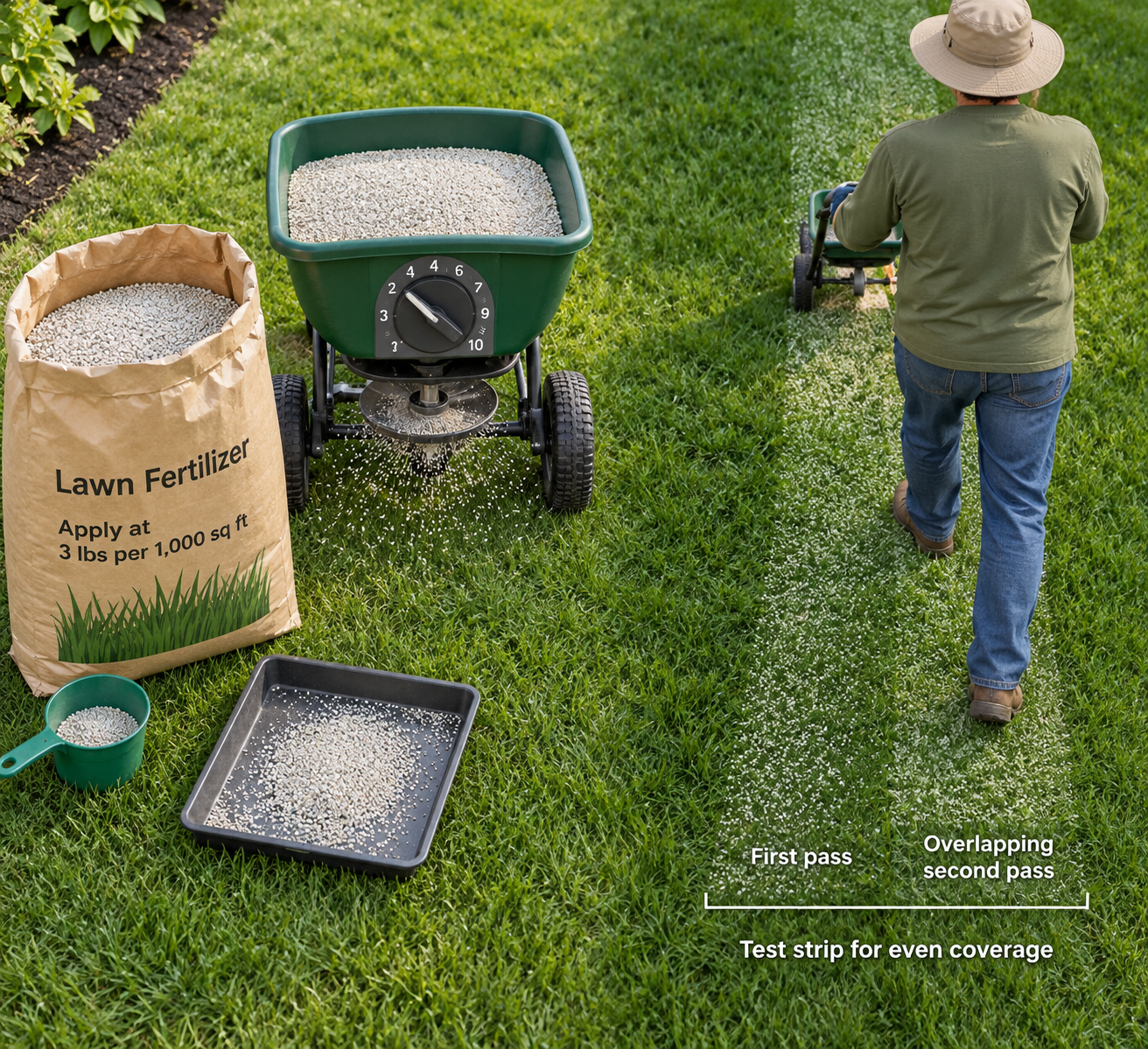
Read the bag for your spreader’s setting. Each product has its own number, and a bag with no setting isn’t meant for lawns.
Close the hopper shutoff, then fill on the driveway or a tarp. Never fill on the grass, because spills scorch it.
Do the perimeter pass first. If your spreader has a side shield, use it so granules stay out of beds and off the sidewalk.
Switch the shield off and walk straight rows, overlapping a little. Moving over about 2 steps from your last pass is a good guide.
Keep a steady, normal walking pace. Open the hopper only once you’re moving, and close it before you stop or turn.
Sweep stray granules off hard surfaces back onto the lawn, then pour leftovers into the bag.
Why the Perimeter Pass Comes First
Going around the edge first means you can’t miss the borders later. It also gives you a clean turning zone. Leaving the hopper open during turns is the classic way to burn a lawn.
Spreading by Hand Doesn’t Work
Don’t throw granules by hand. It almost never gives even coverage, and you’ll get patches of dark green and thin yellow.
Setting Your Spreader: Trust the Bag, Then Test It
The printed number is a starting point. Spreaders wear, and a worn gate can deliver more or less than the bag assumes. If a stripe shows up after your first use, that’s usually why.
A quick test fixes it. Lay a tarp or work on a clean driveway, mark a 10 ft by 10 ft square, and spread. Then compare what came out against what the bag rate calls for.
If a 25 lb bag covers 5,000 square feet, you need ½ lb of product for every 100 square feet.
If the hopper runs dry before you finish the square, lower the setting. If product is left over, raise it. Repeat until it’s close. Penn State Extension describes a more exact method: weigh the product before and after a test strip, then compare it to your target rate.
For stripe-free results, apply half the rate in two passes, with the second pass at a right angle to the first. If your spreader runs a bit off, the errors average out instead of lining up.
No Setting on the Bag?
Some store bags list a setting only for certain spreader brands. Use a generic chart as a guide, then calibrate. For grass seed, the seed bag’s setting or the spreader maker’s seed chart is the answer; seed varies too much for me to give you one number.
Broadcast vs. Drop Spreader vs. Handheld
Each type fits a different yard. A broadcast (rotary) spreader throws granules in a fan, so it covers wide areas fast. A drop spreader drops product in a narrow band right below the hopper.
Type
Coverage
Precision
Best for
Wheeled broadcast
Wide swath
Moderate; thins out at the edges
Medium to large lawns
Drop
Narrow band
High
Small yards, tight edges
Handheld broadcast
Small area
Lower
Small lawns, patches, seed
Tractor-pulled
Very wide
Moderate
Large properties
My pick for most homeowners is a wheeled broadcast spreader. The drawback is that it throws granules past the edge, so you need the side shield or a careful perimeter pass.
A drop spreader is more exact, but you have to overlap the wheel tracks by about half a foot. Miss that and you get stripes, because there’s no feathered edge. For a handheld model, crank steadily while walking rows, and keep your pace the same as you would with a wheeled one.
When Not to Spread, and What to Do After
Don’t fertilize before heavy rain, on frozen ground, or during local blackout dates. Maryland, for example, bans homeowner nitrogen and phosphorus applications from November 16 to March 1. Fertilizer on hard or frozen ground washes into storm drains and streams.
Check your state or county rules before you buy. Many states restrict timing or phosphorus, and the rules vary.
Watering
Water lightly after application only if the label says to. Some products need it to move into the soil, and some, like weed and feed, work best on damp leaves. Follow your bag. A good soak a few days beforehand helps soil take up the feed.
Cleanup
Empty the hopper and rinse the spreader on the driveway, then dry it. Fertilizer is corrosive, and a rusty gate changes your output next season. Store leftover product sealed in its bag. Our lawn fertilizer care guides on The Mowers Guide cover timing by grass type.
Fixing Streaks and Burn Marks
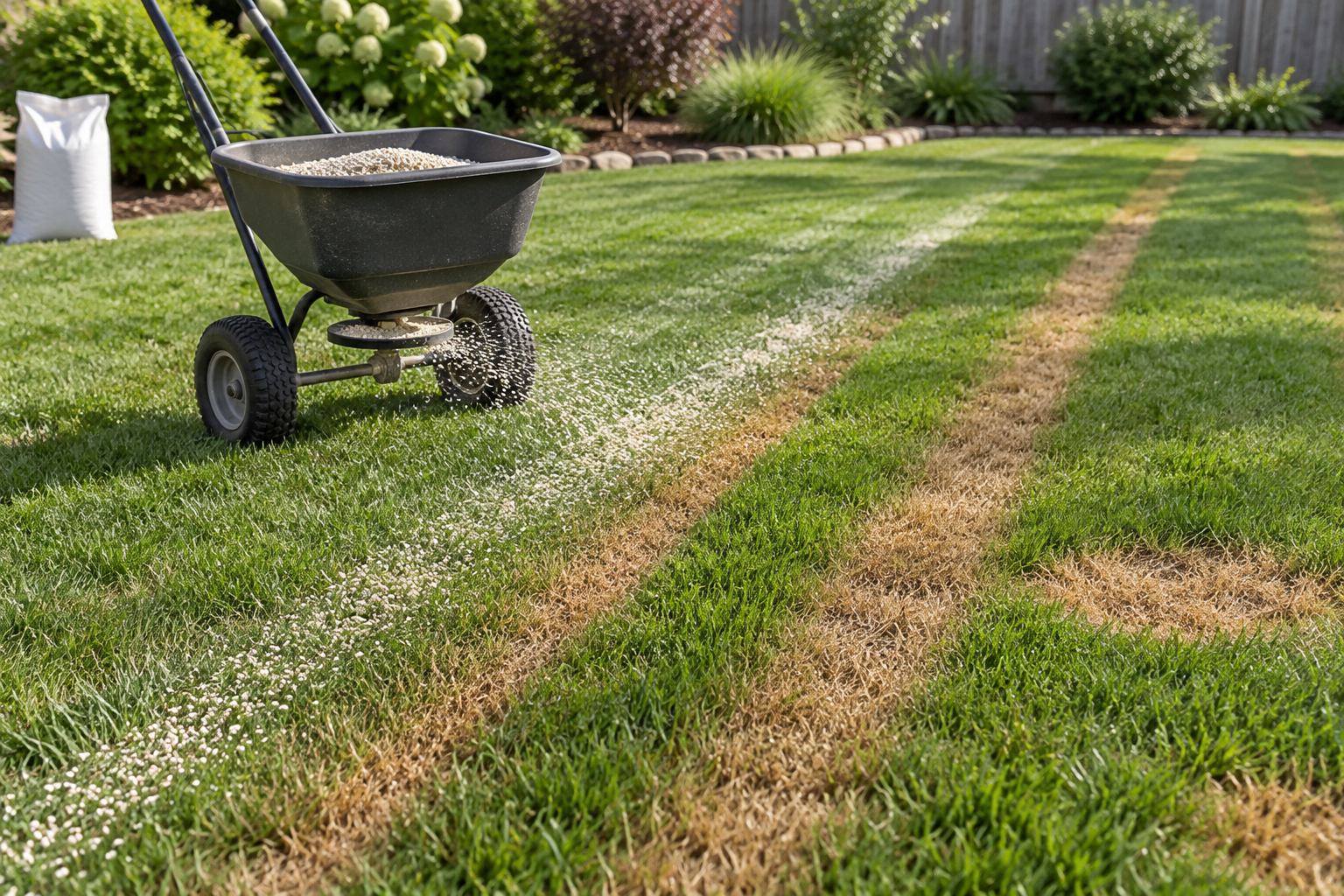
Streaks mean uneven overlap or a miscalibrated spreader. Burn spots mean too much product landed in one place.
Stripes of pale grass: you left gaps. Next time, add the half-rate double pass.
Dark green lines: you overlapped too much, or your setting is too high.
Brown patches at row ends: the hopper was open while turning or stopping.
Brown spots where you filled: spills. Water the area well and rake out loose granules.
Burned grass often recovers once you flush the spot with water. Badly scorched patches may need reseeding.
Frequently Asked Questions
Should I water right after fertilizing?
Only if the bag says to. Many granular products need a light watering to reach the soil, but others work better dry. Skip watering entirely if heavy rain is in the forecast, because runoff wastes product.
Should I mow before or after fertilizing?
Mow first. Shorter grass lets granules fall to the soil, and you avoid bagging up or flinging fertilizer around. Wait a day or so, and hold off on the next mow for a couple of days after.
What setting should I use for grass seed?
Use the setting on the seed bag, or the spreader maker’s chart. If neither lists one, calibrate on a tarp, starting low, and spread in two passes at half rate for even coverage.
Is a zoysia grass lawn worth the work? It depends on your climate and your mower. Zoysia makes a thick, soft-looking turf that crowds out weeds and handles heat and foot...
Mix it wrong and you’ll be pulling the carburetor apart by mid-summer. Get the echo weed eater fuel mixture right, though, and that trimmer will outlast three cheaper ones. Most people...
5 October 2026
The Mowers Guide is reader-supported. When you buy through links on our site, we may earn an affiliate commission.





Comments are closed.