A quality pole saw costs anywhere from $80 to over $400. Pick the wrong one for your yard and you’ll likely be buying a second one within a year. That gap matters because the right pole saw for a homeowner trimming two oak trees twice a year looks nothing like the right one for someone managing a half-acre lot full of mature pines. This guide focuses on matching the tool to your actual situation, not just ranking by brand name.
Most people searching for a pole saw already know they need to cut branches they can’t safely reach from a ladder. The real question is which power source, reach, and bar length fit their trees, their yard, and how often they’ll use the tool.
What a Pole Saw Actually Is (and What It’s Not)
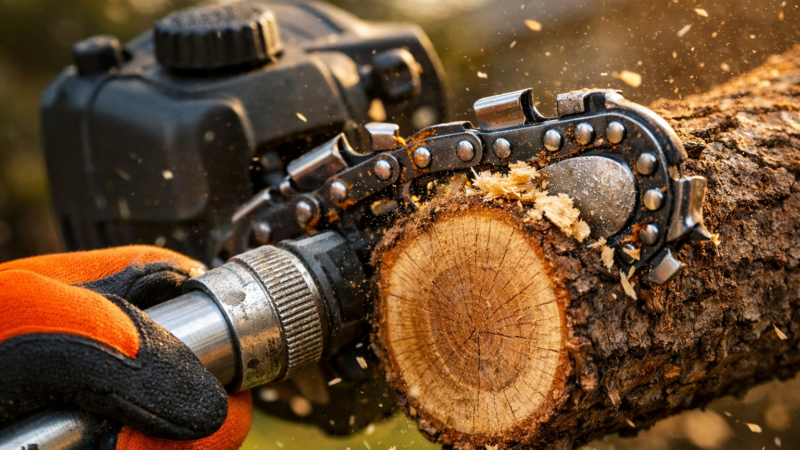
A pole saw is a chainsaw mounted at the end of an extendable pole, designed to cut overhead branches without a ladder. It is not a pole pruner, which uses a bypass blade and works like scissors. More on that distinction later. The key difference is cutting capacity: a pole saw’s chain cuts through wood up to 8-10 inches in diameter, while a pole pruner tops out around 1.5 inches.
The American National Standards Institute (ANSI) defines a pole saw as a powered or manual cutting tool with a saw blade or chain attached to an extension pole, intended for pruning or limbing trees from ground level.
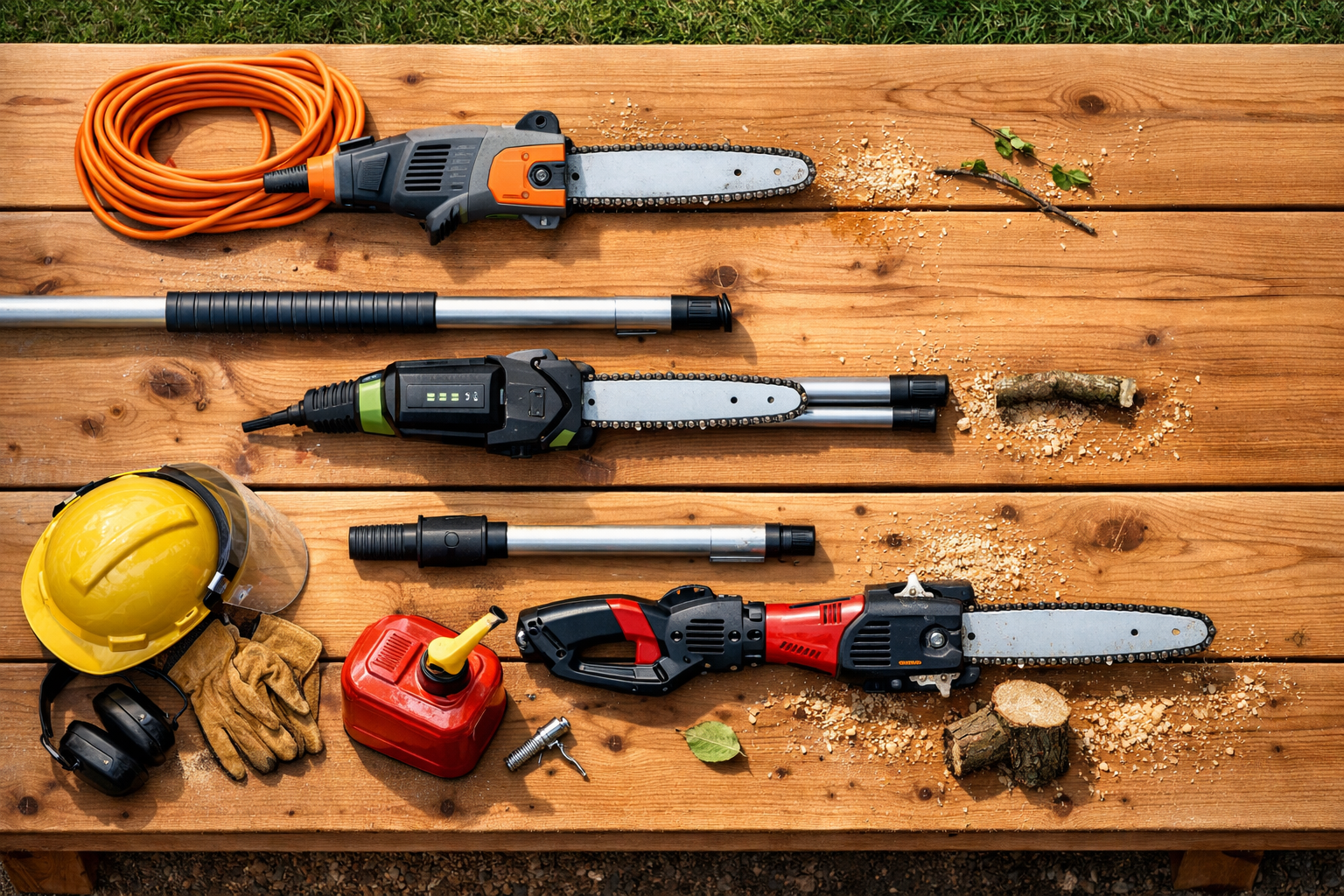
Pole saws come in four types: corded electric, battery-powered, gas-powered, and manual. Manual pole saws use a hand-pulled bow saw blade. Fine for occasional light work, but slow on anything thicker than 3 inches. The powered types are what most homeowners actually need.
Top Pole Saw Picks by Power Type: A Quick Comparison
The right pole saw type depends on how far your trees are from an outlet, how thick the branches are, and how often you trim. A gas model sitting in the garage unused most of the year is money wasted. Here’s how the three powered types stack up.
Feature
Corded Electric
Battery (40V+)
Gas
Typical price range
$80 – $150
$150 – $300
$200 – $450+
Reach (max)
8 – 10 ft
8 – 12 ft
10 – 15 ft
Bar length
8 – 10 in
8 – 12 in
10 – 14 in
Weight
7 – 10 lbs
9 – 14 lbs
12 – 20 lbs
Maintenance level
Low
Low
High
Best for
Small yards, outlet nearby
Most homeowners
Large lots, frequent use
Corded Electric: Best for Small Yards with Outlet Access
Corded electric pole saws are the most affordable entry point, and models like the Oregon PS250 run on standard 120V outlets with a consistent power output that doesn’t fade as the job goes on. The drawback is the cord itself — a 100-foot extension cord is the practical maximum before voltage drop affects cutting performance, which limits you to trees within roughly 80 feet of your house.
These models work well for homeowners with one or two trees close to the structure. They’re light (often under 9 lbs), require almost no maintenance beyond bar oil refills and occasional chain sharpening, and start instantly every time.
Battery-Powered (40V+): The Best All-Around Choice for Most Homeowners
A 40V lithium-ion battery pole saw handles branches up to 8 inches in diameter on a single charge — which covers the vast majority of routine residential trimming. The EGO Power+ PSA1000 attachment, for example, pairs with the EGO 56V platform and cuts through 6-inch oak limbs without bogging down. Battery technology has improved enough that the “batteries can’t handle thick wood” reputation is outdated for anything 40V and above.
Expect 30 to 45 minutes of cutting time per charge on a 40V+ model, which is enough for a full trimming session on most home lots. The freedom from cords is the real advantage — you can reach trees at the back of a deep yard without extension cords or fuel mixing.
Gas-Powered: When You Have a Lot of Trees and No Patience for Cords
Gas pole saws, like the Husqvarna 525PT5S, are built for extended work sessions and heavier branches. A two-stroke engine running on a 50:1 fuel-to-oil mix gives you unlimited runtime as long as you have fuel, and gas models typically reach 12 to 15 feet with extensions. They’re louder, heavier (often 15+ lbs), and require carburetor maintenance and seasonal storage prep.
For a homeowner trimming twice a year, gas is genuinely overkill. But if you have 20 or more mature trees and spend full days on seasonal cleanup, the sustained power and reach justify the extra maintenance.
Reach, Bar Length, and Weight: The Three Numbers That Actually Matter
Most buyers focus on reach and stop there. That’s a mistake. Reach tells you how high you can get; bar length tells you what you can cut when you get there; and weight determines whether you can hold the saw steady long enough to finish the job safely.
How High Can a Pole Saw Reach?
Most pole saws reach between 8 and 15 feet from the ground, depending on the model and whether it has a fixed or extendable pole. Add the average user’s height (about 5.5 to 6 feet) and you’re cutting branches at 13 to 21 feet — without a ladder.
Fixed-length poles are more rigid and easier to control, while telescoping poles add reach but introduce flex at the joint, which makes precise cuts harder at full extension. For branches above 15 feet, a gas model with a full extension pole is the practical choice; battery models with fixed poles are better suited to the 10-to-14-foot range.
Bar Length and Cutting Capacity for Branches Up to 10 Inches
The guide bar — the metal plate the chain runs around — determines the maximum branch diameter you can cut in a single pass. An 8-inch bar handles branches up to about 6 inches cleanly. A 10-inch bar gets you to 8 inches. A 12-inch bar can work through 10-inch limbs, though on a pole saw (versus a handheld chainsaw) you’ll feel the extra length as increased vibration and reduced control overhead.
For most residential trees, an 8- to 10-inch bar is the right range. Branches over 8 inches on a residential lot are uncommon, and if you’re regularly cutting 10-inch limbs, you’re doing work that’s approaching professional-grade tree removal.
Weight and Why It Causes More Problems Than Underpowered Motors
A pole saw that’s too light for the job cuts slowly. A pole saw that’s too heavy causes fatigue in under 10 minutes of overhead work, and fatigue causes unsafe handling. At 12 lbs, holding a pole extended to 10 feet overhead puts roughly 30 to 40 lbs of effective load on your wrists and shoulders — physics multiplies the weight at the tip.
Gas models above 15 lbs are genuinely hard to use for more than a few minutes of continuous overhead cutting. If you’re choosing between a 13-lb gas model and an 11-lb battery model with similar bar length, the battery model will likely get used more safely and more often. Weight is the spec most buyers underestimate until they’re 20 minutes into a job with shaking arms.
Pole Saw Attachment vs. Standalone Unit: Which Saves You More
If you already own a battery-powered multi-tool system like a Ryobi 40V or EGO 56V, a pole saw attachment will almost always save you money over buying a standalone unit. Attachments typically run $80 to $130, compared to $150 to $300 for a complete standalone pole saw in the same voltage class.
Here’s how to decide:
Check whether your existing tool platform offers a pole saw attachment. EGO, Ryobi, and DEWALT all do, and the attachment shares the battery you already own.
Compare the bar length on the attachment to a standalone in the same price range; attachments sometimes top out at 8 inches, while standalone models offer 10 to 12 inches.
Factor in the power head cost if you don’t own one. A compatible power head plus attachment can equal or exceed the price of a standalone unit.
Consider storage: attachments are modular and store compactly; standalone pole saws need dedicated wall or ceiling space.
If you trim fewer than three times per year, an attachment almost certainly makes more financial sense than a dedicated unit.
The attachment route only fails you if your existing platform doesn’t support one, or if you need a longer bar length than the attachment offers. In that case, a standalone battery model is the better buy.
How to Use a Pole Saw Safely Without Prior Experience
Read the manual before you start. Not as a formality, but because pole saw kickback zones and chain brake locations vary by model. First-time users cause most incidents in the first 20 minutes, usually because they skip setup checks or stand in the wrong position.
Positioning, Footing, and the Two-Hand Rule
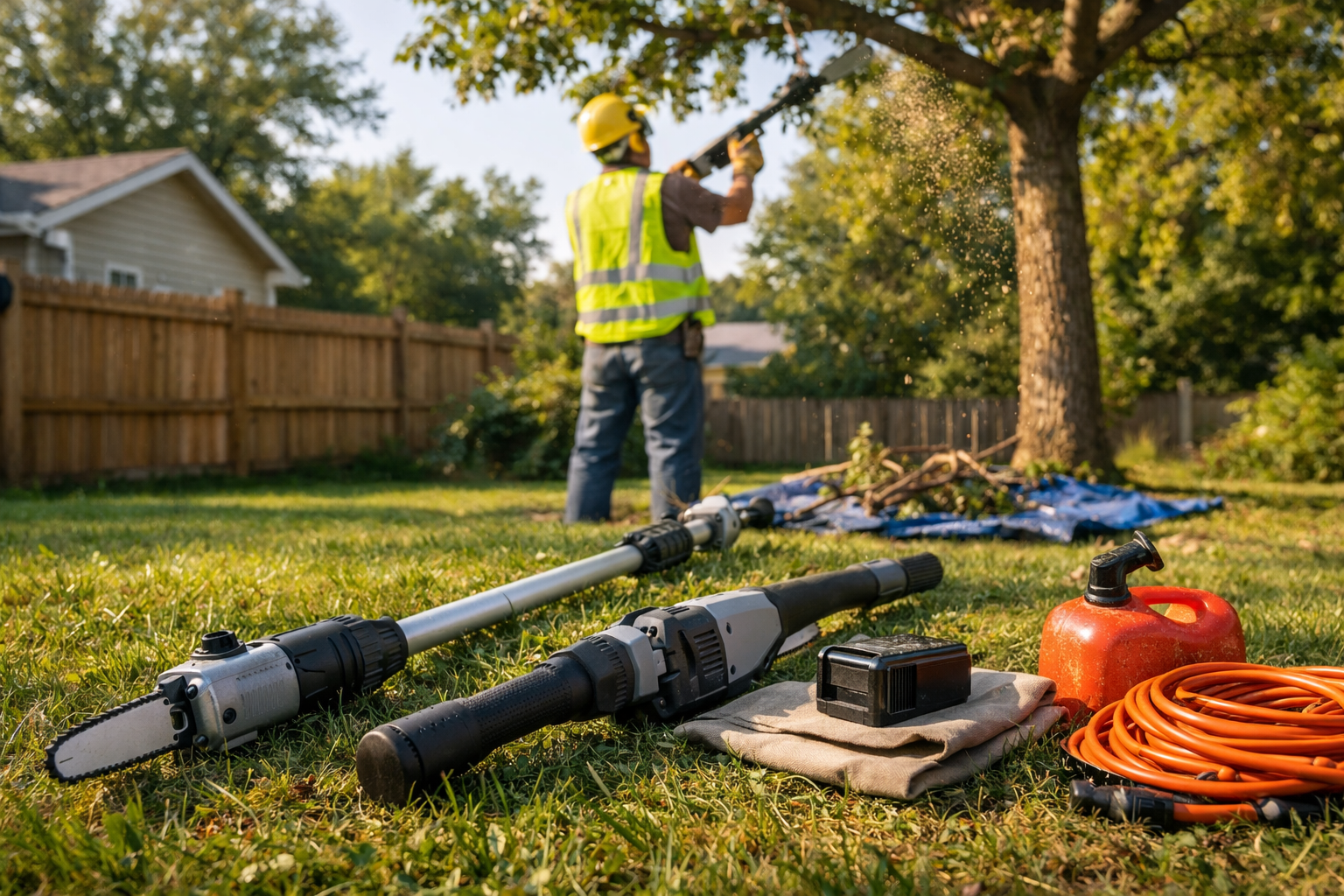
Never stand directly under the branch you’re cutting. Position yourself at a 45-degree angle to one side, so that when the branch falls, it drops away from you. On uneven ground, plant your feet about shoulder-width apart before you extend the pole. Once the saw is overhead, adjusting your stance is awkward and risky.
Always keep both hands on the pole during a cut. One hand grips near the rear handle; the other steadies the pole roughly mid-shaft. This two-hand grip gives you control over the saw’s direction and absorbs vibration. Letting one hand drop to reposition while the chain is running is how the bar drifts into unintended contact with the branch or a secondary limb.
Wear a hard hat rated for falling debris, safety glasses, and cut-resistant gloves on every cut. Not just the first few. A branch that looks 3 inches in diameter can weigh 15 to 25 lbs and fall unpredictably.
Chain Tension, Bar Oil, and Pre-Cut Checks That Prevent Kickback
Before every session, check chain tension by pulling the chain away from the guide bar at the midpoint. It should pull out about 1/4 inch and snap back without sagging. A loose chain can derail mid-cut or cause the saw to grab and kick back toward you. Most pole saws have a tool-free tension adjustment knob. Use it every time, not just when something feels wrong.
Fill the bar oil reservoir before each use. Bar oil lubricates the chain as it runs around the guide bar; running dry overheats the chain, accelerates wear, and increases the chance of a rough, grabbing cut. A standard reservoir holds enough oil for roughly 30 to 45 minutes of cutting, which is about one session.
Kickback is the sudden upward rotation of the bar when the chain tip contacts wood unexpectedly. It’s the most dangerous event in pole saw use, and it happens most often when the tip of the bar contacts a branch or a secondary limb mid-cut. Keep the tip clear, cut with the lower half of the bar, and never plunge-cut with the tip. If your model has a chain brake, confirm it engages correctly before you start; the brake stops the chain within fractions of a second if kickback occurs.
Pole Saw vs. Pole Pruner: They Are Not the Same Tool
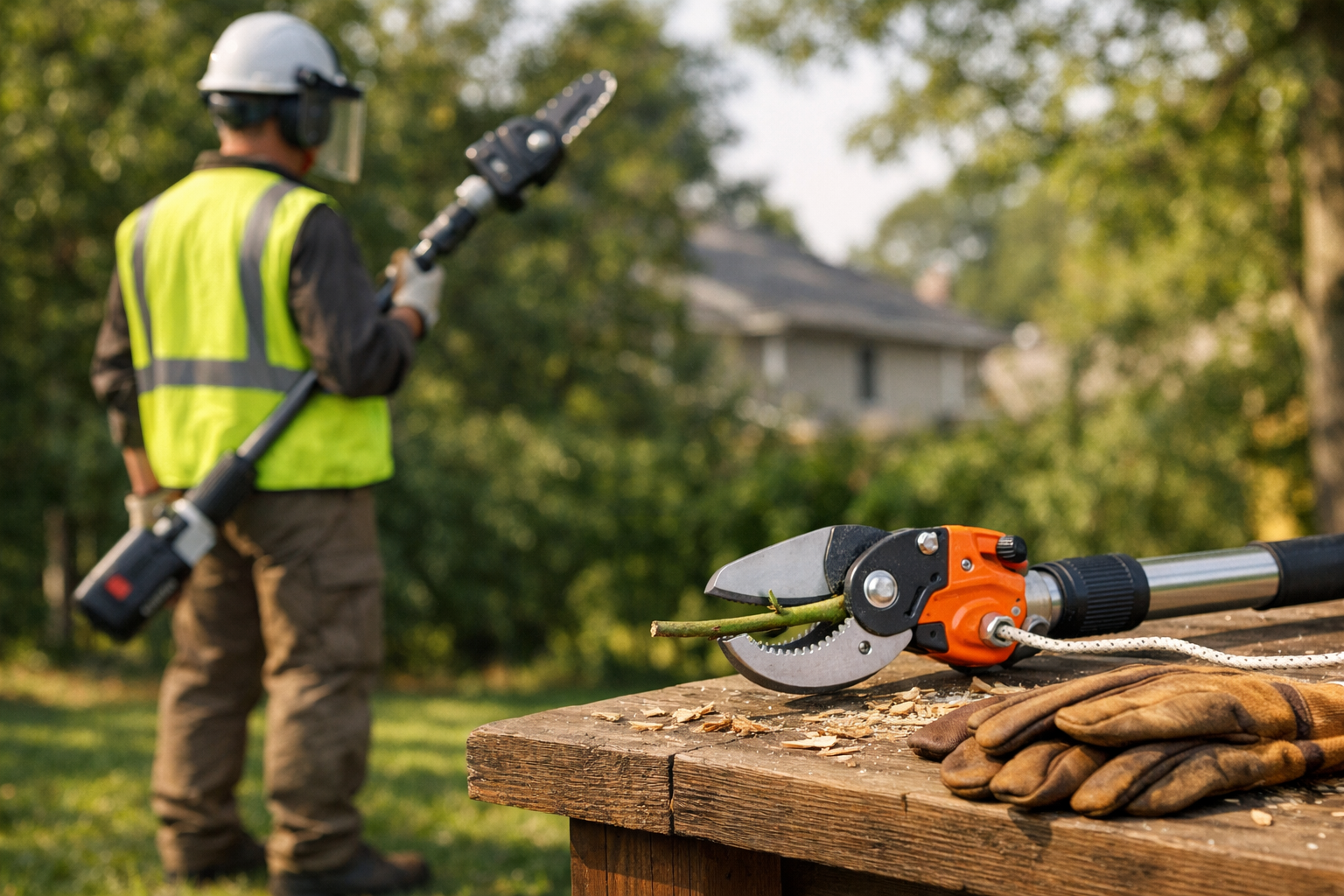
A pole saw has a motorized or hand-operated chain that cuts through wood like a miniature chainsaw on a stick. A pole pruner — sometimes called a loppers-on-a-pole — uses a bypass blade mechanism operated by a pull cord to make a single scissor-style cut. They look similar from a distance but work completely differently.
Pole pruners are better for branches under 1.5 inches in diameter — green, living wood that a chain would tear rather than slice cleanly. Arborists use pole pruners for crown thinning on fruit trees and ornamentals where a clean cut at the collar matters for the tree’s health. A pole saw leaves a rougher cut face on small-diameter wood.
For anything over 2 inches, the pole saw wins on speed and control. For delicate ornamental trimming where cut quality affects plant health, the pole pruner is the right tool. Owning one of each costs less than $200 combined and covers every pruning scenario a typical home lot presents.
Frequently Asked Questions
Can a pole saw cut branches thicker than 4 inches?
Yes, if the bar is long enough. A 10-inch bar can handle branches up to about 8 to 10 inches in diameter, and a 12-inch bar pushes that further. Modern 40V+ battery models handle 6-inch branches without struggling. The 4-inch limit applies to underpowered corded models with short bars, not the category as a whole.
How often does a pole saw chain need sharpening?
Sharpen after every 3 to 5 hours of cutting, or sooner if the saw starts pushing rather than pulling through wood. A dull chain forces you to apply more pressure, which increases kickback risk. A round file sized to match your chain’s pitch (typically 3/16 inch or 5/32 inch) handles the job in under 10 minutes.
Is a pole saw safe to use near power lines?
No. Keep any pole saw at least 10 feet from overhead power lines, and do not attempt to trim branches that contact or overhang active lines yourself. That work requires a licensed utility arborist. The pole itself can conduct electricity even if it’s labeled non-conductive, because a wet or dirty pole changes that rating immediately.
What maintenance does a pole saw need between seasons?
Drain or stabilize the fuel on gas models before storage. For battery models, store the battery at roughly 50% charge in a dry location above freezing. Clean bar oil residue from the guide bar channel, and check chain tension one more time before the first cut of the new season.
Which countries buy the most lawn mowers? These are the nations around the world that mow the most lawns each year. The global lawn mowers market was worth $32.31 billion in...
Mow tall fescue below 3 inches and you cut off the very thing that makes it drought-tolerant: a root system that can reach 2 to 3 feet deep when the canopy...
2 August 2026
The Mowers Guide is reader-supported. When you buy through links on our site, we may earn an affiliate commission.





Comments are closed.