Grass type determines your mowing height, cutting frequency, and even which blade angle works best. Get it wrong and you’re fighting your lawn every week instead of maintaining it. Most types of lawn look similar from a distance, but up close they behave completely differently. A Bermuda grass lawn needs a cut at 1 to 1.5 inches; a tall fescue lawn at that same height is being scalped.
Knowing what you’re growing isn’t a botanical exercise. It’s the foundation of every equipment and schedule decision you make.
Your Grass Type Controls More Than You Think
Your grass type sets the rules for every mowing, watering, and fertilizing decision on your property. Cut a warm-season grass too early in spring and you stress it before it’s out of dormancy. Water a drought-adapted type on a cool-season schedule and you invite disease.
The mower matters too. Reel mowers suit low-cut warm-season grasses like Bermuda at 1 inch. Rotary mowers handle the taller cool-season types at 3 to 4 inches. Same machine, wrong grass — poor cut quality and more blade sharpening than you should need.
Identification isn’t optional. It’s where good lawn care starts.
How to Identify Your Lawn Grass in 5 Steps
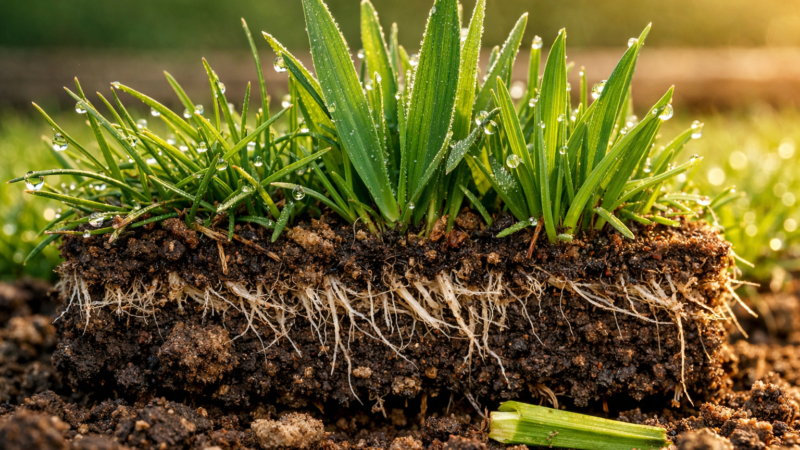
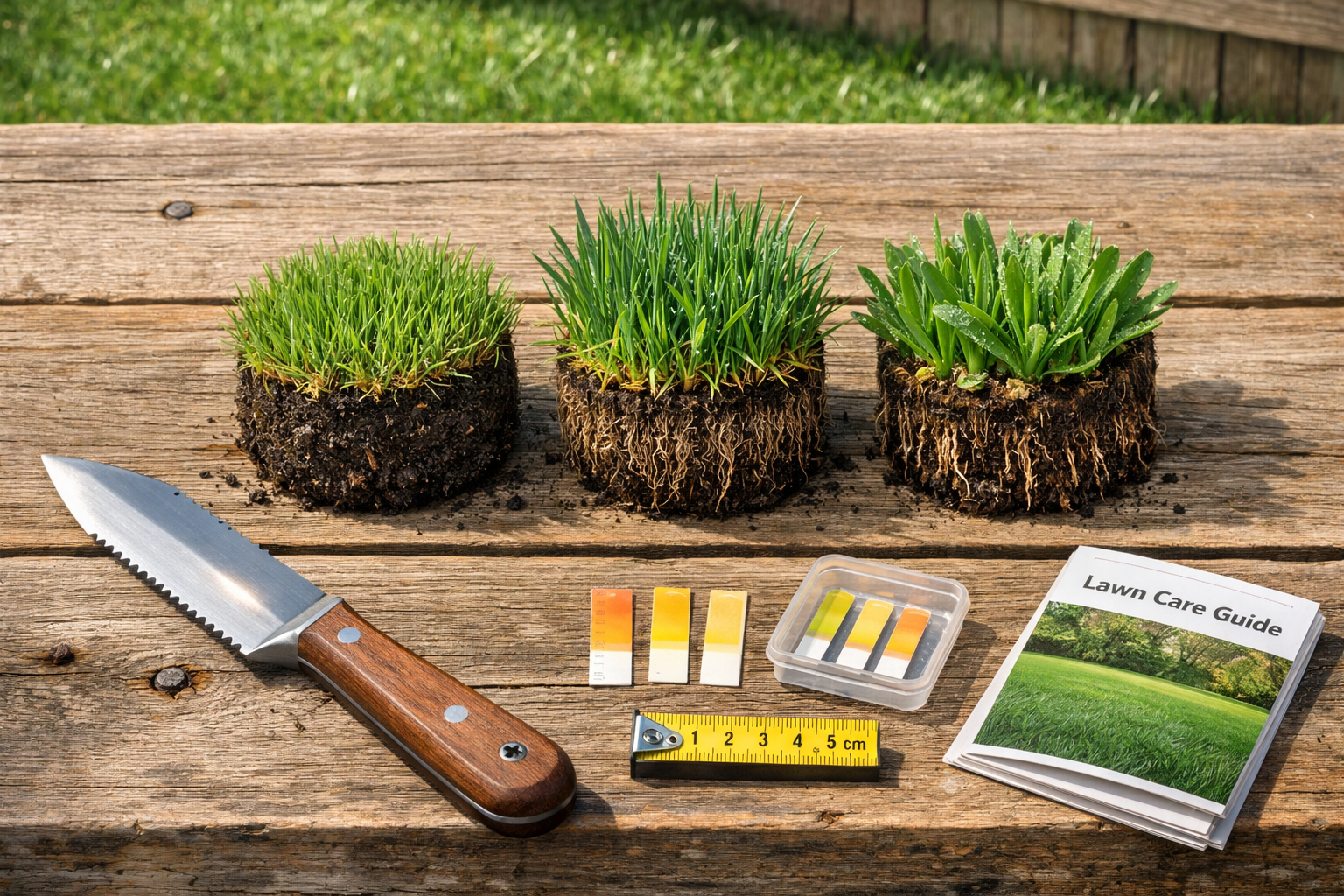
Pull a small section of grass from your lawn, roots and all, before you do anything else. You need the whole plant, not just the blade tip. Most homeowners can narrow down their grass type in under 15 minutes using five observable characteristics.
Check the blade shape and width under natural light.
Feel the texture along the blade surface and edges.
Look at the base of the plant for stolons (above-ground runners) or rhizomes (below-ground runners), or confirm it’s a bunch-type grass with no runners at all.
Note the color: blue-green, medium green, or yellow-green.
Observe what the grass does in heat or cold: does it go brown and dormant, or stay green?
Blade Shape, Texture, and Color
Blade width is one of the fastest separators. Kentucky bluegrass has a narrow blade with a distinctive boat-shaped tip. That V-shaped point at the end is almost diagnostic on its own. Tall fescue blades are wide and coarse, with prominent veins on the upper surface. St. Augustine grass has a wide, flat blade with rounded tips and a noticeably coarse texture.
Color is another reliable clue. Kentucky bluegrass runs blue-green. Bermuda grass is a medium gray-green. Centipede grass leans yellow-green, which homeowners sometimes mistake for nitrogen deficiency.
Growth Habit and Stolons vs. Bunching
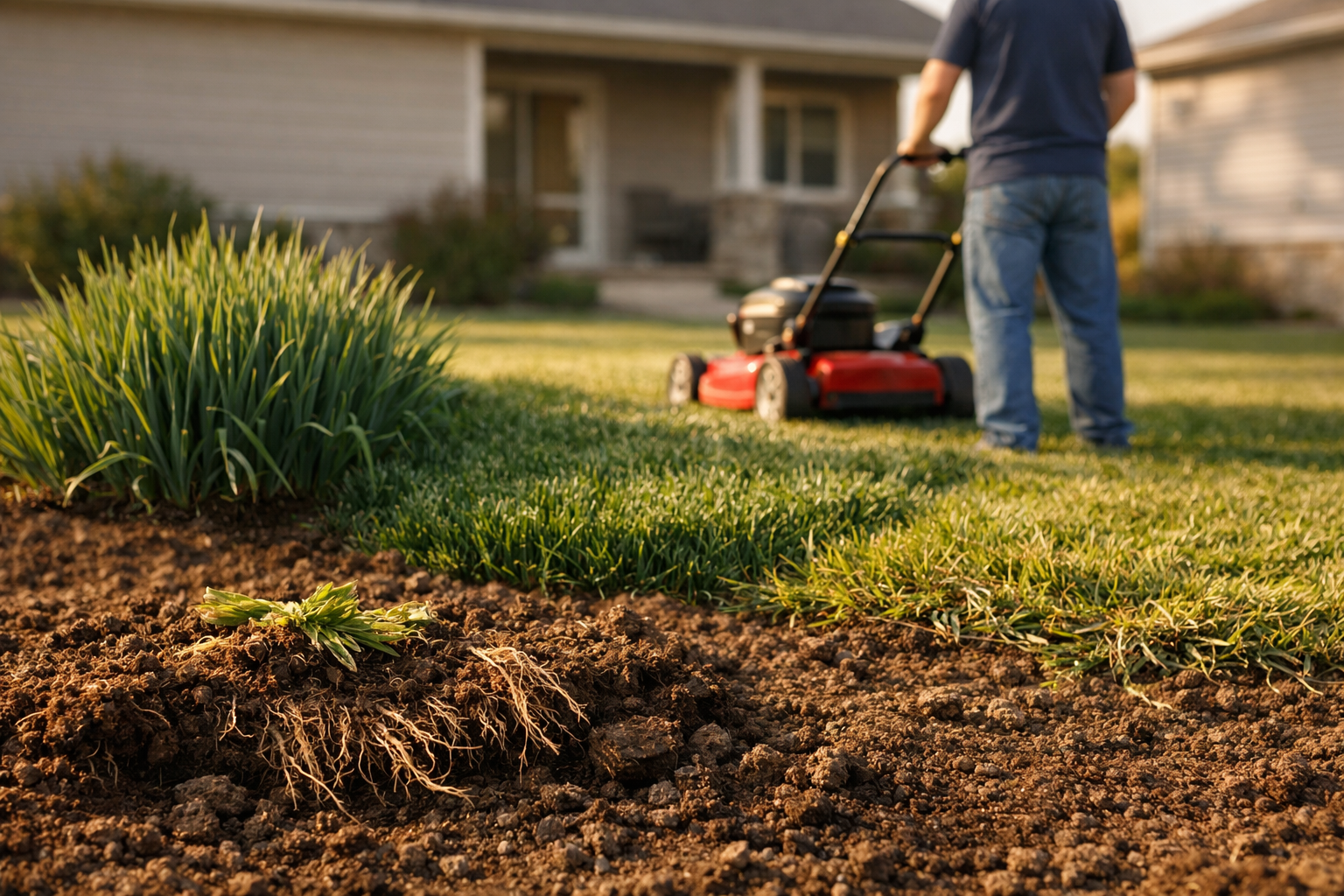
Dig up a small plug and look at the base. Bermuda grass spreads aggressively via both stolons and rhizomes, so you’ll see horizontal stems above and below the soil surface. Zoysia grass does the same but spreads more slowly. St. Augustine spreads only by stolons: thick, flat runners that sit on top of the soil.
Bunch-type grasses like tall fescue and perennial ryegrass have no runners. They grow in tight clumps and spread only by seed. If you see no horizontal stems at all, you’re almost certainly dealing with a bunch-type.
Seasonal Behavior as a Clue
Watch your lawn through a full seasonal cycle if you can. A lawn that turns brown in July heat but greens back up in September is almost certainly a cool-season grass going dormant, not dead grass that needs replacement. Overwatering dormant cool-season grass is one of the most common and expensive mistakes homeowners make.
Warm-season grasses do the opposite: they go tan or straw-colored after the first hard frost and stay that way until soil temperatures climb back above roughly 55°F in spring.
Cool-Season vs. Warm-Season Grass: The Fundamental Split
This is the single most important classification in lawn care. Cool-season grasses grow actively in spring and fall, peaking when soil temperatures sit between 50°F and 65°F. Warm-season grasses hit their stride when soil temperatures exceed 70°F, typically from late spring through summer.
Cool-season grasses: active growth zone is 50°F–65°F soil temperature. Warm-season grasses: active growth zone is 70°F–95°F soil temperature. (University Extension turf management references consistently cite these ranges.)
Characteristic
Cool-Season Grasses
Warm-Season Grasses
Peak growth period
Spring and fall
Late spring through summer
Active soil temp range
50°F–65°F
70°F–95°F
Summer behavior
Slow down or go dormant
Actively growing
Winter behavior
Stay green or semi-green
Go dormant (turn tan/brown)
Common examples
Kentucky bluegrass, tall fescue
Bermuda, Zoysia, St. Augustine
Typical mowing height
2.5–4 inches
1–2.5 inches
Primary U.S. range
Northern states
Southern states
What Cool-Season Grasses Do in Summer Heat
Cool-season grasses slow down and can go fully dormant when air temperatures stay above 90°F for extended periods. The grass isn’t dying — it’s conserving energy. Roots stay alive underground, and most healthy stands of Kentucky bluegrass or tall fescue will recover once temperatures drop in late August or September.
The mistake is treating dormancy like damage. Homeowners who see a brown lawn in August and respond by watering twice a day often cause more harm than the heat did, promoting fungal disease in a grass that just needs to be left alone.
What Warm-Season Grasses Do When Temperatures Drop
Warm-season grasses begin going dormant when nighttime temperatures consistently fall below 50°F. Bermuda grass is particularly sensitive — it can start losing color at the first light frost and won’t green up again until the following late spring.
This dormancy is normal and expected. Applying nitrogen fertilizer to a warm-season lawn in fall trying to keep it green is counterproductive; it pushes tender new growth right before the plant needs to harden off for winter. Timing your last fertilizer application at least 6 weeks before your area’s average first frost date protects the root system through dormancy.
The Major Cool-Season Grass Types and Where They Grow
Cool-season grasses dominate lawns across the northern third of the United States, from the Pacific Northwest through the Great Plains and into New England. Each type has a distinct growth profile that directly affects how you set your mower deck and how often you need to cut.
Kentucky Bluegrass: Fine Texture, High Maintenance
Poa pratensis is the grass most homeowners picture when they imagine a lush, dark green lawn. The boat-shaped blade tip makes it identifiable without a magnifying glass. It spreads by rhizomes, which means it can self-repair bare spots over time. That’s a genuine advantage over bunch-type grasses.
Kentucky bluegrass needs more inputs than almost any other cool-season type. It requires consistent irrigation, regular fertilization (roughly 3 to 4 pounds of nitrogen per 1,000 square feet per year), and a mowing height kept between 2.5 and 3.5 inches. Drop below 2 inches and you scalp the crown. It thrives in USDA hardiness zones 2 through 6.
Tall Fescue: The Drought-Tolerant Workhorse
Tall fescue (Festuca arundinacea) is a bunch-type grass with wide, coarse blades and a deep root system that can reach 2 to 3 feet into the soil. That root depth is what makes it noticeably more drought-tolerant than Kentucky bluegrass. It handles the middle tier of the country well, zones 4 through 7, and is the dominant lawn grass across the mid-Atlantic states.
Mow tall fescue at 3 to 4 inches. Cutting it short stresses the plant and reduces its shade tolerance. Because it’s a bunch-type, it won’t fill in bare spots on its own; overseeding in fall is the standard fix.
Perennial Ryegrass: Fast Germination, Limited Range
Lolium perenne germinates in as few as 5 to 7 days, faster than any other common lawn grass. That speed makes it a go-to for quick repairs and overseeding. It’s not a long-term solution in most northern climates, though, because it lacks the cold hardiness of Kentucky bluegrass and can thin out after a hard winter in zones 3 and below.
It’s most reliable in the Pacific Northwest and parts of the Northeast where winters stay mild. Mow it at 1.5 to 2.5 inches. The blades have a glossy underside, which helps separate it from tall fescue in a quick visual check.
The Major Warm-Season Grass Types and Where They Grow
Warm-season grasses cover the southern United States and perform best where summers are long and hot. They share one important trait: they go dormant in cool weather and actively grow when soil temperatures are consistently above 70°F.
Bermuda Grass: Dense, Aggressive, and Sun-Hungry
Cynodon dactylon is one of the most widely planted warm-season grasses in the country, and for good reason. It handles heat, foot traffic, and drought better than almost any alternative. It spreads by both stolons and rhizomes, making it fast to establish and difficult to contain along borders.
Bermuda grass needs full sun and a mowing height of 1 to 1.5 inches. A standard rotary mower set that low will work, but a reel mower produces a noticeably cleaner cut at those heights. It grows through zones 7 to 10. Shade tolerance is poor; more than 4 hours of shade per day and the stand thins out quickly.
Zoysia Grass: Slow to Establish, Tough Once Set
Zoysia japonica takes roughly 2 to 3 years to fully establish from plugs or sod, which frustrates homeowners used to faster results. Once it fills in, it handles heat, moderate drought, and light shade better than Bermuda. The dense, stiff blades also resist weed pressure well.
Mow zoysia at 1 to 2 inches. It grows best in zones 6 to 9. The slow establishment is the real trade-off. Budget for patience, or pay the premium for full sod installation rather than plugs.
St. Augustine and Centipede Grass: Shade and Low-Input Options
Stenotaphrum secundatum (St. Augustine) is the dominant lawn grass across Florida, the Gulf Coast, and coastal Texas. Its wide, flat blades and coarse texture are easy to identify. It handles shade better than Bermuda, tolerating up to 6 hours of partial shade, and is typically mowed at 3 to 4 inches.
Eremochloa ophiuroides (centipede grass) suits homeowners who want low fertilizer requirements. It needs only about 1 pound of nitrogen per 1,000 square feet per year and performs well in zones 7 to 9. Its yellow-green color is normal, not a sign of nutrient deficiency.
Transition Zone Lawns: When One Grass Type Isn’t Enough
The transition zone runs roughly from northern Virginia through Kansas and into parts of California. It’s a band where winters are too cold for warm-season grasses to stay reliably green and summers are too hot for cool-season grasses to thrive without stress. No single grass type is perfectly suited to this region. That’s why transition zone lawns demand more management than those in clearly northern or southern climates.
The most common approach is choosing the grass that matches your specific site conditions: tall fescue for shaded or drought-prone yards, Zoysia for full-sun lots where you’re willing to accept winter dormancy.
Grass Type
Transition Zone Viability
Key Trade-off
Tall fescue
Best all-around option
Goes semi-dormant in peak summer heat
Zoysia
Good in full sun
Brown and dormant October through April
Kentucky bluegrass
Possible in northern transition zone
Needs irrigation to survive summer
Bermuda grass
Southern transition zone only
Winter kill risk in zone 6 and below
Overseeding a dormant Zoysia lawn with perennial ryegrass each fall is a practical workaround many transition zone homeowners use to maintain green color through winter. It adds mowing and management from October through May, so go in with that expectation.
How Grass Type Directly Affects Mowing Height and Frequency
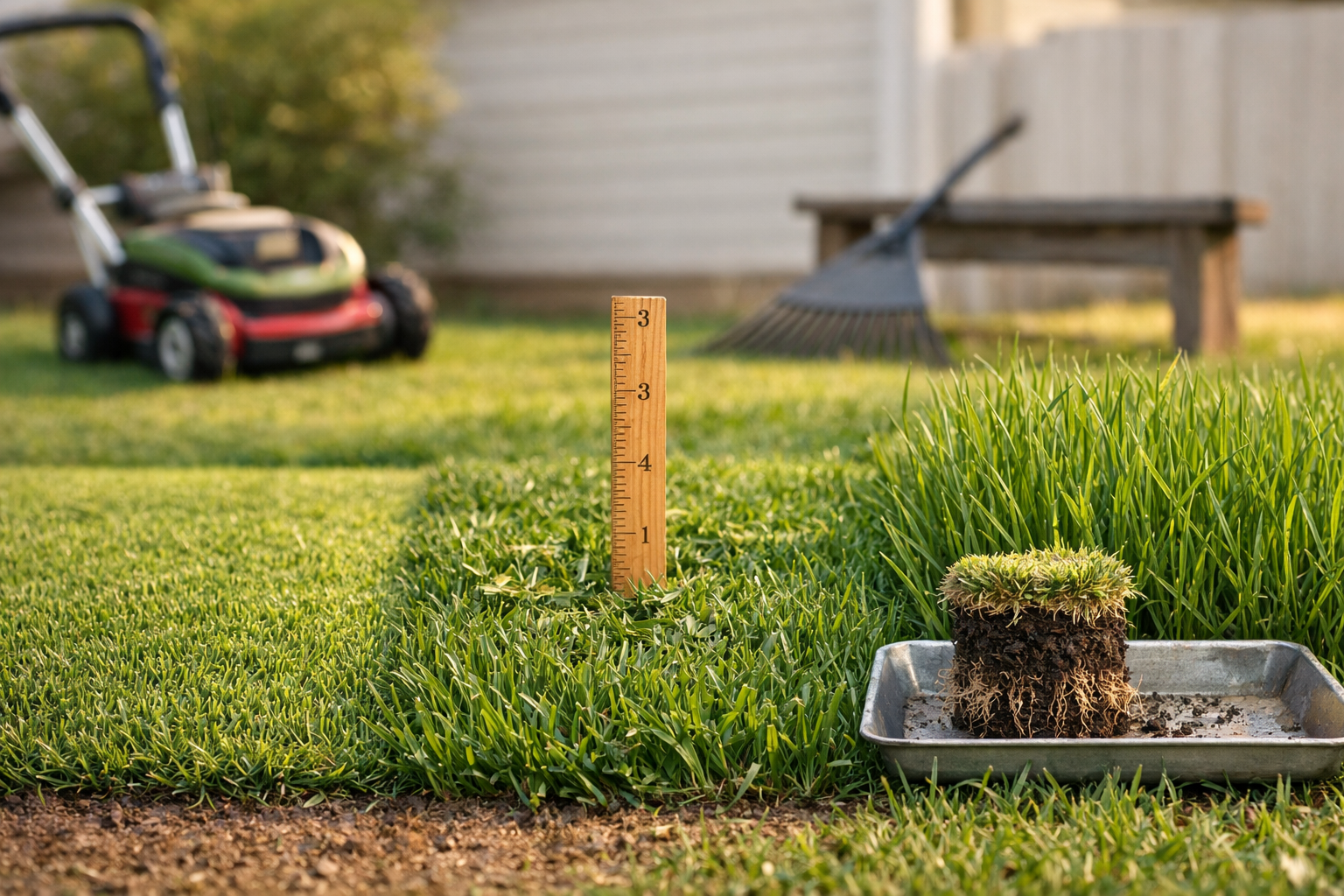
Your grass type sets the floor and ceiling for your mower deck height. Cut outside the correct range for your species and you either scalp the crown or leave the canopy so tall it traps moisture and invites disease. Neither outcome is recoverable without weeks of regrowth.
The numbers vary significantly across types. Bermuda grass wants 1 to 1.5 inches; St. Augustine needs 3 to 4 inches. Running the same deck height across both would wreck one of them. Frequency follows the same logic. Growth rate varies by species and season, so a Kentucky bluegrass lawn in spring may need cutting every 5 days, while centipede grass in the same calendar week might go 10 to 14 days between cuts.
Blade sharpness matters more with dense, stiff-bladed grasses like Zoysia. A dull blade tears rather than cuts, leaving ragged tips that brown within a day and open the plant to fungal infection. Sharpen your blade every 20 to 25 hours of run time, and do it more often if you’re cutting Zoysia or Bermuda regularly. Detailed mowing height guides by grass type are available at themowersguide.com if you need a quick-reference chart for your specific species.
The one-third rule (never remove more than one-third of the blade in a single pass) applies to every turfgrass type, but it’s easiest to violate on fast-growing warm-season grasses during peak summer.
Frequently Asked Questions
How do I tell the difference between crabgrass and my lawn grass?
Crabgrass (Digitaria spp.) grows in a star-shaped, low-spreading pattern from a central point and has wide, light-green blades with a coarse texture. Your lawn grass almost always grows more upright. Crabgrass is an annual — it dies after the first frost and reappears from seed the following spring.
Can I overseed a warm-season lawn with a cool-season grass?
Yes, and many homeowners do it deliberately. Overseeding Bermuda or Zoysia with perennial ryegrass in early fall keeps the lawn green through winter dormancy. Use roughly 5 to 10 pounds of ryegrass seed per 1,000 square feet. The ryegrass dies back naturally once soil temperatures climb above 85°F in late spring.
What mowing height should I use if I’m not sure what grass I have?
Set your deck to 3 inches as a safe middle ground. That height avoids scalping most cool-season grasses and won’t severely stress most warm-season types. Once you identify the species, adjust from there.
Does grass type change how often I need to sharpen my mower blade?
Indirectly, yes. Dense, stiff grasses like Zoysia dull a blade faster than fine-textured grasses like perennial ryegrass. If you cut Zoysia weekly through a full growing season, plan on sharpening every 15 to 20 hours of run time rather than the standard 25.
Mow tall fescue below 3 inches and you cut off the very thing that makes it drought-tolerant: a root system that can reach 2 to 3 feet deep when the canopy...
Grab a handful of your soil right now and squeeze it. Does it hold a shape but crumble when you poke it? That’s loam, and it’s exactly what grass roots want....
7 September 2026
The Mowers Guide is reader-supported. When you buy through links on our site, we may earn an affiliate commission.





Comments are closed.