Strip the threads on your crankshaft, and you’re looking at a repair bill that can beat the price of a new mower. That’s the real danger with a torque wrench lawn mower blade job — not the bolt loosening later, but guessing at tightness and ruining the shaft it screws into. Most guides toss out a single number like “35 to 40 ft-lbs” and call it done. That’s not good enough, because your brand, deck size, and bolt type all change the answer.
This guide gives you the actual numbers by brand, shows you what socket and wrench to grab, and walks through a workaround if you don’t own a torque wrench at all.
What Torque Setting Does Your Mower Blade Bolt Actually Need?
There’s no universal number. Push mowers typically run 35 to 45 ft-lbs, while riding mower and zero-turn blade bolts often need 45 to 70 ft-lbs, depending on the bolt size and deck design. Always check your owner’s manual first — it’s the only source that matches your exact model.
Torque Specs by Common Brand
Here’s a rough reference table based on typical service manual ranges. Treat these as starting points, not gospel — confirm against your specific model number before you tighten anything.
Mower Type / Brand
Bolt Size
Typical Torque (ft-lbs)
Nm Equivalent
Honda push mower
3/8″ – 7/16″
35-40
47-54
Toro/Craftsman push mower
1/2″
40-45
54-61
John Deere riding mower
5/8″
50-60
68-81
Cub Cadet/Husqvarna riding mower
5/8″ – 3/4″
45-70
61-95
Zero-turn commercial deck
3/4″
60-75
81-102
Converting ft-lbs to Nm Without a Chart
Multiply ft-lbs by 1.356 to get Newton-meters. So 40 ft-lbs comes out to about 54 Nm. Most digital torque wrenches sold in the US let you toggle units right on the display, which saves you doing math with greasy hands.
Which Torque Wrench Type Actually Works Under a Mower Deck?
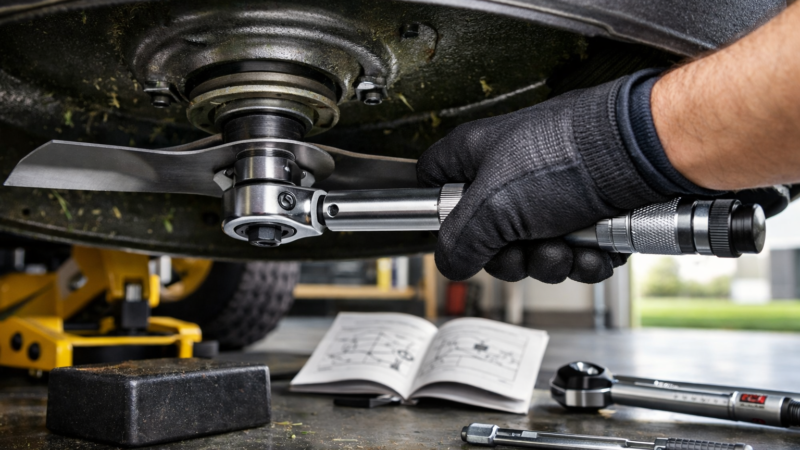
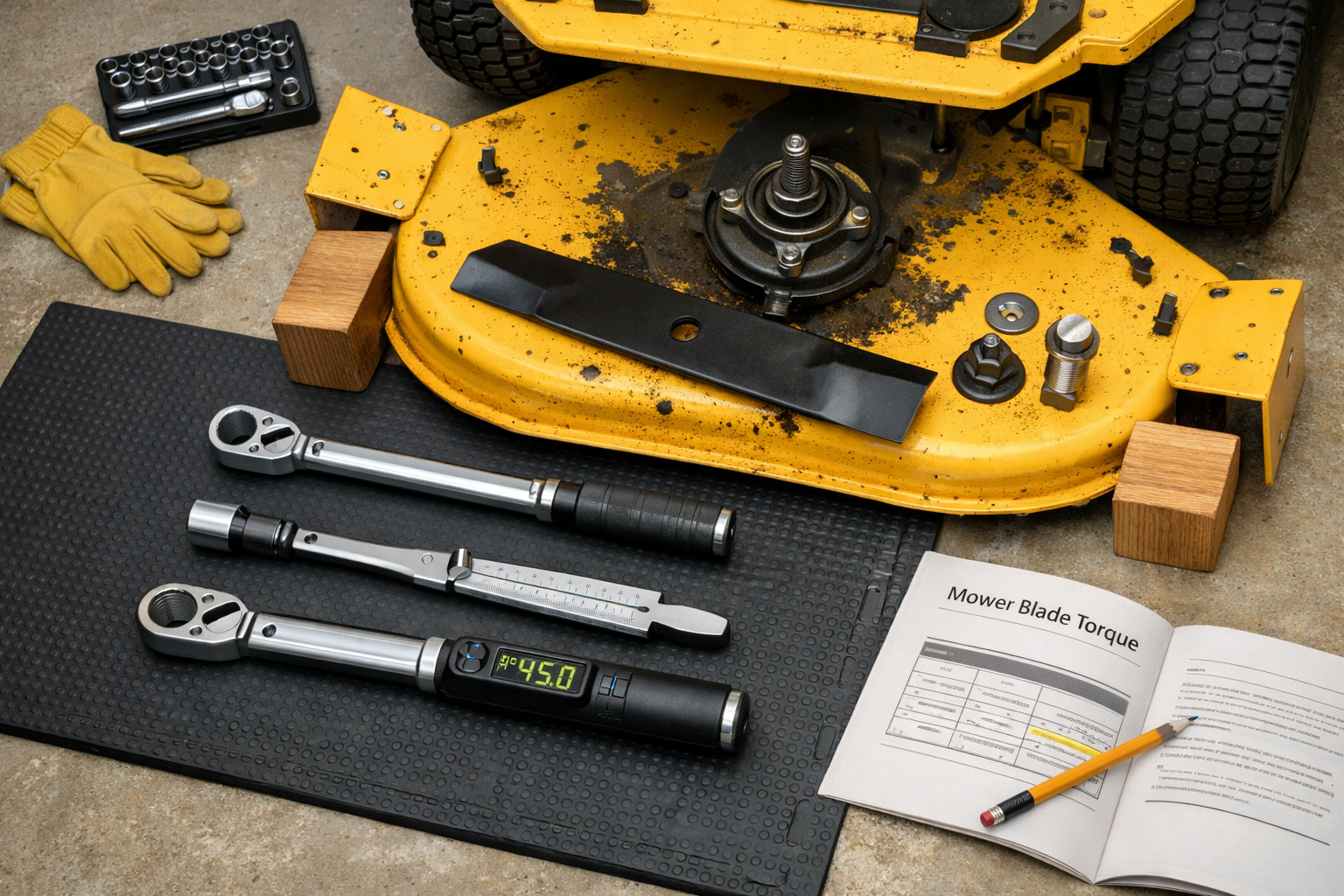
A click-type torque wrench is the best pick for blade bolts — it’s affordable, accurate within about 4%, and gives you a clear physical and audible click at your target number. Beam and digital wrenches work too, each with tradeoffs.
Click-Type Torque Wrench
This is the one most home mechanics already own or can grab for $30 to $60 at any auto parts store. Set the dial to your target ft-lbs, tighten until it clicks, and stop. No guesswork, no reading a dial mid-turn.
Beam-Style Torque Wrench
Cheaper, often under $25, and dead simple — a needle points to the number on a scale as you pull. The catch: you have to watch the scale while you’re applying force, which is awkward in a tight mower deck space.
Digital Torque Wrench
These run $80 and up but give you a screen readout and sometimes a memory function for repeat jobs. Overkill for one mower, but worth it if you’re maintaining multiple machines or teaching someone else the ropes.
No Torque Wrench? Here’s the Leverage Workaround
If you genuinely don’t own one, you can estimate torque using a breaker bar and a bit of math, though this is a stopgap, not a long-term habit. Torque equals force times distance, so a known hand-pressure on a known bar length gets you into the ballpark.
Here’s the practical version: a 2-foot bar with about 20 pounds of steady pull generates roughly 40 ft-lbs. That’s genuinely close for a push mower blade bolt. It’s not precise the way a click wrench is, but it beats cranking with an impact wrench and hoping for the best.
Torque is simply the rotational force applied at a distance from a pivot point — measured in foot-pounds (ft-lbs) or Newton-meters (Nm).
I’d still recommend buying an actual torque wrench before your next blade swap. A basic click-type costs less than a single service center visit, and once you own one, every future blade change, spark plug, and lug nut job gets easier.
Blade Removal and Reinstall: Doing It in the Right Order
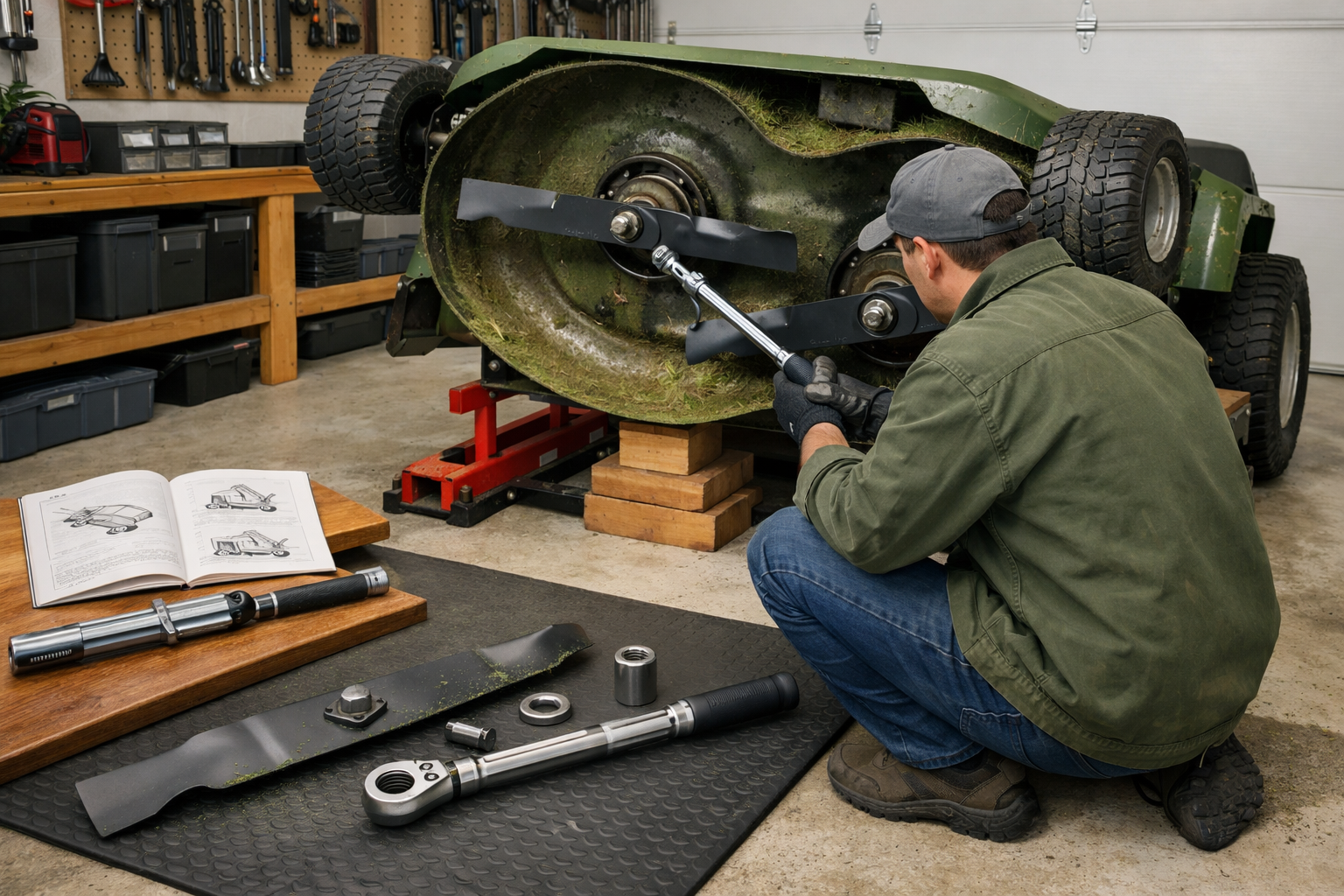
Skipping steps here is how people strip bolts, cut themselves, or end up with a wobbling blade. Follow this sequence every time, whether it’s a push mower or a riding deck.
Disconnect the spark plug wire (or pull the key on a riding mower) before you touch anything under the deck.
Shut off the fuel valve or tip the mower with the carburetor facing up to avoid a fuel spill.
Wedge a block of wood against the blade to stop it from spinning while you break the bolt loose.
Note the thread direction — most mowers loosen counterclockwise, but some Honda and older Snapper models reverse this, so check your manual.
Remove the bolt, swap or sharpen the blade, and check that it’s balanced on a blade balancer or a nail through the center hole before reinstalling.
Reinstall with the correct socket — usually 9/16″ or 15/16″ depending on brand — and hand-thread it before using any tool.
Torque to spec with your click wrench, confirm the click, and reconnect the spark plug last.
What Happens If You Get the Torque Wrong
Overtightening and undertightening cause different failures, but both cost you money. Neither is “safer” than the other — they’re just bad in different ways.
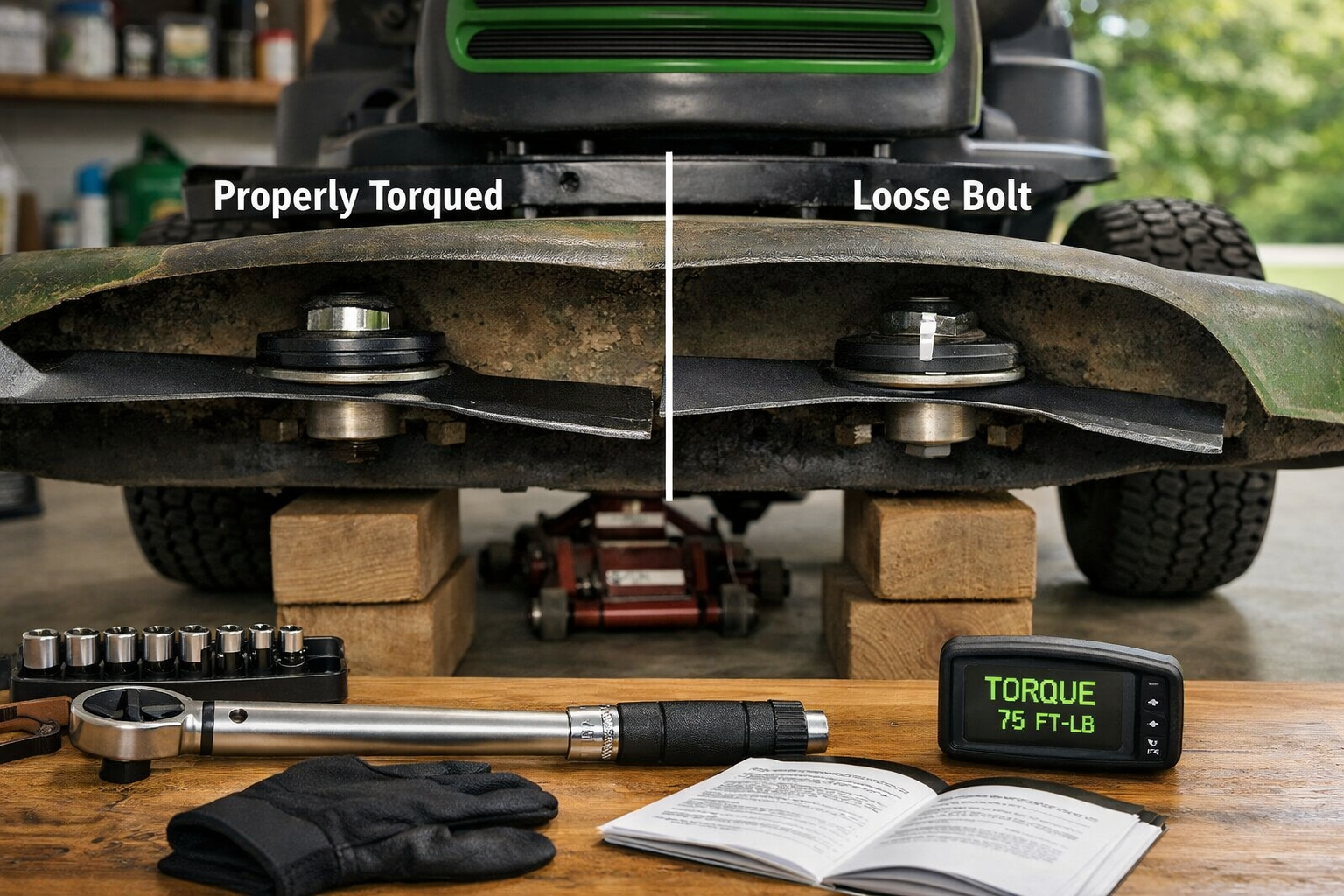
Overtightening stresses the bolt threads and the crankshaft they’re threaded into. Keep cranking past spec with an impact wrench, and you can shear the bolt or strip the crankshaft threads entirely — a repair that often means a new engine block or a trip to a small engine shop running $150 to $300 in labor alone.
Undertightening lets the blade bolt work loose during operation. A loose blade wobbles, chews up the mounting hole, and in bad cases can detach mid-mow. That’s not just a mower problem — it’s a safety hazard for anyone standing nearby.
If you’re doing regular maintenance beyond just blade swaps, keeping a running checklist (oil, air filter, blade, deck belt) makes it a lot easier to catch small issues before they become expensive ones — themowersguide.com keeps maintenance checklists for exactly that kind of season-to-season tracking.
Frequently Asked Questions
Can I use an impact wrench to tighten a lawn mower blade bolt?
You can use one to break the bolt loose or get it snug, but never as your final step. Always finish with a torque wrench set to spec — impact wrenches deliver inconsistent force and are the top cause of stripped crankshaft threads.
Is the mower blade bolt reverse-threaded?
It depends on the brand. Most Toro, Craftsman, and Cub Cadet mowers use standard right-hand threads, but some Honda models and older Snapper units reverse it. Check your owner’s manual before applying force in either direction.
What socket size fits most lawn mower blade bolts?
Push mowers commonly use a 9/16″ or 5/8″ socket, while riding mowers often need 15/16″ or 1″. Confirm with a socket set test-fit before buying a dedicated one, since bolt heads vary even within the same brand’s lineup.
Finding the perfect lawn mower for summer can transform your yard maintenance from a dreaded chore into a satisfying task. With temperatures rising and grass growing at peak rates, having the...
Scag mowers carry a commercial-grade price tag that starts around $5,000 for entry-level zero-turns and climbs past $15,000 for top-tier models. That gap matters because paying for a commercial machine on...
13 July 2026
The Mowers Guide is reader-supported. When you buy through links on our site, we may earn an affiliate commission.





Comments are closed.