Find a model number stamped on the frame near the seat or on the engine shroud, and you’re halfway to fixing whatever’s wrong with your Ford lawn mower. Ford built lawn and garden tractors from the early 1960s through 1991, and most of the confusion today comes from one fact: Ford hasn’t made a single one in over 30 years. That doesn’t make them junk. It means parts sourcing and repair feasibility, not shopping advice, are what actually matter now.
If you inherited one, bought one at an estate sale, or found one rusting in a barn, your first job is figuring out which Ford you’ve got. The series matters more than the color.
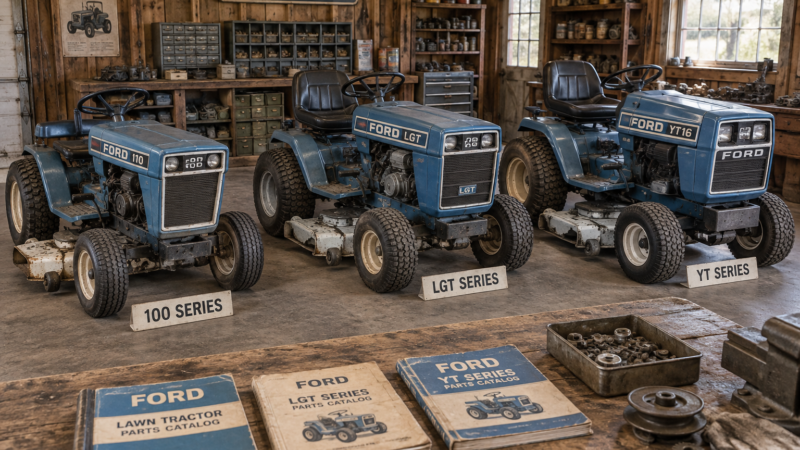
Sorting Ford Lawn Tractors by Series
Ford’s home and light-commercial tractor lineup split into a few distinct families, and mixing them up is the fastest way to order the wrong part.
The 100 Series (Garden Tractors, 1963-1975)
These are the earliest Ford garden tractors, model numbers like the Ford 100, 120, and 145. They’re heavier-built than later lawn tractors, often with cast-iron transmission housings and gear-drive systems rather than hydrostatic. Parts for the 100 series are the hardest to find because production ended almost 50 years ago.
The LGT Series (Lawn and Garden Tractor, 1970s-1980s)
LGT models (LGT 100, LGT 125, LGT 145, LGT 165) are the ones most people picture when they hear “Ford lawn mower.” Many came with Onan or Kohler engines and offered both gear and hydrostatic transmission options. These are generally the easiest vintage Fords to keep running today.
The YT Series (Yard Tractor, late 1980s-early 1990s)
The YT line (YT 16, YT 18) came right before Ford exited the market. They’re more consumer-grade, built lighter for suburban lawns rather than acreage, and closer in feel to the New Holland and other lawn tractors that followed.
Why New Holland Matters for Parts
Ford’s agricultural and tractor division merged with Sperry New Holland in 1986, and by 1991 the Ford nameplate on lawn and garden equipment disappeared entirely. New Holland became the successor brand, which is the single most useful fact for anyone repairing one of these machines today.
That doesn’t mean New Holland dealers stock shelves of Ford lawn tractor parts. It means their parts lookup systems and microfiche archives often still carry the old Ford part numbers, and a New Holland dealer is more likely to cross-reference a number than a general farm store is. Independent small-engine shops and online specialty retailers (sites that deal specifically in vintage garden tractor parts) are usually your faster, cheaper option for gaskets, belts, and deck parts. Engine parts are a different story — if your tractor has a Kohler, Onan, or Briggs & Stratton engine, you go straight to that engine maker’s parts network, not Ford or New Holland at all.
A lawn tractor’s engine, transmission, and deck are often three separate supply chains, from three different manufacturers, under one Ford badge.
Common Problems Across Ford Lawn Tractor Models
Most issues on a 30-to-50-year-old machine trace back to fuel, electrical corrosion, or deck wear, not some mysterious Ford-specific flaw.
Hydrostatic transmission fluid breakdown, usually from decades without a fluid change, leading to loss of power on hills.
Deck spindle wear, causing a wobble or belt-throwing, especially on tractors that mowed rough or sloped yards for years.
Wiring and safety-switch corrosion, since seat and PTO interlock switches on machines this age often fail intermittently.
Cracked or dry-rotted tires, a cosmetic nuisance until one loses air mid-mow and tips the deck.
None of these are expensive fixes individually. A carburetor rebuild kit runs $10 to $25; a full deck belt and spindle job might run $80 to $150 in parts if you’re doing it yourself. Step-by-step troubleshooting for specific models (what to check first on a Ford LGT 145 versus a YT 16, for instance) is the kind of thing worth looking up by model number rather than guessing.
Transmission Type and Collector Value
Whether your Ford has a gear-drive or hydrostatic transmission changes both how it drives and what it’s worth.
Gear-Drive Models
Simpler, more durable over the long haul, and cheaper to repair when something does go wrong. Many 100-series and early LGT tractors used multi-speed gear transmissions that, aside from clutch linkage wear, rarely need major work.
Hydrostatic Models
Smoother to operate (no clutching, just a pedal), but when the hydrostatic unit fails, you’re often looking at a full unit replacement rather than a simple repair, since rebuild parts for these older units are scarce.
As for collectibility, Ford garden tractors occupy a smaller niche than brands like Allis-Chalmers or Cub Cadet, but clean, running 100-series and early LGT models do draw interest at farm equipment auctions and from garden tractor pulling enthusiasts. Condition and completeness (original seat, deck, attachments) matter more than rarity alone.
Series
Years Built
Transmission
Parts Difficulty
100 Series
1963-1975
Mostly gear
Hardest
LGT Series
1970s-1980s
Gear or hydrostatic
Moderate
YT Series
Late 1980s-1991
Mostly hydrostatic
Moderate to easy
Frequently Asked Questions
Does Ford still make lawn tractors?
No. Ford exited the lawn and garden tractor business around 1991, following its merger with New Holland in 1986. Any “Ford lawn mower” you find today is used, and parts support now runs through New Holland or independent suppliers, not Ford directly.
Are Ford lawn tractor parts interchangeable between series?
Rarely, and don’t assume they are. Deck sizes, spindle housings, and transmission mounts differ between the 100, LGT, and YT series, so always confirm the exact model number before ordering a part.
Is a Ford garden tractor worth restoring?
If the frame and deck are solid and the engine isn’t seized, yes — parts and labor for a full LGT-series restoration typically run a few hundred dollars, well below buying a comparable new tractor.
A gummed-up carburetor is the reason behind most of the “won’t start after winter” calls small engine shops get every spring, and a fresh rebuild kit runs about $8 to $15...
Pour gas and 2-cycle oil into a Stihl 4 cycle weed eater and you’ll likely kill the engine within a season. That’s the single biggest mix-up owners bring over from older...
19 August 2026
The Mowers Guide is reader-supported. When you buy through links on our site, we may earn an affiliate commission.






Comments are closed.